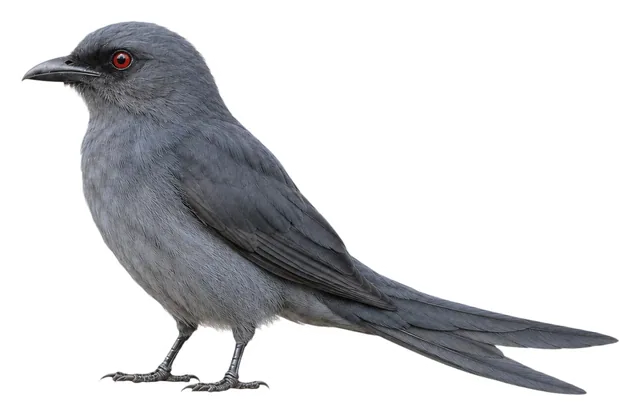
Ashy Drongo
Dicrurus leucophaeus Vieillot, 1817
≈24 cmLength38 gWeight
It is dark gray overall, with a long, deeply forked tail and a very upright perching stance.
Busiest months: February · Most records: India, Thailand, China
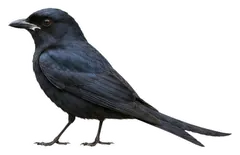
Looks like Black Drongo
AI-generated illustration. It may contain mistakes. · How the stickers are made
How to identify
Field marks
- Body feathers mainly dark gray
- Tail long and deeply forked
- Some subspecies have white markings on the head
- Legs short; body held very upright when perched
Male, female and young
Juvenile is dark rufous-gray.
Voice
Often gives “drangh gip” or “gip-gip-drangh”.
Similar species
Where and when it's recorded

Ashy Drongo has been recorded at 1,148 of the 8,171 birding hotspots we track, in 19 countries and regions.
Records by month Northern Hemisphere
Where it's recorded most
- GKVK CampusIndia8,608 records
- Nandi HillsIndia1,550 records
- Rishi Valley – School CampusIndia1,419 records
More places
- College of Veterinary and Animal Sciences, PookodeIndia1,330 records
- Kinabalu Park – HQ areaMalaysia1,277 records
- Saul Kere / Sowl KereIndia1,111 records
- Valley SchoolIndia1,101 records
- Fergusson College CampusIndia1,065 records
- Kaeng Krachan NPThailand1,052 records
- Cat Tien NPVietnam1,030 records
Countries and regions with the most records
eBird records via GBIF up to 2024-12-31. A record means someone listed it; more records partly mean more birders, not more birds.
Questions
How big is the Ashy Drongo?
The Ashy Drongo is about ≈24 cm long and weighs around 38 g.
Where does the Ashy Drongo live?
Its breeding range: Oriental: widespread. It is most often recorded in India, Thailand and China.
When is the best time to see the Ashy Drongo?
At the hotspots we track, it is recorded most in February (Northern Hemisphere).
Is the Ashy Drongo endangered?
The IUCN Red List classifies the Ashy Drongo as Least Concern.
What does the Ashy Drongo eat?
Main food: Insects & other invertebrates.
What family is the Ashy Drongo in?
It belongs to the family Drongos (Dicruridae), order Passerines (Passeriformes).
At a glance
- Length
- ≈24 cm
- Weight
- 38 g
- Habitat
- Forest
- Diet
- Insects & other invertebrates
- Lifestyle
- Perches in trees
- Migration
- Resident (barely migrates)
- Conservation
- Least Concern
More measurements
- Wing
- 135 mm
- Tail
- 135 mm
- Bill
- 25 mm
- Tarsus
- 19 mm
Averages from the AVONET dataset; length from field guides where available.
Range
Oriental: widespread
Breeding range, IOC World Bird List 15.2
Subspecies · 4
- Dicrurus leucophaeus hopwoodi e Himalayas through s China and n Myanmar to ne Indochina | non-breeding: to s Indochina
- Dicrurus leucophaeus leucogenis c, n, e China | non-breeding: to Malay Pen. and Cambodia
- Dicrurus leucophaeus salangensis se China | non-breeding: to Malay Pen. and s Indochina
- Dicrurus leucophaeus innexus Hainan I. (off se China)
Classification
- Order
- Passerines Passeriformes
- Family
- Drongos Dicruridae
- Genus
- Dicrurus
Other birds in the genus Dicrurus
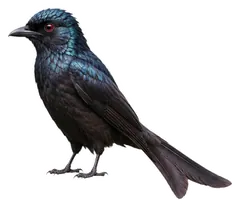 Bronzed DrongoDicrurus aeneus
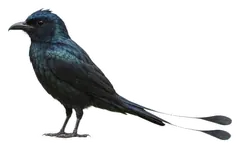 Lesser Racket-tailed DrongoDicrurus remifer
 Crow-billed DrongoDicrurus annectens
 Greater Racket-tailed DrongoDicrurus paradiseus
 Sri Lanka DrongoDicrurus lophorinus
 Andaman DrongoDicrurus andamanensis
 Sumatran DrongoDicrurus sumatranus
 Sulawesi DrongoDicrurus montanus
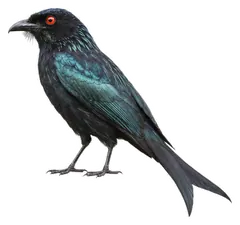 Spangled DrongoDicrurus bracteatus
 Paradise DrongoDicrurus megarhynchus
 Hair-crested DrongoDicrurus hottentottus
 Tablas DrongoDicrurus menagei
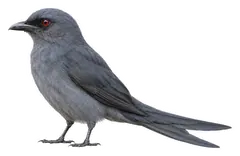
Download illustration
Free to use with credit: “Illustration: Field Stickers”. AI-generated. Its appearance was checked against a reference photo by Tisha Mukherjee; the pose follows our standard. ↗
