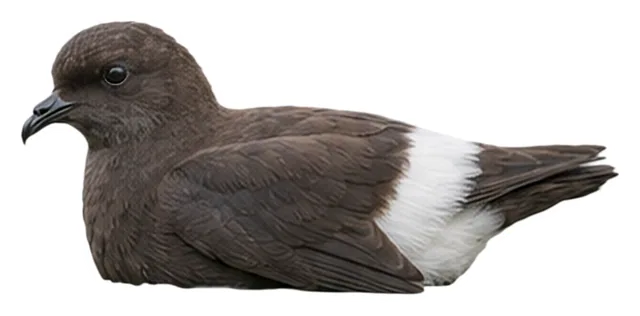
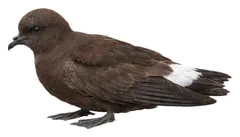
Band-rumped Storm Petrel
Hydrobates castro (Harcourt, 1851)
46 gWeight
Busiest months: April · Most records: Ecuador, St. Helena, United States
AI-generated illustration. It may contain mistakes. · How the stickers are made
Where and when it's recorded

Band-rumped Storm Petrel has been recorded at 18 of the 8,171 birding hotspots we track, in 5 countries and regions.
Records by month Southern Hemisphere
Where it's recorded most
- Española – Punta SuárezEcuador78 records
- Nearshore waters (0-2mi/3km) - James Bay to Egg IslandSt. Helena41 records
- Southeast Farallon IslandUnited States24 records
More places
- Boatswain Bird IslandSt. Helena10 records
- Jamestown Harbor/James BaySt. Helena4 records
- PN Sintra-Cascais – Cabo RasoPortugal3 records
- Kathryn Abbey Hanna ParkUnited States3 records
- Huguenot Memorial City ParkUnited States3 records
- Jones Beach SP – Coast Guard StationUnited States3 records
- Cap GhirMorocco2 records
Countries and regions with the most records
eBird records via GBIF up to 2024-12-31. A record means someone listed it; more records partly mean more birders, not more birds.
Questions
How big is the Band-rumped Storm Petrel?
The Band-rumped Storm Petrel weighs around 46 g.
Where does the Band-rumped Storm Petrel live?
Its breeding range: Pacific Ocean, Atlantic Ocean: Azores (cold-season breeding), Madeira (hot-season breeding), Desertas, Salvage, Canary and Cape Verde islands (northern to southern Macaronesia, west of northern Africa); Berlengas Islands (just west of central Portugal); islands off St. Helena (tropical southeastern Atlantic Ocean), Boatswainbird Island (just east of Ascension Island; southeastern Atlantic Ocean); Hide-jima and Sangan-jima (Futagojima Islands, east of southern Honshu, central Japan); Kauai (western main Hawaiian Islands) and widely in Galápagos. It is most often recorded in Ecuador, St. Helena and United States.
When is the best time to see the Band-rumped Storm Petrel?
At the hotspots we track, it is recorded most in April (Southern Hemisphere).
Is the Band-rumped Storm Petrel endangered?
The IUCN Red List classifies the Band-rumped Storm Petrel as Least Concern.
What does the Band-rumped Storm Petrel eat?
Main food: Fish, shrimp & shellfish.
What family is the Band-rumped Storm Petrel in?
It belongs to the family Northern Storm Petrels (Hydrobatidae), order Procellariiformes.
At a glance
- Weight
- 46 g
- Habitat
- Ocean
- Diet
- Fish, shrimp & shellfish
- Lifestyle
- Feeds in the air
- Migration
- Migratory
- Conservation
- Least Concern
More measurements
- Wing
- 150 mm
- Tail
- 69 mm
- Bill
- 16 mm
- Tarsus
- 23 mm
Averages from the AVONET dataset; length from field guides where available.
Range
Pacific Ocean, Atlantic Ocean: Azores (cold-season breeding), Madeira (hot-season breeding), Desertas, Salvage, Canary and Cape Verde islands (northern to southern Macaronesia, west of northern Africa); Berlengas Islands (just west of central Portugal); islands off St. Helena (tropical southeastern Atlantic Ocean), Boatswainbird Island (just east of Ascension Island; southeastern Atlantic Ocean); Hide-jima and Sangan-jima (Futagojima Islands, east of southern Honshu, central Japan); Kauai (western main Hawaiian Islands) and widely in Galápagos
Breeding range, IOC World Bird List 15.2
Classification
- Order
- Procellariiformes
- Family
- Northern Storm Petrels Hydrobatidae
- Genus
- Hydrobates
Other birds in the genus Hydrobates
 European Storm PetrelHydrobates pelagicus
 Fork-tailed Storm PetrelHydrobates furcatus
 Ringed Storm PetrelHydrobates hornbyi
 Swinhoe's Storm PetrelHydrobates monorhis
 Matsudaira's Storm PetrelHydrobates matsudairae
 Leach's Storm PetrelHydrobates leucorhous
 Townsend's Storm PetrelHydrobates socorroensis
 Ainley's Storm PetrelHydrobates cheimomnestes
 Ashy Storm PetrelHydrobates homochroa
 Monteiro's Storm PetrelHydrobates monteiroi
 Cape Verde Storm PetrelHydrobates jabejabe
 Wedge-rumped Storm PetrelHydrobates tethys
 WebP · 1070 px
In other languages
- EnglishBand-rumped Storm Petrel
- 简体中文斑腰叉尾海燕
- 繁體中文哈考氏叉尾海燕
- 日本語クロコシジロウミツバメ
- DeutschMadeirawellenläufer
- FrançaisOcéanite de Castro
- EspañolPaíño de Madeira
- Portuguêsroquinho
- ItalianoUccello delle tempeste di Castro
- NederlandsMadeirastormvogeltje
- РусскийМадейрская качурка
- Svenskaoceanstormsvala
- DanskMadeirastormsvale
- Polskinawałnik białorzytny