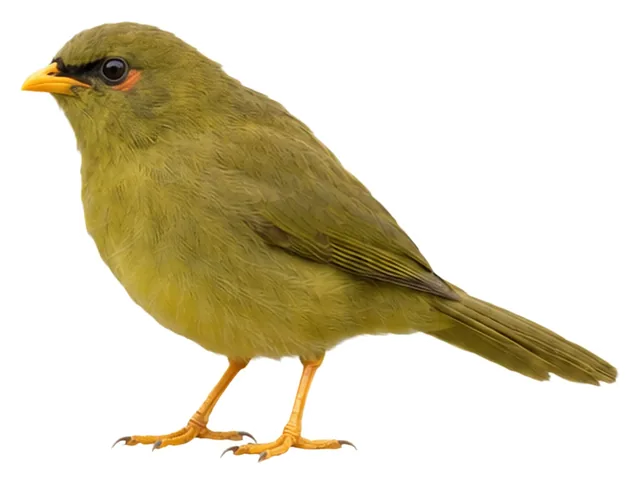
Bell Miner
Manorina melanophrys (Latham, 1801)
30 gWeight
The bell miner or bellbird (Manorina melanophrys) is a colonial honeyeater, endemic to southeastern Australia.
Busiest months: September–October · Most records: Australia
AI-generated illustration. It may contain mistakes. · How the stickers are made
Where and when it's recorded

Bell Miner has been recorded at 63 of the 8,171 birding hotspots we track, in 1 country or region.
Records by month Southern Hemisphere
Where it's recorded most
- Royal Botanic Gardens MelbourneAustralia4,186 records
- Royal ParkAustralia3,610 records
- Gold Creek ReservoirAustralia2,420 records
More places
- Boys WalkAustralia1,682 records
- Dandenong Valley WetlandAustralia1,421 records
- La Trobe University Bundoora – Nangak Tamboree Wildlife SanctuaryAustralia1,250 records
- Wilson ReserveAustralia1,207 records
- Mount Annan Botanic GardensAustralia1,172 records
- Warriewood WetlandsAustralia1,167 records
- Lake Samsonvale – Postmans TrackAustralia1,119 records
Countries and regions with the most records
eBird records via GBIF up to 2024-12-31. A record means someone listed it; more records partly mean more birders, not more birds.
About
The bell miner or bellbird (Manorina melanophrys) is a colonial honeyeater, endemic to southeastern Australia. The common name refers to their bell-like call. "Miner" is an old alternative spelling of "myna", and is shared with other members of the genus Manorina.
Excerpt from Wikipedia, CC BY-SA 4.0 · authors · Read more on Wikipedia
Questions
How big is the Bell Miner?
The Bell Miner weighs around 30 g.
Where does the Bell Miner live?
Its breeding range: Australasia: southeastern Queensland to south-central Victoria (southeastern Australia). It is most often recorded in Australia.
When is the best time to see the Bell Miner?
At the hotspots we track, it is recorded most in September and October (Southern Hemisphere).
Is the Bell Miner endangered?
The IUCN Red List classifies the Bell Miner as Least Concern.
What does the Bell Miner eat?
Main food: Insects & other invertebrates.
What family is the Bell Miner in?
It belongs to the family Honeyeaters (Meliphagidae), order Passerines (Passeriformes).
At a glance
- Weight
- 30 g
- Habitat
- Forest
- Diet
- Insects & other invertebrates
- Lifestyle
- Perches in trees
- Migration
- Resident (barely migrates)
- Conservation
- Least Concern
More measurements
- Wing
- 95 mm
- Tail
- 81 mm
- Bill
- 17 mm
- Tarsus
- 22 mm
Averages from the AVONET dataset; length from field guides where available.
Range
Australasia: southeastern Queensland to south-central Victoria (southeastern Australia)
Breeding range, IOC World Bird List 15.2
Classification
- Order
- Passerines Passeriformes
- Family
- Honeyeaters Meliphagidae
- Genus
- Manorina
Other birds in the genus Manorina
 Noisy MinerManorina melanocephala
 Yellow-throated MinerManorina flavigula
 Black-eared MinerManorina melanotis
 Dark-eared MyzaMyza celebensis
 White-eared MyzaMyza sarasinorum
 Eastern SpinebillAcanthorhynchus tenuirostris
 Western SpinebillAcanthorhynchus superciliosus
 Green-backed HoneyeaterGlycichaera fallax
 Sooty HoneyeaterMelionyx fuscus
 Long-bearded HoneyeaterMelionyx princeps
 WebP · 1070 px