
Black-necked Crane
Grus nigricollis Przevalski, 1876
114–150 cmLength190 cmWingspan6 kgWeight
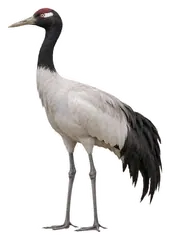
This grayish-white plateau crane has a black head and upper neck and a red patch on the crown.
Busiest months: November · Most records: China, Bhutan, India
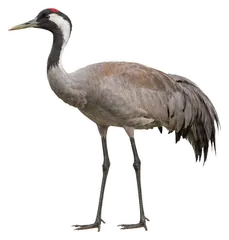
Looks like Common Crane
AI-generated illustration. It may contain mistakes. · How the stickers are made
How to identify
Field marks
- Head and roughly the upper two-thirds of the neck black
- Bare skin on the crown blood-red
- One small white patch behind and below the eye
- Tail feathers black
Male, female and young
Sexes similar; juvenile rufous-yellow, slightly darker on the neck, back and wings and paler on the belly, with flesh-red bill and legs and feet.
Voice
Loud trumpeting, similar to other cranes; families keep in contact with a short, low, nasal “kurrr”.
Similar species
Where and when it's recorded

Black-necked Crane has been recorded at 82 of the 8,171 birding hotspots we track, in 4 countries and regions.
Records by month Northern Hemisphere
To protect this bird from disturbance, we don't list exact sites.
Countries and regions with the most records
eBird records via GBIF up to 2024-12-31. A record means someone listed it; more records partly mean more birders, not more birds.
About
The black-necked crane (Grus nigricollis) is a medium-sized crane in Asia that breeds on the Tibetan Plateau and remote parts of India and Bhutan. Both sexes are similar. Some populations are known to make seasonal movements.
Excerpt from Wikipedia, CC BY-SA 4.0 · authors · Read more on Wikipedia
Questions
How big is the Black-necked Crane?
The Black-necked Crane is about 114–150 cm long, with a wingspan of 190 cm and weighs around 6 kg.
Where does the Black-necked Crane live?
Its breeding range: Palearctic: Tibet and west-central China. It is most often recorded in China, Bhutan and India.
When is the best time to see the Black-necked Crane?
At the hotspots we track, it is recorded most in November (Northern Hemisphere).
Is the Black-necked Crane endangered?
The IUCN Red List classifies the Black-necked Crane as Near Threatened.
What does the Black-necked Crane eat?
Main food: Omnivore.
What family is the Black-necked Crane in?
It belongs to the family Cranes (Gruidae), order Gruiformes.
How do you identify the Black-necked Crane?
Head and roughly the upper two-thirds of the neck black. Bare skin on the crown blood-red. One small white patch behind and below the eye.
How do male and female Black-necked Crane differ?
Sexes similar; juvenile rufous-yellow, slightly darker on the neck, back and wings and paler on the belly, with flesh-red bill and legs and feet.
How do you tell the Black-necked Crane from the Common Crane?
Similar in appearance; Black-necked Crane has a black tail, while Common Crane has a gray tail, allowing them to be distinguished at a distance.
At a glance
- Length
- 114–150 cm
- Wingspan
- 190 cm
- Weight
- 6 kg
- Habitat
- Wetland
- Diet
- Omnivore
- Lifestyle
- Active on the ground
- Migration
- Migratory
- Conservation
- Near Threatened
More measurements
- Wing
- 579 mm
- Tail
- 217 mm
- Bill
- 124 mm
- Tarsus
- 240 mm
Averages from the AVONET dataset; length from field guides where available.
Range
Palearctic: Tibet and west-central China
Breeding range, IOC World Bird List 15.2
Classification
- Order
- Gruiformes
- Family
- Cranes Gruidae
- Genus
- Grus
Other birds in the genus Grus
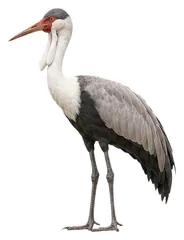 Wattled CraneGrus carunculata
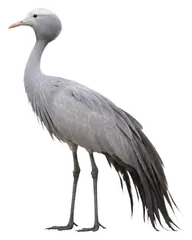 Blue CraneGrus paradisea
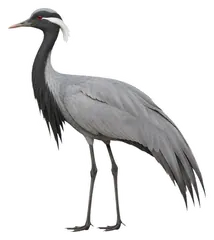 Demoiselle CraneGrus virgo
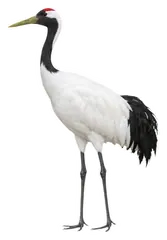 Red-crowned CraneGrus japonensis
 Whooping CraneGrus americana
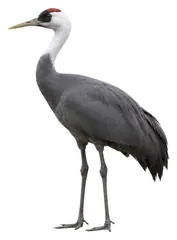 Hooded CraneGrus monacha
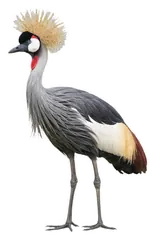 Grey Crowned CraneBalearica regulorum
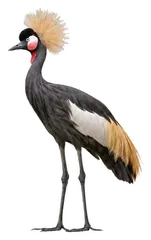 Black Crowned CraneBalearica pavonina
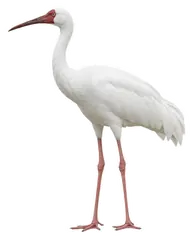 Siberian CraneLeucogeranus leucogeranus
Download illustration
Free to use with credit: “Illustration: Field Stickers”. AI-generated. Its appearance was checked against a reference photo by Sumeetmoghe; the pose follows our standard. ↗

In other languages
- EnglishBlack-necked Crane
- 简体中文黑颈鹤
- 繁體中文黑頸鶴
- 日本語オグロヅル
- 한국어검은꼬리두루미
- DeutschSchwarzhalskranich
- FrançaisGrue à cou noir
- EspañolGrulla cuellinegra
- Portuguêsgrou-de-pescoço-preto
- ItalianoGru collonero
- NederlandsZwarthalskraanvogel
- РусскийЧерношейный журавль
- Svenskasvarthalsad trana
- DanskSorthalset Trane
- Polskiżuraw czarnoszyi