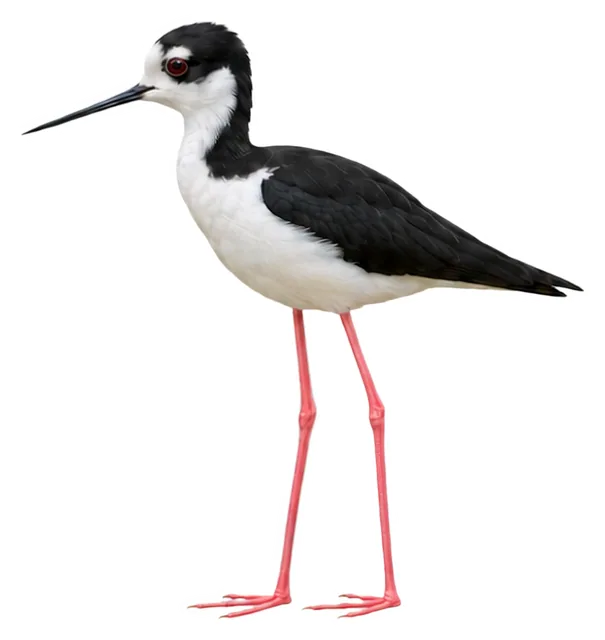
Black-necked Stilt
Himantopus mexicanus (Müller, PLS, 1776)
177 gWeight
The black-necked stilt (Himantopus mexicanus), also called the pied stilt, is a locally abundant shorebird of North and South American wetlands and coastlines.
Busiest months: April · Most records: United States, Mexico, Costa Rica
AI-generated illustration. It may contain mistakes. · How the stickers are made
Records by month · United States · Black-necked Stilt
| Month | Records |
|---|---|
| January | 29,875 |
| February | 25,101 |
| March | 38,894 |
| April | 80,989 |
| May | 56,701 |
| June | 25,624 |
| July | 30,466 |
| August | 34,570 |
| September | 28,971 |
| October | 21,467 |
| November | 28,930 |
| December | 23,185 |
Counts come from the birding hotspots covered by Field Stickers. eBird records via GBIF up to 2024-12-31. A record means someone listed it; more records partly mean more birders, not more birds. eBird / GBIF
Where and when it's recorded

Black-necked Stilt has been recorded at 993 of the 8,171 birding hotspots we track, in 50 countries and regions.
Records by month Northern Hemisphere
Where it's recorded most
- Riparian Preserve at Gilbert Water RanchUnited States25,360 records
- Estero Llano Grande SP WBCUnited States19,081 records
- IRWD San Joaquin Marsh & Wildlife Sanctuary, IrvineUnited States18,587 records
More places
- Leonabelle Turnbull Birding Ctr.United States12,953 records
- Santa Ana NWRUnited States11,608 records
- Willcox – Lake Cochise and Twin Lakes Golf CourseUnited States10,144 records
- South Padre Is. – WBC/Conv. Center/Laguna Madre TrailUnited States9,658 records
- Howard Marsh MetroparkUnited States9,055 records
- Mitchell Lake Audubon CenterUnited States8,940 records
- South Padre Is. – Birding and Nature CenterUnited States8,892 records
Countries and regions with the most records
eBird records via GBIF up to 2024-12-31. A record means someone listed it; more records partly mean more birders, not more birds.
About
The black-necked stilt (Himantopus mexicanus), also called the pied stilt, is a locally abundant shorebird of North and South American wetlands and coastlines. It is found from the coastal areas of California through much of the interior western United States and along the Gulf of Mexico as far east as Florida, then south through Central America and the Caribbean to Brazil, Peru and the Galápagos Islands, with an isolated population, the Hawaiian stilt, in Hawaii.
Excerpt from Wikipedia, CC BY-SA 4.0 · authors · Read more on Wikipedia
Questions
How big is the Black-necked Stilt?
The Black-necked Stilt weighs around 177 g.
Where does the Black-necked Stilt live?
Its breeding range: North America, Middle America, South America, Pacific Ocean: coastal and inland western, southern, southeastern USA to southwestern Peru, Galápagos and northeastern Brazil; also Hawaiian Islands. It is most often recorded in United States, Mexico and Costa Rica.
When is the best time to see the Black-necked Stilt?
At the hotspots we track, it is recorded most in April (Northern Hemisphere).
What does the Black-necked Stilt eat?
Main food: Fish, shrimp & shellfish.
What family is the Black-necked Stilt in?
It belongs to the family Stilts, Avocets (Recurvirostridae), order Charadriiformes.
At a glance
- Weight
- 177 g
- Habitat
- Wetland
- Diet
- Fish, shrimp & shellfish
- Lifestyle
- Active on the ground
- Migration
- Partial migrant
More measurements
- Wing
- 224 mm
- Tail
- 74 mm
- Bill
- 67 mm
- Tarsus
- 107 mm
Averages from the AVONET dataset; length from field guides where available.
Range
North America, Middle America, South America, Pacific Ocean: coastal and inland western, southern, southeastern USA to southwestern Peru, Galápagos and northeastern Brazil; also Hawaiian Islands
Breeding range, IOC World Bird List 15.2
Classification
- Order
- Charadriiformes
- Family
- Stilts, Avocets Recurvirostridae
- Genus
- Himantopus
Other birds in the genus Himantopus
 Black-winged StiltHimantopus himantopus
 Pied StiltHimantopus leucocephalus
 White-backed StiltHimantopus melanurus
 Black StiltHimantopus novaezelandiae
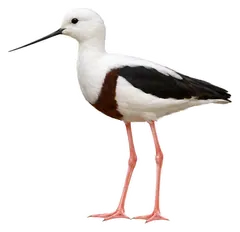 Banded StiltCladorhynchus leucocephalus
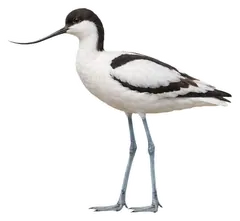 Pied AvocetRecurvirostra avosetta
 American AvocetRecurvirostra americana
 Red-necked AvocetRecurvirostra novaehollandiae
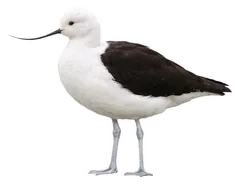 Andean AvocetRecurvirostra andina
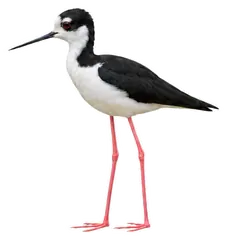
Download illustration
Free to use with credit: “Illustration: Field Stickers”. AI-generated. Its appearance was checked against a reference photo by João Vitor Andriola; the pose follows our standard. ↗
In other languages
- EnglishBlack-necked Stilt
- 简体中文黑颈长脚鹬
- 繁體中文黑頸高蹺鴴
- 日本語クロエリセイタカシギ
- DeutschSchwarznacken-Stelzenläufer
- FrançaisÉchasse d’Amérique
- EspañolCigüeñuela de Cuello Negro
- Portuguêspernilongo-de-costas-negras
- ItalianoCavaliere collonero
- NederlandsAmerikaanse Steltkluut
- РусскийАмериканский ходулочник
- Svenskaamerikansk styltlöpare
- DanskSortnakket Stylteløber
- Polskiszczudłak białobrewy