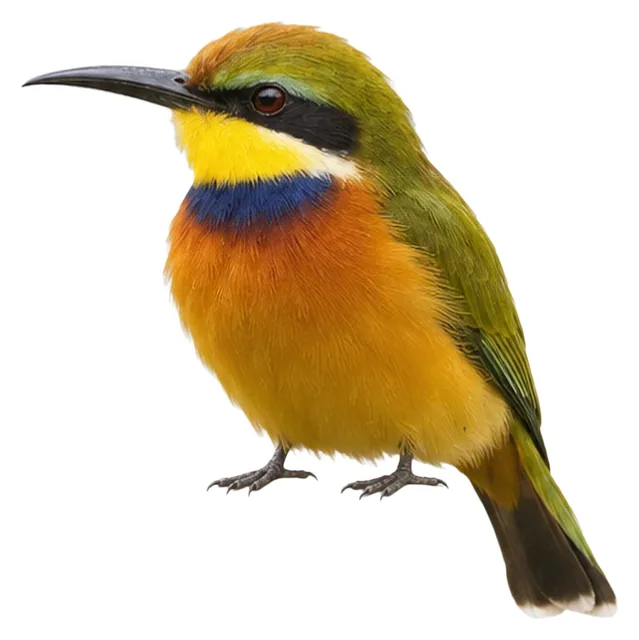
Blue-breasted Bee-eater
Merops variegatus Vieillot, 1817
21 cmLength22 gWeight
The blue-breasted bee-eater (Merops variegatus) is a central African species of bird.
Busiest months: July · Most records: Uganda, Gabon, Congo - Brazzaville
AI-generated illustration. It may contain mistakes. · How the stickers are made
Where and when it's recorded

Blue-breasted Bee-eater has been recorded at 68 of the 8,171 birding hotspots we track, in 10 countries and regions.
Records by month Northern Hemisphere
Where it's recorded most
- Mabamba SwampUganda875 records
- Mabamba Swamp – Main channelUganda272 records
- Lutembe Bay Ramsar SiteUganda73 records
More places
- Nyonié – Chez BétiGabon58 records
- Murchison Falls NP – North sideUganda41 records
- PN de la LopéGabon39 records
- Entebbe Botanical GardenUganda33 records
- PN de la Lopé – La Lopé LodgeGabon29 records
- Lesio-Louna Reserve – Iboubikro and track to MahCongo - Brazzaville26 records
- Lake Mburo NPUganda22 records
Countries and regions with the most records
eBird records via GBIF up to 2024-12-31. A record means someone listed it; more records partly mean more birders, not more birds.
About
The blue-breasted bee-eater (Merops variegatus) is a central African species of bird. It is a member of the family Meropidae. Meropids are all visually similar and have a diet specialized in Hymenopterans.
Excerpt from Wikipedia, CC BY-SA 4.0 · authors · Read more on Wikipedia
Questions
How big is the Blue-breasted Bee-eater?
The Blue-breasted Bee-eater is about 21 cm long and weighs around 22 g.
Where does the Blue-breasted Bee-eater live?
Its breeding range: Africa: southeastern Nigeria to Angola and eastern Africa. It is most often recorded in Uganda, Gabon and Congo - Brazzaville.
When is the best time to see the Blue-breasted Bee-eater?
At the hotspots we track, it is recorded most in July (Northern Hemisphere).
Is the Blue-breasted Bee-eater endangered?
The IUCN Red List classifies the Blue-breasted Bee-eater as Least Concern.
What does the Blue-breasted Bee-eater eat?
Main food: Insects & other invertebrates.
What family is the Blue-breasted Bee-eater in?
It belongs to the family Bee-eaters (Meropidae), order Coraciiformes.
At a glance
- Length
- 21 cm
- Weight
- 22 g
- Habitat
- Wetland
- Diet
- Insects & other invertebrates
- Lifestyle
- Perches in trees
- Migration
- Resident (barely migrates)
- Conservation
- Least Concern
More measurements
- Wing
- 90 mm
- Tail
- 76 mm
- Bill
- 32 mm
- Tarsus
- 11 mm
Averages from the AVONET dataset; length from field guides where available.
Range
Africa: southeastern Nigeria to Angola and eastern Africa
Breeding range, IOC World Bird List 15.2
Classification
- Order
- Coraciiformes
- Family
- Bee-eaters Meropidae
- Genus
- Merops
Other birds in the genus Merops
 Black-headed Bee-eaterMerops breweri
 Blue-headed Bee-eaterMerops muelleri
 Blue-moustached Bee-eaterMerops mentalis
 Black Bee-eaterMerops gularis
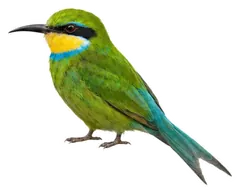 Swallow-tailed Bee-eaterMerops hirundineus
 Little Bee-eaterMerops pusillus
 Ethiopian Bee-eaterMerops lafresnayii
 Cinnamon-chested Bee-eaterMerops oreobates
 Red-throated Bee-eaterMerops bulocki
 White-fronted Bee-eaterMerops bullockoides
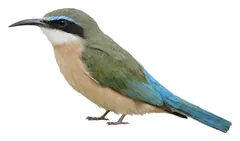 Somali Bee-eaterMerops revoilii
 White-throated Bee-eaterMerops albicollis
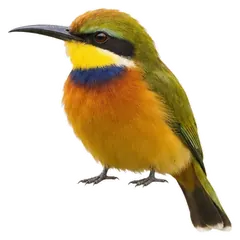
Download illustration
Free to use with credit: “Illustration: Field Stickers”. AI-generated. Its appearance was checked against a reference photo by Xavier Rufray; the pose follows our standard. ↗
In other languages
- EnglishBlue-breasted Bee-eater
- 简体中文蓝胸蜂虎
- 繁體中文藍胸蜂虎
- 日本語ルリムネハチクイ
- DeutschBlaubrustspint
- FrançaisGuêpier à collier bleu
- EspañolAbejaruco variegado
- Portuguêsabelharuco-de-colar-azul
- ItalianoGruccione pettoblu
- NederlandsBlauwborstbijeneter
- РусскийСинегрудая щурка
- Svenskablåkragad biätare
- DanskBlåkravet Biæder
- Polskiżołna niebieskopierśna