
Blue-eared Barbet
Psilopogon cyanotis (Blyth, 1847)
16–17 cmLength33 gWeight
It has a green body, blue throat and ear-coverts, and red cheek patches.
Busiest months: February–March · Most records: Thailand, Vietnam, India
AI-generated illustration. It may contain mistakes. · How the stickers are made
How to identify
Field marks
- Green feathers with dark red spots on the cheeks
- Blue throat and ear-coverts
- A single black band between the throat and breast
- Plump, rounded body with a short neck, large head and short tail
Male, female and young
The male has a black forehead; the female has duller head markings, with orangish patches above and below the ear-coverts; juveniles have a green head with a slight blue tinge to the ear-coverts and throat.
Voice
The male repeatedly gives a loud “ko-turr” when proclaiming territory.
Where and when it's recorded

Blue-eared Barbet has been recorded at 171 of the 8,171 birding hotspots we track, in 9 countries and regions.
Records by month Northern Hemisphere
Where it's recorded most
- Kaeng Krachan NPThailand943 records
- Kaeng Krachan NP – km 9 vicinityThailand862 records
- Cat Tien NPVietnam774 records
More places
- Kaeng Krachan NP – Ban Krang CampgroundsThailand683 records
- Kaeng Krachan NP – stream crossings 1–3Thailand634 records
- Khao Yai NPThailand497 records
- Garbhanga Reserve ForestIndia467 records
- Khao Yai NP – headquarters vicinityThailand465 records
- Chiang Dao Wildlife Sanctuary – Wat Tham Pha PlongThailand447 records
- Kaeng Krachan NP – Panoen Thung (upper elevation) vicinityThailand411 records
Countries and regions with the most records
eBird records via GBIF up to 2024-12-31. A record means someone listed it; more records partly mean more birders, not more birds.
About
The blue-eared barbet (Psilopogon cyanotis) is a barbet in the Megalaimidae family native to mainland Southeast Asia. Because of its wide distribution and stable population it is listed as Least Concern on the IUCN Red List.
Excerpt from Wikipedia, CC BY-SA 4.0 · authors · Read more on Wikipedia
Questions
How big is the Blue-eared Barbet?
The Blue-eared Barbet is about 16–17 cm long and weighs around 33 g.
Where does the Blue-eared Barbet live?
Its breeding range: Oriental: eastern Nepal, northeastern India and southern Myanmar through Thailand and Indochina. It is most often recorded in Thailand, Vietnam and India.
When is the best time to see the Blue-eared Barbet?
At the hotspots we track, it is recorded most in February and March (Northern Hemisphere).
Is the Blue-eared Barbet endangered?
The IUCN Red List classifies the Blue-eared Barbet as Least Concern.
What does the Blue-eared Barbet eat?
Main food: Fruit.
What family is the Blue-eared Barbet in?
It belongs to the family Asian Barbets (Megalaimidae), order Piciformes.
At a glance
- Length
- 16–17 cm
- Weight
- 33 g
- Habitat
- Forest
- Diet
- Fruit
- Lifestyle
- Perches in trees
- Migration
- Resident (barely migrates)
- Conservation
- Least Concern
More measurements
- Wing
- 84 mm
- Tail
- 50 mm
- Bill
- 18 mm
- Tarsus
- 20 mm
Averages from the AVONET dataset; length from field guides where available.
Range
Oriental: eastern Nepal, northeastern India and southern Myanmar through Thailand and Indochina
Breeding range, IOC World Bird List 15.2
Subspecies · 1
- Psilopogon cyanotis cyanotis e Nepal and ne India to s China and n Thailand
Classification
- Order
- Piciformes
- Family
- Asian Barbets Megalaimidae
- Genus
- Psilopogon
Other birds in the genus Psilopogon
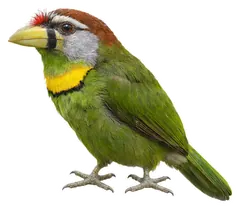 Fire-tufted BarbetPsilopogon pyrolophus
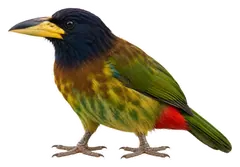 Great BarbetPsilopogon virens
 Red-vented BarbetPsilopogon lagrandieri
 Brown-headed BarbetPsilopogon zeylanicus
 Lineated BarbetPsilopogon lineatus
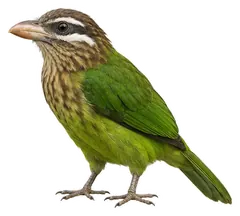 White-cheeked BarbetPsilopogon viridis
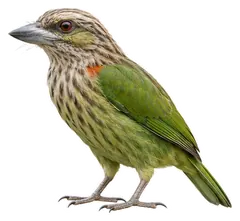 Green-eared BarbetPsilopogon faiostrictus
 Brown-throated BarbetPsilopogon corvinus
 Golden-whiskered BarbetPsilopogon chrysopogon
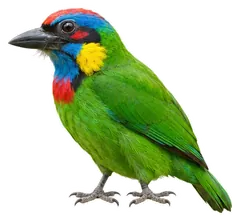 Red-crowned BarbetPsilopogon rafflesii
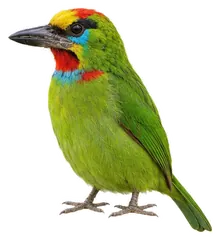 Red-throated BarbetPsilopogon mystacophanos
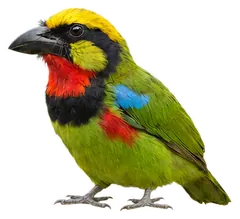 Black-banded BarbetPsilopogon javensis
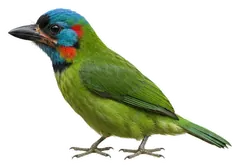
Download illustration
Free to use with credit: “Illustration: Field Stickers”. AI-generated. Its appearance was checked against a reference photo by ANIRUDHA CHAKRABORTY; the pose follows our standard. ↗