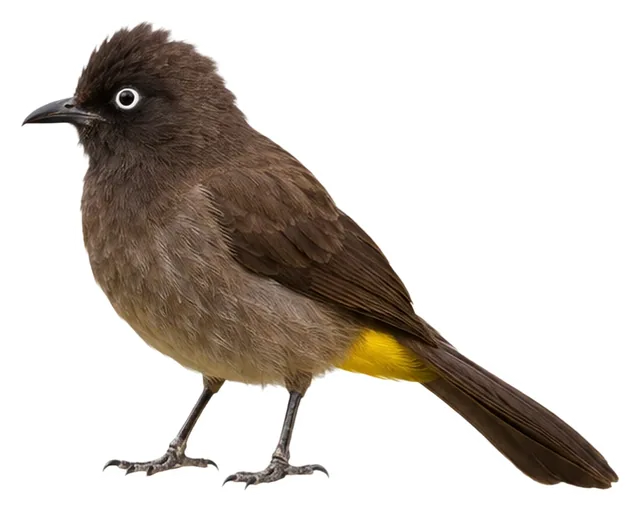
Cape Bulbul
Pycnonotus capensis (Linnaeus, 1766)
39 gWeight
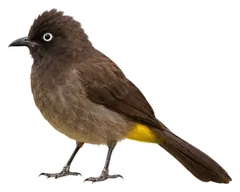
The Cape bulbul (Pycnonotus capensis) is a member of the bulbul family of passerine birds.
Busiest months: September–October · Most records: South Africa
AI-generated illustration. It may contain mistakes. · How the stickers are made
Where and when it's recorded

Cape Bulbul has been recorded at 23 of the 8,171 birding hotspots we track, in 1 country or region.
Records by month Southern Hemisphere
Where it's recorded most
- Kirstenbosch Botanical GardenSouth Africa2,751 records
- Strandfontein WTPSouth Africa1,358 records
- West Coast NPSouth Africa915 records
More places
- Harold Porter Botanical GardensSouth Africa819 records
- Rondevlei NRSouth Africa741 records
- Rooi-ElsSouth Africa679 records
- De Hoop Nature ReserveSouth Africa494 records
- Boulders BeachSouth Africa455 records
- West Coast NP – Abrahamskraal hideSouth Africa452 records
- Kirstenhof WetlandSouth Africa415 records
Countries and regions with the most records
eBird records via GBIF up to 2024-12-31. A record means someone listed it; more records partly mean more birders, not more birds.
About
The Cape bulbul (Pycnonotus capensis) is a member of the bulbul family of passerine birds. It is an endemic resident breeder in coastal bush, open forest, gardens and fynbos in western and southern South Africa. This species nests mainly in the southern spring from September to November.
Excerpt from Wikipedia, CC BY-SA 4.0 · authors · Read more on Wikipedia
Questions
How big is the Cape Bulbul?
The Cape Bulbul weighs around 39 g.
Where does the Cape Bulbul live?
Its breeding range: Africa: western, southern South Africa. It is most often recorded in South Africa.
When is the best time to see the Cape Bulbul?
At the hotspots we track, it is recorded most in September and October (Southern Hemisphere).
Is the Cape Bulbul endangered?
The IUCN Red List classifies the Cape Bulbul as Least Concern.
What does the Cape Bulbul eat?
Main food: Omnivore.
What family is the Cape Bulbul in?
It belongs to the family Bulbuls (Pycnonotidae), order Passerines (Passeriformes).
At a glance
- Weight
- 39 g
- Habitat
- Shrubland
- Diet
- Omnivore
- Lifestyle
- Perches in trees
- Migration
- Resident (barely migrates)
- Conservation
- Least Concern
More measurements
- Wing
- 93 mm
- Tail
- 86 mm
- Bill
- 20 mm
- Tarsus
- 22 mm
Averages from the AVONET dataset; length from field guides where available.
Range
Africa: western, southern South Africa
Breeding range, IOC World Bird List 15.2
Classification
- Order
- Passerines Passeriformes
- Family
- Bulbuls Pycnonotidae
- Genus
- Pycnonotus
Other birds in the genus Pycnonotus
 Cream-vented BulbulPycnonotus simplex
 Olive-winged BulbulPycnonotus plumosus
 Asian Red-eyed BulbulPycnonotus brunneus
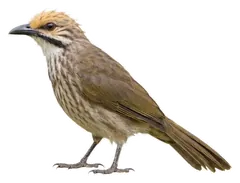 Straw-headed BulbulPycnonotus zeylanicus
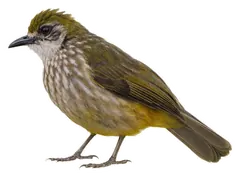 Spot-necked BulbulPycnonotus tympanistrigus
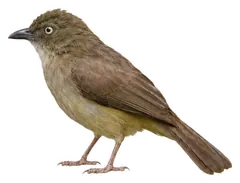 Cream-eyed BulbulPycnonotus pseudosimplex
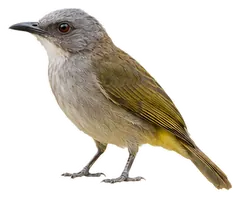 Ashy-fronted BulbulPycnonotus cinereifrons
 White-browed BulbulPycnonotus luteolus
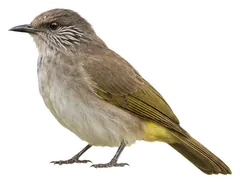 Ayeyarwady BulbulPycnonotus blanfordi
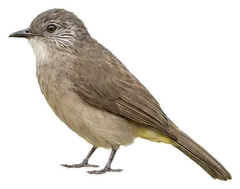 Streak-eared BulbulPycnonotus conradi
 Pale-eyed BulbulPycnonotus davisoni
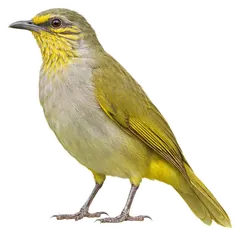 Stripe-throated BulbulPycnonotus finlaysoni
 WebP · 1070 px