
Caspian Gull
Larus cachinnans Pallas, 1811
56–68 cmLength141 cmWingspan1.1 kgWeight
It is a large herring-type gull with a long, slender bill, sloping forehead and rather long legs and neck.
Busiest months: March–May and October · Most records: Czechia, Poland, United Kingdom
AI-generated illustration. It may contain mistakes. · How the stickers are made
How to identify
Field marks
- Bill long and slender, appearing longer because of the sloping forehead
- Eyes small and often dark; legs pale pink to pale yellow
- Legs, wings and neck longer than in European Herring Gull
- Large white patch at tip of outermost primary
Male, female and young
First-winter juvenile has a pale head, dark streaks on the nape and two pale transverse lines on the upperwing.
Where and when it's recorded

Caspian Gull has been recorded at 762 of the 8,171 birding hotspots we track, in 68 countries and regions.
Records by month Northern Hemisphere
Where it's recorded most
- VN RozkošCzechia1,569 records
- Tovačov – Hradecký rybníkCzechia1,090 records
- Eilat north beachIsrael757 records
More places
- International Birding and Research Center Eilat (IBRCE)Israel728 records
- Poznań – Maltańskie LakePoland708 records
- Spytkowice FishpondsPoland704 records
- Záhlinické rybníkyCzechia683 records
- Biserovo Fish FarmRussia662 records
- Besh Barmag bottleneckAzerbaijan640 records
- Pískovny Krčmaň a MajetínCzechia602 records
Countries and regions with the most records
eBird records via GBIF up to 2024-12-31. A record means someone listed it; more records partly mean more birders, not more birds.
About
The Caspian gull (Larus cachinnans) is a large gull and a member of the herring and lesser black-backed gull complex. The scientific name is from Latin. Larus appears to have referred to a gull or other large seabird, and cachinnans means 'laughing', from cachinnare 'to laugh'.
Excerpt from Wikipedia, CC BY-SA 4.0 · authors · Read more on Wikipedia
Questions
How big is the Caspian Gull?
The Caspian Gull is about 56–68 cm long, with a wingspan of 141 cm and weighs around 1.1 kg.
Where does the Caspian Gull live?
Its breeding range: Palearctic: inland southern Poland and Hungary east through Black, Caspian and Aral seas to eastern Kazakhstan. It is most often recorded in Czechia, Poland and United Kingdom.
When is the best time to see the Caspian Gull?
At the hotspots we track, it is recorded most in March, April, May and October (Northern Hemisphere).
Is the Caspian Gull endangered?
The IUCN Red List classifies the Caspian Gull as Least Concern.
What does the Caspian Gull eat?
Main food: Omnivore.
What family is the Caspian Gull in?
It belongs to the family Gulls, Terns, Skimmers (Laridae), order Charadriiformes.
How do you identify the Caspian Gull?
Bill long and slender, appearing longer because of the sloping forehead. Eyes small and often dark; legs pale pink to pale yellow. Legs, wings and neck longer than in European Herring Gull.
How do male and female Caspian Gull differ?
First-winter juvenile has a pale head, dark streaks on the nape and two pale transverse lines on the upperwing.
At a glance
- Length
- 56–68 cm
- Wingspan
- 141 cm
- Weight
- 1.1 kg
- Habitat
- Coast & tidal flats
- Diet
- Omnivore
- Lifestyle
- Varied
- Migration
- Migratory
- Conservation
- Least Concern
More measurements
- Wing
- 427 mm
- Tail
- 162 mm
- Bill
- 65 mm
- Tarsus
- 67 mm
Averages from the AVONET dataset; length from field guides where available.
Range
Palearctic: inland southern Poland and Hungary east through Black, Caspian and Aral seas to eastern Kazakhstan
Breeding range, IOC World Bird List 15.2
Classification
- Order
- Charadriiformes
- Family
- Gulls, Terns, Skimmers Laridae
- Genus
- Larus
Other birds in the genus Larus
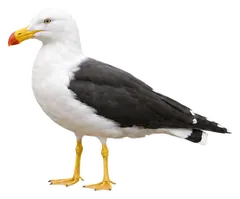 Pacific GullLarus pacificus
 Belcher's GullLarus belcheri
 Black-tailed GullLarus crassirostris
 Olrog's GullLarus atlanticus
 Heermann's GullLarus heermanni
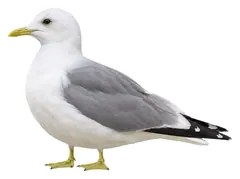 Common GullLarus canus
 Short-billed GullLarus brachyrhynchus
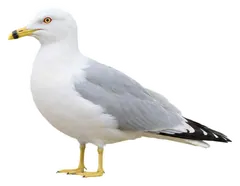 Ring-billed GullLarus delawarensis
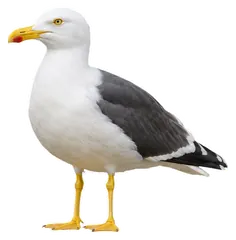 Yellow-footed GullLarus livens
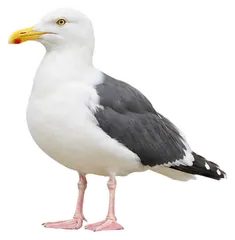 Western GullLarus occidentalis
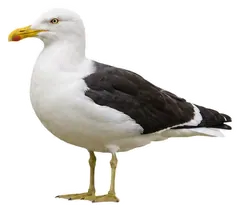 Kelp GullLarus dominicanus
 European Herring GullLarus argentatus
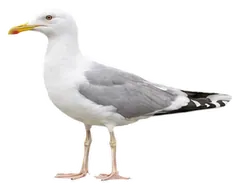
Download illustration
Free to use with credit: “Illustration: Field Stickers”. AI-generated. Its appearance was checked against a reference photo by Геннадий; the pose follows our standard. ↗