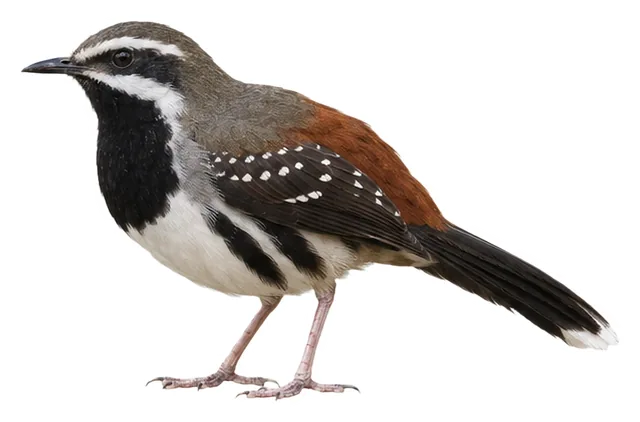
Chestnut Quail-thrush
Cinclosoma castanotum Gould, 1840
73 gWeight
The chestnut quail-thrush (Cinclosoma castanotum) is a native Australian bird of the family Cinclosomatidae.
Busiest months: October · Most records: Australia
AI-generated illustration. It may contain mistakes. · How the stickers are made
Where and when it's recorded

Chestnut Quail-thrush has been recorded at 2 of the 8,171 birding hotspots we track, in 1 country or region.
Records by month Southern Hemisphere
Where it's recorded most
- Gluepot ReserveAustralia432 records
- Hattah-Kulkyne National ParkAustralia384 records
Countries and regions with the most records
eBird records via GBIF up to 2024-12-31. A record means someone listed it; more records partly mean more birders, not more birds.
About
The chestnut quail-thrush (Cinclosoma castanotum) is a native Australian bird of the family Cinclosomatidae. These scrub birds are endemic to Australia and found in all states - barring Tasmania. They are relatively uncommon and are isolated to the semi-arid and arid fringes of the Australian interior.
Excerpt from Wikipedia, CC BY-SA 4.0 · authors · Read more on Wikipedia
Questions
How big is the Chestnut Quail-thrush?
The Chestnut Quail-thrush weighs around 73 g.
Where does the Chestnut Quail-thrush live?
Its breeding range: Australasia: east-central South Australia to central New South Wales and northwestern Victoria (southeastern Australia). It is most often recorded in Australia.
When is the best time to see the Chestnut Quail-thrush?
At the hotspots we track, it is recorded most in October (Southern Hemisphere).
Is the Chestnut Quail-thrush endangered?
The IUCN Red List classifies the Chestnut Quail-thrush as Least Concern.
What does the Chestnut Quail-thrush eat?
Main food: Insects & other invertebrates.
What family is the Chestnut Quail-thrush in?
It belongs to the family Jewel-babblers, Quail-thrushes (Cinclosomatidae), order Passerines (Passeriformes).
At a glance
- Weight
- 73 g
- Habitat
- Woodland
- Diet
- Insects & other invertebrates
- Lifestyle
- Active on the ground
- Migration
- Resident (barely migrates)
- Conservation
- Least Concern
More measurements
- Wing
- 101 mm
- Tail
- 101 mm
- Bill
- 21 mm
- Tarsus
- 29 mm
Averages from the AVONET dataset; length from field guides where available.
Range
Australasia: east-central South Australia to central New South Wales and northwestern Victoria (southeastern Australia)
Breeding range, IOC World Bird List 15.2
Classification
- Order
- Passerines Passeriformes
- Family
- Jewel-babblers, Quail-thrushes Cinclosomatidae
- Genus
- Cinclosoma
Other birds in the genus Cinclosoma
 Spotted Quail-thrushCinclosoma punctatum
 Copperback Quail-thrushCinclosoma clarum
 Cinnamon Quail-thrushCinclosoma cinnamomeum
 Nullarbor Quail-thrushCinclosoma alisteri
 Chestnut-breasted Quail-thrushCinclosoma castaneothorax
 Western Quail-thrushCinclosoma marginatum
 Painted Quail-thrushCinclosoma ajax
 Spotted Jewel-babblerPtilorrhoa leucosticta
 Blue Jewel-babblerPtilorrhoa caerulescens
 Brown-headed Jewel-babblerPtilorrhoa geislerorum
 WebP · 1070 px
In other languages
- EnglishChestnut Quail-thrush
- 简体中文栗鹑鸫
- 繁體中文栗鶉鶇
- 日本語クリゴシウズラチメドリ
- DeutschKastanienmantelflöter
- FrançaisCinclosome marron
- EspañolZordala castaña
- Portuguêstordiz-castanho
- ItalianoTordo quaglia castano
- NederlandsRoodrugkwartellijster
- РусскийПестрокрылый флейтист
- Svenskasvartbröstad vakteltrast
- DanskKastanjerygget Vagteldrossel
- Polskipieszak kasztanowaty