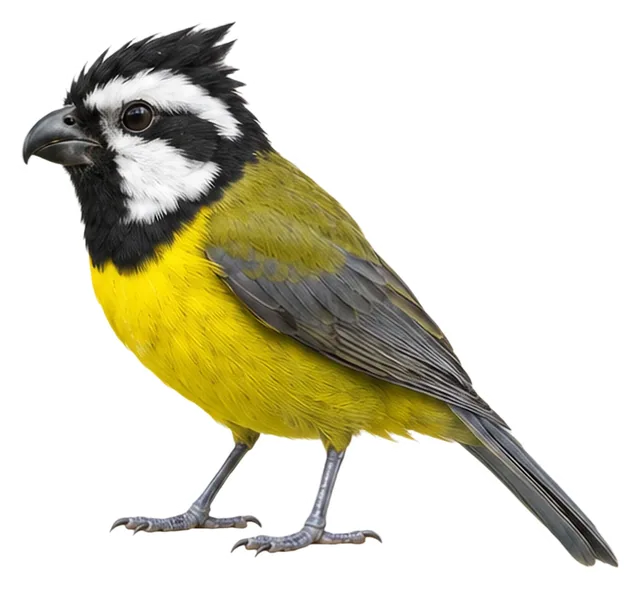
Eastern Shriketit
Falcunculus frontatus (Latham, 1801)
28 gWeight
The eastern shriketit (Falcunculus frontatus) is a species of passerine bird in the family Falcunculidae.
Busiest months: January and October · Most records: Australia
AI-generated illustration. It may contain mistakes. · How the stickers are made
Where and when it's recorded

Eastern Shriketit has been recorded at 85 of the 8,171 birding hotspots we track, in 1 country or region.
Records by month Southern Hemisphere
Where it's recorded most
- Serendip SanctuaryAustralia370 records
- Eynesbury Forest and GrasslandsAustralia362 records
- Wonga WetlandsAustralia324 records
More places
- Gemmill Swamp Wildlife ReserveAustralia323 records
- Laratinga WetlandsAustralia270 records
- Chiltern-Mt Pilot National Park – ChilternAustralia244 records
- Bendthualaly, BellawongarahAustralia232 records
- Hamilton ParkAustralia211 records
- Western Treatment PlantAustralia207 records
- You Yangs Regional ParkAustralia204 records
Countries and regions with the most records
eBird records via GBIF up to 2024-12-31. A record means someone listed it; more records partly mean more birders, not more birds.
About
The eastern shriketit (Falcunculus frontatus) is a species of passerine bird in the family Falcunculidae. It is also known as bark tit, crested tit or yellow-bellied tit.
Excerpt from Wikipedia, CC BY-SA 4.0 · authors · Read more on Wikipedia
Questions
How big is the Eastern Shriketit?
The Eastern Shriketit weighs around 28 g.
Where does the Eastern Shriketit live?
Its breeding range: Australasia: northeastern Queensland from Atherton to southeastern South Australia and Victoria (eastern, southeastern Australia). It is most often recorded in Australia.
When is the best time to see the Eastern Shriketit?
At the hotspots we track, it is recorded most in January and October (Southern Hemisphere).
Is the Eastern Shriketit endangered?
The IUCN Red List classifies the Eastern Shriketit as Least Concern.
What does the Eastern Shriketit eat?
Main food: Insects & other invertebrates.
What family is the Eastern Shriketit in?
It belongs to the family Shriketits (Falcunculidae), order Passerines (Passeriformes).
At a glance
- Weight
- 28 g
- Habitat
- Woodland
- Diet
- Insects & other invertebrates
- Lifestyle
- Perches in trees
- Migration
- Resident (barely migrates)
- Conservation
- Least Concern
More measurements
- Wing
- 90 mm
- Tail
- 78 mm
- Bill
- 20 mm
- Tarsus
- 21 mm
Averages from the AVONET dataset; length from field guides where available.
Range
Australasia: northeastern Queensland from Atherton to southeastern South Australia and Victoria (eastern, southeastern Australia)
Breeding range, IOC World Bird List 15.2
Classification
- Order
- Passerines Passeriformes
- Family
- Shriketits Falcunculidae
- Genus
- Falcunculus
Other birds in the genus Falcunculus
 Northern ShriketitFalcunculus whitei
 Western ShriketitFalcunculus leucogaster
 WebP · 1070 px
In other languages
- EnglishEastern Shriketit
- 简体中文东鵙雀鹟
- 繁體中文冠鵙雀
- 日本語ハシブトモズヒタキ
- DeutschMeisendickkopf
- FrançaisFalconelle à casque
- EspañolSilbador cabezón oriental
- Portuguêscabeçudinho-oriental
- ItalianoCinciaverla crestata
- NederlandsOostelijke Harlekijndikkop
- РусскийСиницевая толстоголовка
- Svenskaöstlig falknäbb
- DanskToppet Tornskademejse
- Polskiczubiec żółtobrzuchy