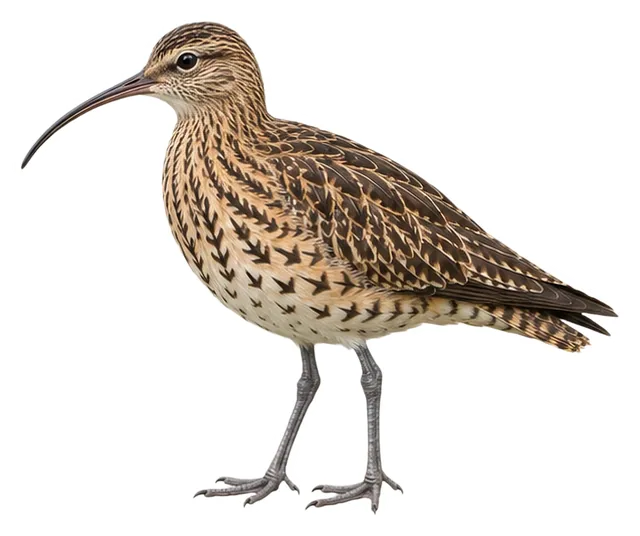
Eskimo Curlew
Numenius borealis (Forster, JR, 1772)
350 gWeight
The Eskimo curlew (Numenius borealis), also known as northern curlew, is a species of curlew in the family Scolopacidae.
Most records: United States, Canada, Barbados
AI-generated illustration. It may contain mistakes. · How the stickers are made
Where and when it's recorded

Eskimo Curlew has been recorded at 4 of the 8,171 birding hotspots we track, in 3 countries and regions.
Records by month Northern Hemisphere
Where it's recorded most
- ChurchillCanada2 records
- St. Paul IslandUnited States2 records
- Chancery Lane SwampBarbados1 record
More places
- Fosters Private WetlandBarbados1 record
Countries and regions with the most records
eBird records via GBIF up to 2024-12-31. A record means someone listed it; more records partly mean more birders, not more birds.
About
The Eskimo curlew (Numenius borealis), also known as northern curlew, is a species of curlew in the family Scolopacidae. It was one of the most numerous shorebirds in the tundra of western Arctic Canada and Alaska. Thousands of birds were then killed per year in the late 1800s.
Excerpt from Wikipedia, CC BY-SA 4.0 · authors · Read more on Wikipedia
Questions
How big is the Eskimo Curlew?
The Eskimo Curlew weighs around 350 g.
Where does the Eskimo Curlew live?
Its breeding range: North America: low Arctic tundra of northwestern North America: northern Northwest Territories (northwestern Canada; possibly also northern Alaska; probably extinct). It is most often recorded in United States, Canada and Barbados.
Is the Eskimo Curlew endangered?
The IUCN Red List classifies the Eskimo Curlew as Critically Endangered.
What does the Eskimo Curlew eat?
Main food: Insects & other invertebrates.
What family is the Eskimo Curlew in?
It belongs to the family Sandpipers, Snipes (Scolopacidae), order Charadriiformes.
At a glance
- Weight
- 350 g
- Habitat
- Grassland
- Diet
- Insects & other invertebrates
- Lifestyle
- Active on the ground
- Migration
- Migratory
- Conservation
- Critically Endangered
More measurements
- Wing
- 214 mm
- Tail
- 78 mm
- Bill
- 58 mm
- Tarsus
- 44 mm
Averages from the AVONET dataset; length from field guides where available.
Range
North America: low Arctic tundra of northwestern North America: northern Northwest Territories (northwestern Canada; possibly also northern Alaska; probably extinct)
Breeding range, IOC World Bird List 15.2
Classification
- Order
- Charadriiformes
- Family
- Sandpipers, Snipes Scolopacidae
- Genus
- Numenius
Other birds in the genus Numenius
 Bristle-thighed CurlewNumenius tahitiensis
 Eurasian WhimbrelNumenius phaeopus
 Hudsonian WhimbrelNumenius hudsonicus
 Little CurlewNumenius minutus
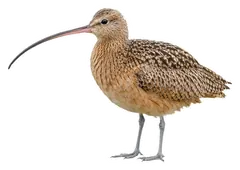 Long-billed CurlewNumenius americanus
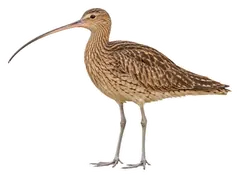 Far Eastern CurlewNumenius madagascariensis
 Slender-billed CurlewNumenius tenuirostris
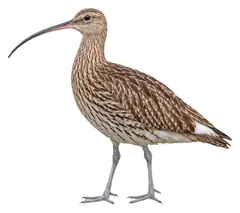 Eurasian CurlewNumenius arquata
 Upland SandpiperBartramia longicauda
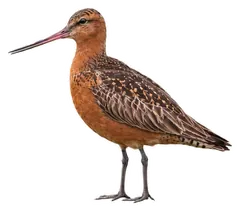 Bar-tailed GodwitLimosa lapponica
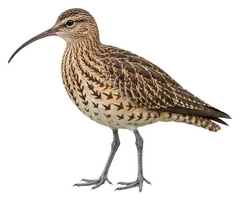
Download illustration
Free to use with credit: “Illustration: Field Stickers”. AI-generated. Its appearance was checked against a reference photo by an uncredited photographer; the pose follows our standard.