Greater Crested Tern
Thalasseus bergii (Lichtenstein, MHC, 1823)
46–49 cmLength120 cmWingspan328 gWeight
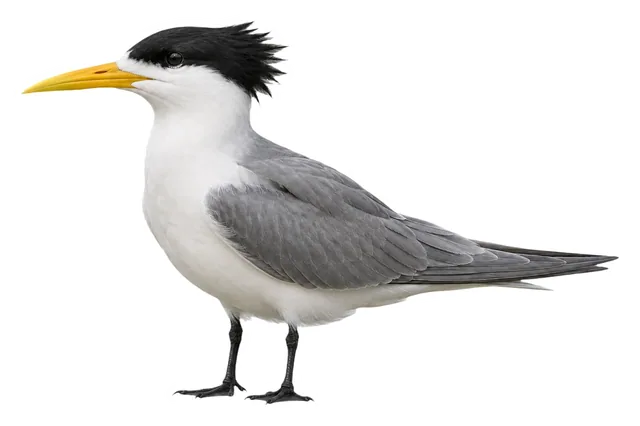
It is a large tern with a yellow bill, gray back, white belly and a shaggy black crest.
Busiest months: January and September–November · Most records: Australia, South Africa, China
Looks like Lesser Crested Tern
AI-generated illustration. It may contain mistakes. · How the stickers are made
How to identify
Field marks
- Bill long and yellow
- Black crest glossy in the breeding season, shaggy at the rear
- Forehead and underparts white; back and inner wings dark gray
- Crown turns white in winter plumage, with mottled black crest at rear
Male, female and young
Adult sexes identical; the juvenile’s head resembles that of an adult in winter plumage, and its upperparts have conspicuous gray, rufous and white markings.
Voice
Territorial call is a loud, grating, crow-like “kerrak”; gives a hard “wep wep” in flight.
Similar species
Where and when it's recorded

Greater Crested Tern has been recorded at 532 of the 8,171 birding hotspots we track, in 56 countries and regions.
Records by month Southern Hemisphere
Where it's recorded most
- Western Treatment PlantAustralia6,245 records
- Lake WollumboolaAustralia2,226 records
- Eaglehawk Neck Pelagic TripAustralia2,166 records
More places
- Strandfontein WTPSouth Africa1,825 records
- Cairns EsplanadeAustralia1,777 records
- Long Reef Aquatic ReserveAustralia1,561 records
- Ricketts PointAustralia1,398 records
- Hunter Wetlands National Park – Stockton SandspitAustralia1,163 records
- Shoalhaven Heads InletAustralia1,121 records
- Jawbone Flora and Fauna ReserveAustralia1,063 records
Countries and regions with the most records
eBird records via GBIF up to 2024-12-31. A record means someone listed it; more records partly mean more birders, not more birds.
About
The greater crested tern (Thalasseus bergii), also called crested tern, swift tern, or great crested tern, is a tern in the family Laridae that nests in dense colonies on coastlines and islands in the tropical and subtropical Old World. Its four or five subspecies breed in the area from South Africa around the Indian Ocean to the central Pacific and Australia, all populations dispersing widely from the breeding range after nesting.
Excerpt from Wikipedia, CC BY-SA 4.0 · authors · Read more on Wikipedia
Questions
How big is the Greater Crested Tern?
The Greater Crested Tern is about 46–49 cm long, with a wingspan of 120 cm and weighs around 328 g.
Where does the Greater Crested Tern live?
Its breeding range: Australasia, Oriental, Africa: coasts of southwestern Africa, North Indian Ocean and marginal seas, through Indonesian and Australian waters from far southern Japan to eastern Polynesia. It is most often recorded in Australia, South Africa and China.
When is the best time to see the Greater Crested Tern?
At the hotspots we track, it is recorded most in January, September, October and November (Southern Hemisphere).
Is the Greater Crested Tern endangered?
The IUCN Red List classifies the Greater Crested Tern as Least Concern.
What does the Greater Crested Tern eat?
Main food: Fish, shrimp & shellfish.
What family is the Greater Crested Tern in?
It belongs to the family Gulls, Terns, Skimmers (Laridae), order Charadriiformes.
How do you identify the Greater Crested Tern?
Bill long and yellow. Black crest glossy in the breeding season, shaggy at the rear. Forehead and underparts white; back and inner wings dark gray.
How do male and female Greater Crested Tern differ?
Adult sexes identical; the juvenile’s head resembles that of an adult in winter plumage, and its upperparts have conspicuous gray, rufous and white markings.
How do you tell the Greater Crested Tern from the Lesser Crested Tern?
Greater Crested Tern is 25% larger than Lesser Crested Tern, with a proportionately longer bill and a longer, heavier head; Lesser Crested Tern has orange in its bill.
At a glance
- Length
- 46–49 cm
- Wingspan
- 120 cm
- Weight
- 328 g
- Habitat
- Coast & tidal flats
- Diet
- Fish, shrimp & shellfish
- Lifestyle
- Feeds in the air
- Migration
- Migratory
- Conservation
- Least Concern
More measurements
- Wing
- 358 mm
- Tail
- 172 mm
- Bill
- 69 mm
- Tarsus
- 30 mm
Averages from the AVONET dataset; length from field guides where available.
Range
Australasia, Oriental, Africa: coasts of southwestern Africa, North Indian Ocean and marginal seas, through Indonesian and Australian waters from far southern Japan to eastern Polynesia
Breeding range, IOC World Bird List 15.2
Subspecies · 1
- Thalasseus bergii cristatus coastal e China, Taiwan (China), Spratly Is. (s China Sea), Senkaku Is. (w of Okinawa), and Nishinoshima (Iwo=Volcano Is., s of Japan), sw Philippines, Con Dao Is. (se of Vietnam), Australia including Torres Strait is. (far ne Australia), New Caledonia, Micronesia, Fiji and Tonga (sw, sc Polynesia), Line Is. (e Kiribati), Society and Tuamotu is. (e Polynesia)
Classification
- Order
- Charadriiformes
- Family
- Gulls, Terns, Skimmers Laridae
- Genus
- Thalasseus
Other birds in the genus Thalasseus
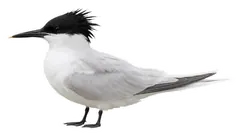 Sandwich TernThalasseus sandvicensis
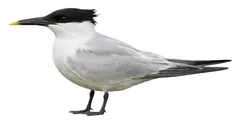 Cabot's TernThalasseus acuflavidus
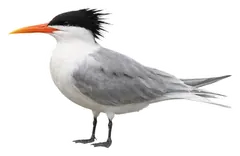 Elegant TernThalasseus elegans
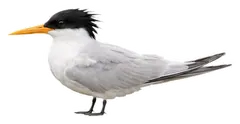 Lesser Crested TernThalasseus bengalensis
 West African Crested TernThalasseus albididorsalis
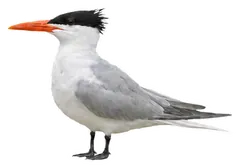 Royal TernThalasseus maximus
 Chinese Crested TernThalasseus bernsteini
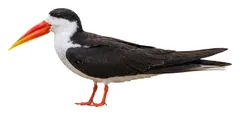 African SkimmerRynchops flavirostris
 Indian SkimmerRynchops albicollis
 Black SkimmerRynchops niger

Download illustration
Free to use with credit: “Illustration: Field Stickers”. AI-generated. Its appearance was checked against a reference photo by mattf1996; the pose follows our standard. ↗
