
Green Imperial Pigeon
Ducula aenea (Linnaeus, 1766)
45 cmLength545 gWeight
Its back, wings, and tail have a green metallic gloss.
Busiest months: February–March · Most records: Sri Lanka, Malaysia, India
AI-generated illustration. It may contain mistakes. · How the stickers are made
How to identify
Field marks
- Back, wings, and tail with green metallic gloss
- Undertail-coverts chestnut
Male, female and young
Sexes similar in appearance.
Voice
Calls are low and resonant; often heard before it is seen.
Where and when it's recorded

Green Imperial Pigeon has been recorded at 326 of the 8,171 birding hotspots we track, in 14 countries and regions.
Records by month Northern Hemisphere
Where it's recorded most
- Chidyatapu Biological ParkIndia1,529 records
- Sepilok – Rainforest Discovery CenterMalaysia1,239 records
- Danum Valley Borneo Rainforest LodgeMalaysia973 records
More places
- KalatangIndia954 records
- Kinabatangan River – SukauMalaysia944 records
- Tangkoko Batuangus NR – Forest andIndonesia921 records
- Danum Valley Field CentreMalaysia883 records
- Thattekkad Bird SanctuaryIndia798 records
- Yala National ParkSri Lanka722 records
- Kota Kinabalu – Tanjung Aru BeachMalaysia648 records
Countries and regions with the most records
eBird records via GBIF up to 2024-12-31. A record means someone listed it; more records partly mean more birders, not more birds.
About
The green imperial pigeon (Ducula aenea) is a large forest pigeon. The large range extends from Nepal, southern India and Sri Lanka eastwards to southern China, Indonesia and the Philippines.
Excerpt from Wikipedia, CC BY-SA 4.0 · authors · Read more on Wikipedia
Questions
How big is the Green Imperial Pigeon?
The Green Imperial Pigeon is about 45 cm long and weighs around 545 g.
Where does the Green Imperial Pigeon live?
Its breeding range: Oriental: widespread. It is most often recorded in Sri Lanka, Malaysia and India.
When is the best time to see the Green Imperial Pigeon?
At the hotspots we track, it is recorded most in February and March (Northern Hemisphere).
Is the Green Imperial Pigeon endangered?
The IUCN Red List classifies the Green Imperial Pigeon as Near Threatened.
What does the Green Imperial Pigeon eat?
Main food: Fruit.
What family is the Green Imperial Pigeon in?
It belongs to the family Pigeons, Doves (Columbidae), order Columbiformes.
How do you identify the Green Imperial Pigeon?
Back, wings, and tail with green metallic gloss. Undertail-coverts chestnut.
How do male and female Green Imperial Pigeon differ?
Sexes similar in appearance.
At a glance
- Length
- 45 cm
- Weight
- 545 g
- Habitat
- Forest
- Diet
- Fruit
- Lifestyle
- Perches in trees
- Migration
- Resident (barely migrates)
- Conservation
- Near Threatened
More measurements
- Wing
- 236 mm
- Tail
- 135 mm
- Bill
- 30 mm
- Tarsus
- 30 mm
Averages from the AVONET dataset; length from field guides where available.
Range
Oriental: widespread
Breeding range, IOC World Bird List 15.2
Subspecies · 1
- Ducula aenea sylvatica n India and Nepal to s China to Thailand and Indochina
Classification
- Order
- Columbiformes
- Family
- Pigeons, Doves Columbidae
- Genus
- Ducula
Other birds in the genus Ducula
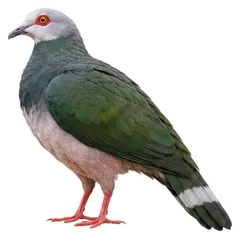 Pink-bellied Imperial PigeonDucula poliocephala
 White-bellied Imperial PigeonDucula forsteni
 Mindoro Imperial PigeonDucula mindorensis
 Grey-headed Imperial PigeonDucula radiata
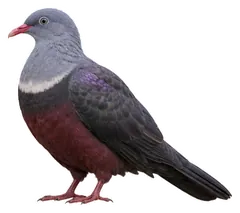 Spotted Imperial PigeonDucula carola
 Enggano Imperial PigeonDucula oenothorax
 Nicobar Imperial PigeonDucula nicobarica
 Spectacled Imperial PigeonDucula perspicillata
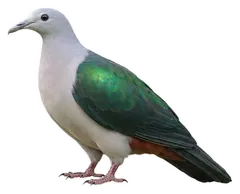 Seram Imperial PigeonDucula neglecta
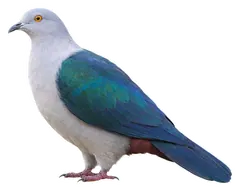 Elegant Imperial PigeonDucula concinna
 Pacific Imperial PigeonDucula pacifica
 Micronesian Imperial PigeonDucula oceanica
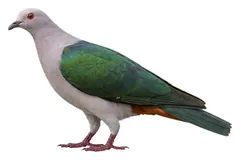
Download illustration
Free to use with credit: “Illustration: Field Stickers”. AI-generated. Its appearance was checked against a reference photo by sunnyjosef; the pose follows our standard. ↗

In other languages
- EnglishGreen Imperial Pigeon
- 简体中文绿皇鸠
- 繁體中文綠皇鳩
- 日本語ミカドバト
- DeutschBronzefruchttaube
- FrançaisCarpophage de Pauline
- EspañolDúcula verde
- Portuguêspombo-imperial-verde
- ItalianoPiccione imperiale verde
- NederlandsGroene Muskaatduif
- РусскийБронзовый плодовый голубь
- Svenskagrön kejsarduva
- DanskKejserdue
- Polskimuszkatela miedziana