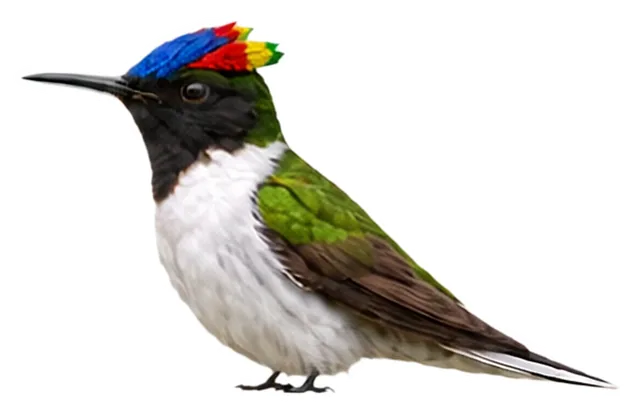
Horned Sungem
Heliactin bilophus (Temminck, 1820)
≈11 cmLength4.4 gWeight
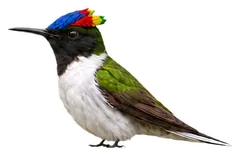
The adult male has two tufts of colorful hornlike feathers above the eyes and a pointed beard extending from the black throat.
Busiest months: May · Most records: Brazil, Bolivia
AI-generated illustration. It may contain mistakes. · How the stickers are made
How to identify
Field marks
- Male has two tufts of colorful hornlike feathers above the eyes
- Male has a pointed beard extending from the black throat
- Upperparts metallic yellow-green; underparts white
- Four central tail feathers distinctly longer
Male, female and young
Female lacks the hornlike tufts and black throat; throat brown or yellowish-brown. Juvenile resembles the female.
Voice
Repeated “tsit”, “tseet” or “chup” notes.
Where and when it's recorded

Horned Sungem has been recorded at 14 of the 8,171 birding hotspots we track, in 2 countries and regions.
Records by month Southern Hemisphere
Where it's recorded most
- Botumirim – Reserva Natural Rolinha-do-planaltoBrazil425 records
- Pousada TrijunçãoBrazil361 records
- Pompéu – apenas listas históricasBrazil98 records
More places
- PN Chapada dos GuimarãesBrazil46 records
- Fazenda Água LimpaBrazil35 records
- PARNA das EmasBrazil22 records
- PN Chapada dos Guimarães – Pousada do ParqueBrazil14 records
- Alto Paraíso de Goiás – área urbanaBrazil9 records
- RPPN Pedra D'AntasBrazil3 records
- PN Serra da CanastraBrazil2 records
Countries and regions with the most records
eBird records via GBIF up to 2024-12-31. A record means someone listed it; more records partly mean more birders, not more birds.
About
The horned sungem (Heliactin bilophus) is a species of hummingbird native to much of central Brazil and parts of Bolivia and Suriname. It prefers open habitats such as savanna and grassland and readily occupies human-created habitats such as gardens. It recently expanded its range into southern Amazonas and Espírito Santo, probably as a result of deforestation; few other hummingbird species have recently expanded their range.
Excerpt from Wikipedia, CC BY-SA 4.0 · authors · Read more on Wikipedia
Questions
How big is the Horned Sungem?
The Horned Sungem is about ≈11 cm long and weighs around 4.4 g.
Where does the Horned Sungem live?
Its breeding range: South America: southern Suriname and northern Brazil; eastern, southeastern Brazil to eastern Bolivia. It is most often recorded in Brazil and Bolivia.
When is the best time to see the Horned Sungem?
At the hotspots we track, it is recorded most in May (Southern Hemisphere).
Is the Horned Sungem endangered?
The IUCN Red List classifies the Horned Sungem as Least Concern.
What does the Horned Sungem eat?
Main food: Nectar.
What family is the Horned Sungem in?
It belongs to the family Hummingbirds (Trochilidae), order Apodiformes.
How do you identify the Horned Sungem?
Male has two tufts of colorful hornlike feathers above the eyes. Male has a pointed beard extending from the black throat. Upperparts metallic yellow-green; underparts white.
How do male and female Horned Sungem differ?
Female lacks the hornlike tufts and black throat; throat brown or yellowish-brown. Juvenile resembles the female.
At a glance
- Length
- ≈11 cm
- Weight
- 4.4 g
- Habitat
- Woodland
- Diet
- Nectar
- Lifestyle
- Feeds in the air
- Migration
- Resident (barely migrates)
- Conservation
- Least Concern
More measurements
- Wing
- 48 mm
- Tail
- 50 mm
- Bill
- 18 mm
- Tarsus
- 4 mm
Averages from the AVONET dataset; length from field guides where available.
Range
South America: southern Suriname and northern Brazil; eastern, southeastern Brazil to eastern Bolivia
Breeding range, IOC World Bird List 15.2
Classification
- Order
- Apodiformes
- Family
- Hummingbirds Trochilidae
- Genus
- Heliactin
More from the family Hummingbirds
 Crimson TopazTopaza pella
 Fiery TopazTopaza pyra
 White-necked JacobinFlorisuga mellivora
 Black JacobinFlorisuga fusca
 White-tipped SicklebillEutoxeres aquila
 Buff-tailed SicklebillEutoxeres condamini
 Saw-billed HermitRamphodon naevius
 Hook-billed HermitGlaucis dohrnii
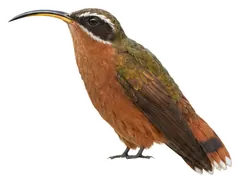 Bronzy HermitGlaucis aeneus
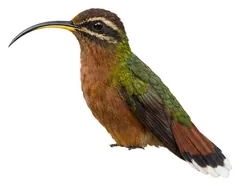 Rufous-breasted HermitGlaucis hirsutus
 WebP · 1070 px