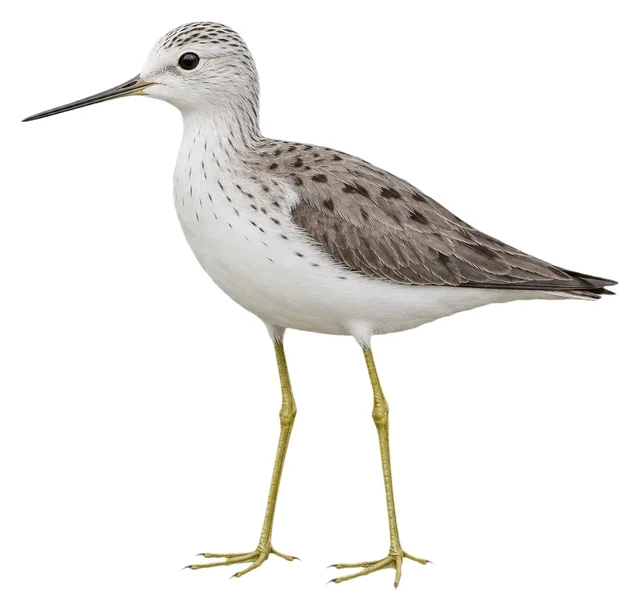
Marsh Sandpiper
Tringa stagnatilis (Bechstein, 1803)
22–26 cmLength57 cmWingspan78 gWeight
This small, elegant sandpiper has a long, slender bill and very long, yellowish legs and feet.
Busiest months: April · Most records: China, India, Israel
Looks like Common Greenshank
AI-generated illustration. It may contain mistakes. · How the stickers are made
How to identify
Field marks
- Bill long and slender
- Legs and feet very long and yellowish
- White wedge on the back in flight
- Breeding plumage gray-brown; winter plumage paler
Similar species
Where and when it's recorded

Marsh Sandpiper has been recorded at 1,830 of the 8,171 birding hotspots we track, in 125 countries and regions.
Records by month Northern Hemisphere
Where it's recorded most
- International Birding and Research Center Eilat (IBRCE)Israel3,801 records
- Mai Po Nature ReserveHong Kong (China)3,088 records
- Western Treatment PlantAustralia2,910 records
More places
- Eilat – KM20 Flamingo Pools 20Israel2,857 records
- Pak Thale Nature ReserveThailand2,215 records
- Aogu Wetland IBATaiwan (China)1,285 records
- Hama'apil FishpondsIsrael1,263 records
- Lizejian IBA – 52-Jia WetlandTaiwan (China)1,084 records
- Al Wathba Wetland ReserveUnited Arab Emirates974 records
- Khok Kham – Bird Center vicinityThailand889 records
Countries and regions with the most records
eBird records via GBIF up to 2024-12-31. A record means someone listed it; more records partly mean more birders, not more birds.
About
The marsh sandpiper (Tringa stagnatilis) is a small wader. It is a rather small shank, and breeds in open grassy steppe and taiga wetlands from easternmost Europe to the Russian Far East. The specific stagnatilis is from Latin stagnum, "swamp".
Excerpt from Wikipedia, CC BY-SA 4.0 · authors · Read more on Wikipedia
Questions
How big is the Marsh Sandpiper?
The Marsh Sandpiper is about 22–26 cm long, with a wingspan of 57 cm and weighs around 78 g.
Where does the Marsh Sandpiper live?
Its breeding range: Palearctic: temperate zone freshwater marshes of west-central to east-central Palearctic: eastern Poland and Baltic states east through southern Russia, northern Kazakhstan and northern Mongolia to Amurland and northeastern China. It is most often recorded in China, India and Israel.
When is the best time to see the Marsh Sandpiper?
At the hotspots we track, it is recorded most in April (Northern Hemisphere).
Is the Marsh Sandpiper endangered?
The IUCN Red List classifies the Marsh Sandpiper as Least Concern.
What does the Marsh Sandpiper eat?
Main food: Fish, shrimp & shellfish.
What family is the Marsh Sandpiper in?
It belongs to the family Sandpipers, Snipes (Scolopacidae), order Charadriiformes.
At a glance
- Length
- 22–26 cm
- Wingspan
- 57 cm
- Weight
- 78 g
- Habitat
- Wetland
- Diet
- Fish, shrimp & shellfish
- Lifestyle
- Active on the ground
- Migration
- Migratory
- Conservation
- Least Concern
More measurements
- Wing
- 133 mm
- Tail
- 56 mm
- Bill
- 42 mm
- Tarsus
- 50 mm
Averages from the AVONET dataset; length from field guides where available.
Range
Palearctic: temperate zone freshwater marshes of west-central to east-central Palearctic: eastern Poland and Baltic states east through southern Russia, northern Kazakhstan and northern Mongolia to Amurland and northeastern China
Breeding range, IOC World Bird List 15.2
Classification
- Order
- Charadriiformes
- Family
- Sandpipers, Snipes Scolopacidae
- Genus
- Tringa
Other birds in the genus Tringa
 Green SandpiperTringa ochropus
 Solitary SandpiperTringa solitaria
 Grey-tailed TattlerTringa brevipes
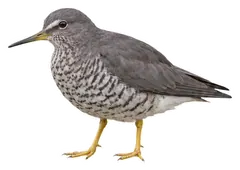 Wandering TattlerTringa incana
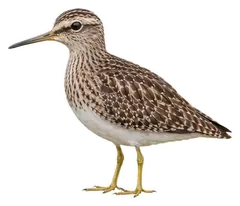 Wood SandpiperTringa glareola
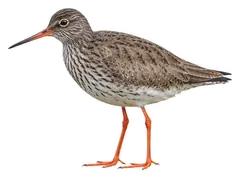 Common RedshankTringa totanus
 Lesser YellowlegsTringa flavipes
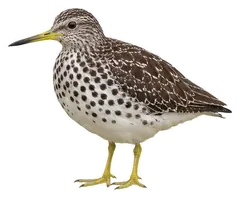 Nordmann's GreenshankTringa guttifer
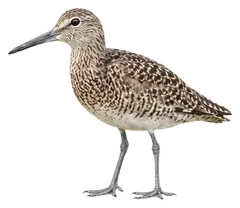 WilletTringa semipalmata
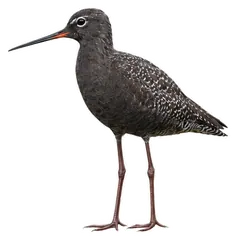 Spotted RedshankTringa erythropus
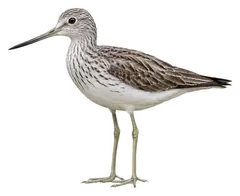 Common GreenshankTringa nebularia
 Greater YellowlegsTringa melanoleuca
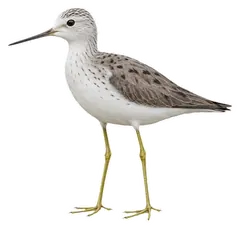
Download illustration
Free to use with credit: “Illustration: Field Stickers”. AI-generated. Its appearance was checked against a reference photo by JJ Harrison (https://www.jjharrison.com.au/); the pose follows our standard. ↗
