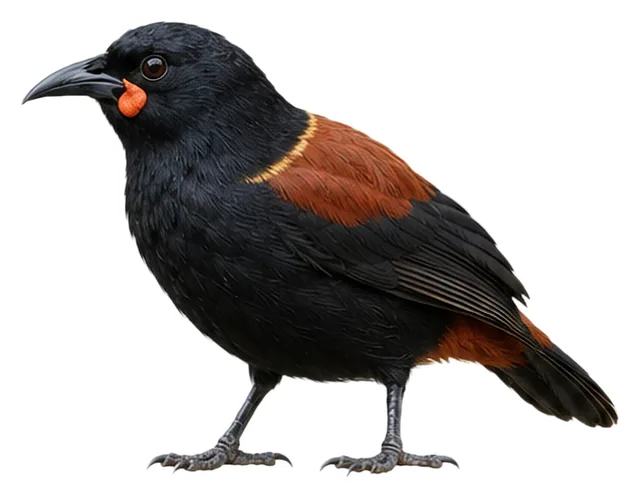
North Island Saddleback
Philesturnus rufusater (Lesson, RP, 1828)
25 cmLength75 gWeight
The North Island saddleback (Philesturnus rufusater) is a forest-dwelling passerine bird species endemic to the North Island of New Zealand.
Busiest months: November · Most records: New Zealand
AI-generated illustration. It may contain mistakes. · How the stickers are made
Where and when it's recorded

North Island Saddleback has been recorded at 11 of the 8,171 birding hotspots we track, in 1 country or region.
Records by month Southern Hemisphere
Where it's recorded most
- Tiritiri MatangiNew Zealand1,665 records
- Zealandia Te Mara a Tane Wildlife SanctuaryNew Zealand1,387 records
- Tawharanui Regional ParkNew Zealand667 records
More places
- Tiritiri Matangi – Wattle TrackNew Zealand565 records
- Maungatautari – Southern Enclosure & Tautari WetlandNew Zealand279 records
- Rotokare Scenic ReserveNew Zealand247 records
- Zealandia – Lower DamNew Zealand215 records
- Kapiti Island LodgeNew Zealand128 records
- Shakespear Regional ParkNew Zealand90 records
- Tawharanui Regional Park – LagoonNew Zealand9 records
Countries and regions with the most records
eBird records via GBIF up to 2024-12-31. A record means someone listed it; more records partly mean more birders, not more birds.
About
The North Island saddleback (Philesturnus rufusater) is a forest-dwelling passerine bird species endemic to the North Island of New Zealand. It was once considered conspecific with the South Island saddleback. The IUCN lists the species as Near Threatened, while it is listed as a "relict" species in the New Zealand Threat Classification System.
Excerpt from Wikipedia, CC BY-SA 4.0 · authors · Read more on Wikipedia
Questions
How big is the North Island Saddleback?
The North Island Saddleback is about 25 cm long and weighs around 75 g.
Where does the North Island Saddleback live?
Its breeding range: Australasia: North Island, now mainly on satellites (New Zealand). It is most often recorded in New Zealand.
When is the best time to see the North Island Saddleback?
At the hotspots we track, it is recorded most in November (Southern Hemisphere).
Is the North Island Saddleback endangered?
The IUCN Red List classifies the North Island Saddleback as Near Threatened.
What does the North Island Saddleback eat?
Main food: Insects & other invertebrates.
What family is the North Island Saddleback in?
It belongs to the family New Zealand Wattlebirds (Callaeidae), order Passerines (Passeriformes).
At a glance
- Length
- 25 cm
- Weight
- 75 g
- Habitat
- Forest
- Diet
- Insects & other invertebrates
- Lifestyle
- Varied
- Migration
- Resident (barely migrates)
- Conservation
- Near Threatened
More measurements
- Wing
- 107 mm
- Tail
- 101 mm
- Bill
- 38 mm
- Tarsus
- 44 mm
Averages from the AVONET dataset; length from field guides where available.
Range
Australasia: North Island, now mainly on satellites (New Zealand)
Breeding range, IOC World Bird List 15.2
Classification
- Order
- Passerines Passeriformes
- Family
- New Zealand Wattlebirds Callaeidae
- Genus
- Philesturnus
Other birds in the genus Philesturnus
 South Island SaddlebackPhilesturnus carunculatus
 North Island KokakoCallaeas wilsoni
 WebP · 1070 px