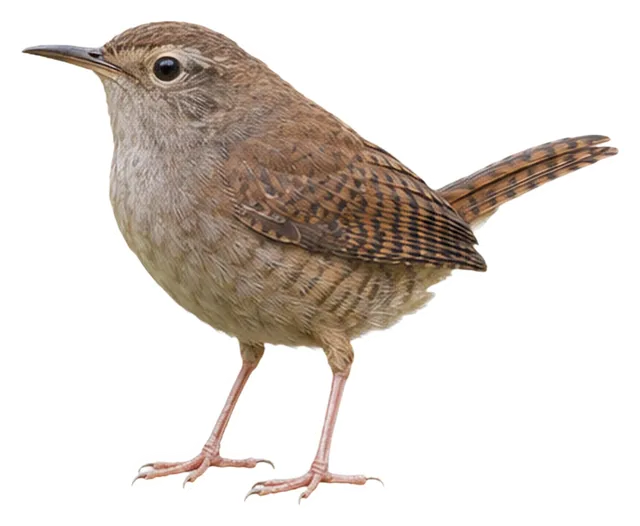
Northern House Wren
Troglodytes aedon Vieillot, 1809
11 gWeight
The northern house wren (Troglodytes aedon) is a very small passerine in the wren family Troglodytidae.
Busiest months: May · Most records: United States, Canada, Mexico
AI-generated illustration. It may contain mistakes. · How the stickers are made
Where and when it's recorded

Northern House Wren has been recorded at 773 of the 8,171 birding hotspots we track, in 6 countries and regions.
Records by month Northern Hemisphere
Where it's recorded most
- Magee Marsh – BoardwalkUnited States27,938 records
- Point Pelee National ParkCanada16,410 records
- Prospect ParkUnited States11,195 records
More places
- Estero Llano Grande SP WBCUnited States10,349 records
- John Heinz NWR – impoundmentUnited States10,165 records
- Montrose Point Bird Sanctuary, Lincoln Park, ChicagoUnited States10,160 records
- Long Point – LPBO Old Cut Field StationCanada7,102 records
- Schlitz Audubon Nature CenterUnited States6,894 records
- Huntington Central Park – EastUnited States6,508 records
- Santa Ana NWRUnited States6,340 records
Countries and regions with the most records
eBird records via GBIF up to 2024-12-31. A record means someone listed it; more records partly mean more birders, not more birds.
About
The northern house wren (Troglodytes aedon) is a very small passerine in the wren family Troglodytidae. It is found in southern Canada, the USA and Mexico. It occurs in most suburban areas in its range.
Excerpt from Wikipedia, CC BY-SA 4.0 · authors · Read more on Wikipedia
Questions
How big is the Northern House Wren?
The Northern House Wren weighs around 11 g.
Where does the Northern House Wren live?
Its breeding range: North America, Middle America: southern Canada and western, central, eastern USA to central, southern Mexico. It is most often recorded in United States, Canada and Mexico.
When is the best time to see the Northern House Wren?
At the hotspots we track, it is recorded most in May (Northern Hemisphere).
Is the Northern House Wren endangered?
The IUCN Red List classifies the Northern House Wren as Least Concern.
What does the Northern House Wren eat?
Main food: Insects & other invertebrates.
What family is the Northern House Wren in?
It belongs to the family Wrens (Troglodytidae), order Passerines (Passeriformes).
At a glance
- Weight
- 11 g
- Habitat
- Shrubland
- Diet
- Insects & other invertebrates
- Lifestyle
- Perches in trees
- Migration
- Resident (barely migrates)
- Conservation
- Least Concern
More measurements
- Wing
- 51 mm
- Tail
- 41 mm
- Bill
- 16 mm
- Tarsus
- 20 mm
Averages from the AVONET dataset; length from field guides where available.
Range
North America, Middle America: southern Canada and western, central, eastern USA to central, southern Mexico
Breeding range, IOC World Bird List 15.2
Classification
- Order
- Passerines Passeriformes
- Family
- Wrens Troglodytidae
- Genus
- Troglodytes
Other birds in the genus Troglodytes
 Eurasian WrenTroglodytes troglodytes
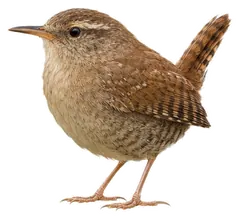 Winter WrenTroglodytes hiemalis
 Pacific WrenTroglodytes pacificus
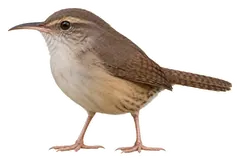 Clarion WrenTroglodytes tanneri
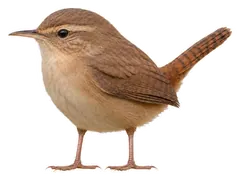 Southern House WrenTroglodytes musculus
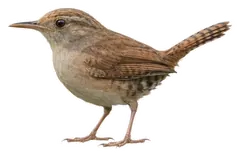 Cozumel WrenTroglodytes beani
 Kalinago WrenTroglodytes martinicensis
 St. Lucia WrenTroglodytes mesoleucus
 St. Vincent WrenTroglodytes musicus
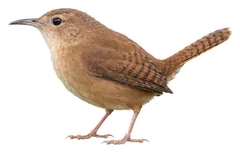 Grenada WrenTroglodytes grenadensis
 Cobb's WrenTroglodytes cobbi
 Socorro WrenTroglodytes sissonii
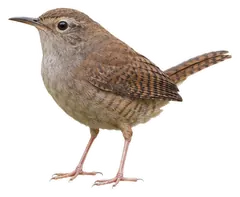
Download illustration
Free to use with credit: “Illustration: Field Stickers”. AI-generated. Its appearance was checked against a reference photo by Juan Miguel Artigas Azas; the pose follows our standard. ↗