Oriental Stork
Ciconia boyciana Swinhoe, 1873
100–129 cmLength198 cmWingspan4.8 kgWeight
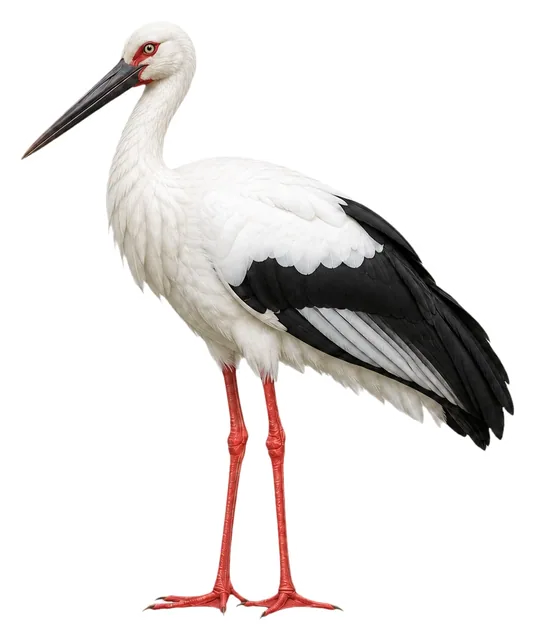
This large stork has a white body, black wings, red skin around the eye and a black bill.
Busiest months: December · Most records: China, Russia, South Korea
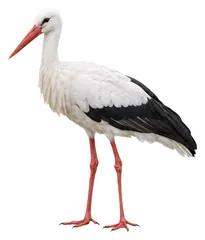
Looks like White Stork
AI-generated illustration. It may contain mistakes. · How the stickers are made
How to identify
Field marks
- Body white; wings black
- Red skin around the eye; iris white
- Bill black
- Usually larger than White Stork; body length over 1 m
Male, female and young
Sexes similar; female slightly smaller; juvenile white with an orange bill.
Similar species
Where and when it's recorded

Oriental Stork has been recorded at 280 of the 8,171 birding hotspots we track, in 5 countries and regions.
Records by month Northern Hemisphere
To protect this bird from disturbance, we don't list exact sites.
Countries and regions with the most records
eBird records via GBIF up to 2024-12-31. A record means someone listed it; more records partly mean more birders, not more birds.
About
The Oriental stork (Ciconia boyciana; traditional Chinese: 東方白鸛; simplified Chinese: 东方白鹳; pinyin: dōngfāng bái guàn; Japanese: コウノトリ Kounotori; Korean: 황새 Hwangsae) is a large, white bird with black-feathered wings in the stork family Ciconiidae.
Excerpt from Wikipedia, CC BY-SA 4.0 · authors · Read more on Wikipedia
Questions
How big is the Oriental Stork?
The Oriental Stork is about 100–129 cm long, with a wingspan of 198 cm and weighs around 4.8 kg.
Where does the Oriental Stork live?
Its breeding range: Palearctic: southeastern Siberia, northeastern China, Korea, Japan. It is most often recorded in China, Russia and South Korea.
When is the best time to see the Oriental Stork?
At the hotspots we track, it is recorded most in December (Northern Hemisphere).
Is the Oriental Stork endangered?
The IUCN Red List classifies the Oriental Stork as Endangered.
What does the Oriental Stork eat?
Main food: Fish, shrimp & shellfish.
What family is the Oriental Stork in?
It belongs to the family Storks (Ciconiidae), order Ciconiiformes.
How do you identify the Oriental Stork?
Body white; wings black. Red skin around the eye; iris white. Bill black.
How do male and female Oriental Stork differ?
Sexes similar; female slightly smaller; juvenile white with an orange bill.
How do you tell the Oriental Stork from the White Stork?
Oriental Stork is usually larger, with red skin around the eye, a white iris and a black bill.
At a glance
- Length
- 100–129 cm
- Wingspan
- 198 cm
- Weight
- 4.8 kg
- Habitat
- Wetland
- Diet
- Fish, shrimp & shellfish
- Lifestyle
- Active on the ground
- Migration
- Migratory
- Conservation
- Endangered
More measurements
- Wing
- 602 mm
- Tail
- 228 mm
- Bill
- 225 mm
- Tarsus
- 254 mm
Averages from the AVONET dataset; length from field guides where available.
Range
Palearctic: southeastern Siberia, northeastern China, Korea, Japan
Breeding range, IOC World Bird List 15.2
Classification
- Order
- Ciconiiformes
- Family
- Storks Ciconiidae
- Genus
- Ciconia
Other birds in the genus Ciconia
 Abdim's StorkCiconia abdimii
 African Woolly-necked StorkCiconia microscelis
 Asian Woolly-necked StorkCiconia episcopus
 Storm's StorkCiconia stormi
 Black StorkCiconia nigra
 Maguari StorkCiconia maguari
 White StorkCiconia ciconia
 African OpenbillAnastomus lamelligerus
 Asian OpenbillAnastomus oscitans
 Marabou StorkLeptoptilos crumenifer
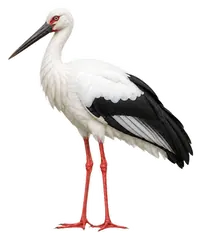
Download illustration
Free to use with credit: “Illustration: Field Stickers”. AI-generated. Its appearance was checked against a reference photo by an uncredited photographer; the pose follows our standard. ↗
