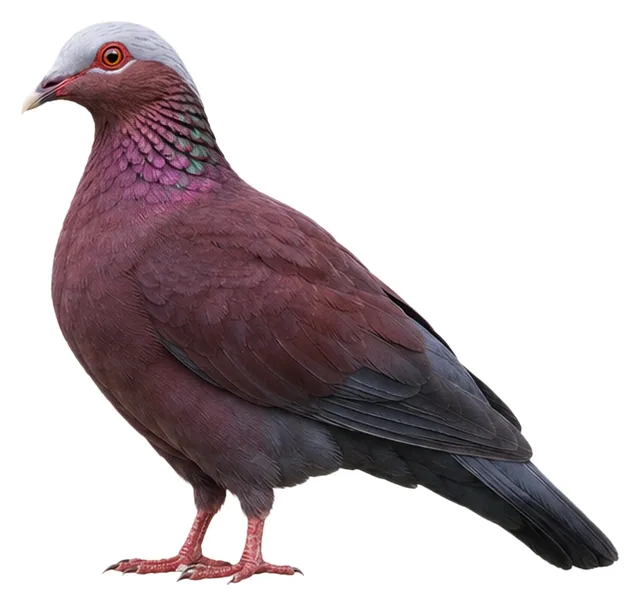
Pale-capped Pigeon
Columba punicea Blyth, 1842
≈40 cmLength434 gWeight
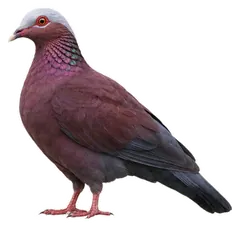
It is a large dark chestnut-brown pigeon with a pale crown.
Busiest months: March and December · Most records: India, Cambodia, China
AI-generated illustration. It may contain mistakes. · How the stickers are made
How to identify
Field marks
- Dark chestnut-brown overall, with pale crown
- Legs and feet dark red
- Iris creamy yellow
- Skin around the eye magenta
Male, female and young
Male has a grayish-white crown; female has a brownish-gray crown and feathers with a weaker metallic gloss; juvenile initially has the crown the same color as the upper back.
Voice
Reportedly gives low calls similar to those of Ducula aenea, but shorter and less drawn out.
Where and when it's recorded

Pale-capped Pigeon has been recorded at 34 of the 8,171 birding hotspots we track, in 7 countries and regions.
Records by month Northern Hemisphere
To protect this bird from disturbance, we don't list exact sites.
Countries and regions with the most records
eBird records via GBIF up to 2024-12-31. A record means someone listed it; more records partly mean more birders, not more birds.
About
The pale-capped pigeon (Columba punicea), also known as the purple wood pigeon, is a species of large pigeon that is found patchily distributed in parts of the Indian subcontinent and Southeast Asia. It has a slow flight and spends a lot of time sitting still in the foliage of large fruiting trees, often in riverine forest on the plains.
Excerpt from Wikipedia, CC BY-SA 4.0 · authors · Read more on Wikipedia
Questions
How big is the Pale-capped Pigeon?
The Pale-capped Pigeon is about ≈40 cm long and weighs around 434 g.
Where does the Pale-capped Pigeon live?
Its breeding range: Oriental: northeastern India through Southeast Asia. It is most often recorded in India, Cambodia and China.
When is the best time to see the Pale-capped Pigeon?
At the hotspots we track, it is recorded most in March and December (Northern Hemisphere).
Is the Pale-capped Pigeon endangered?
The IUCN Red List classifies the Pale-capped Pigeon as Vulnerable.
What does the Pale-capped Pigeon eat?
Main food: Fruit.
What family is the Pale-capped Pigeon in?
It belongs to the family Pigeons, Doves (Columbidae), order Columbiformes.
At a glance
- Length
- ≈40 cm
- Weight
- 434 g
- Habitat
- Forest
- Diet
- Fruit
- Lifestyle
- Active on the ground
- Migration
- Resident (barely migrates)
- Conservation
- Vulnerable
More measurements
- Wing
- 220 mm
- Tail
- 141 mm
- Bill
- 24 mm
- Tarsus
- 26 mm
Averages from the AVONET dataset; length from field guides where available.
Range
Oriental: northeastern India through Southeast Asia
Breeding range, IOC World Bird List 15.2
Classification
- Order
- Columbiformes
- Family
- Pigeons, Doves Columbidae
- Genus
- Columba
Other birds in the genus Columba
 Rock DoveColumba livia
 Hill PigeonColumba rupestris
 Snow PigeonColumba leuconota
 Speckled PigeonColumba guinea
 White-collared PigeonColumba albitorques
 Stock DoveColumba oenas
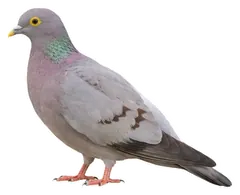 Yellow-eyed PigeonColumba eversmanni
 Somali PigeonColumba oliviae
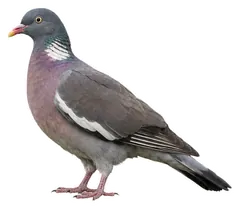 Common Wood PigeonColumba palumbus
 Trocaz PigeonColumba trocaz
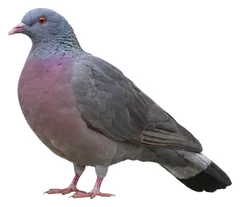 Bolle's PigeonColumba bollii
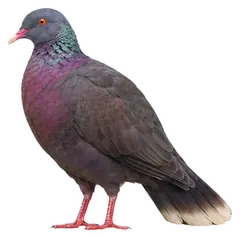 Laurel PigeonColumba junoniae
Download illustration
Free to use with credit: “Illustration: Field Stickers”. AI-generated. Its appearance was checked against a reference photo by Dipak Sinha; the pose follows our standard. ↗