Pallas's Fish Eagle
Haliaeetus leucoryphus (Pallas, 1771)
72–85 cmLength200 cmWingspan2.9 kgWeight
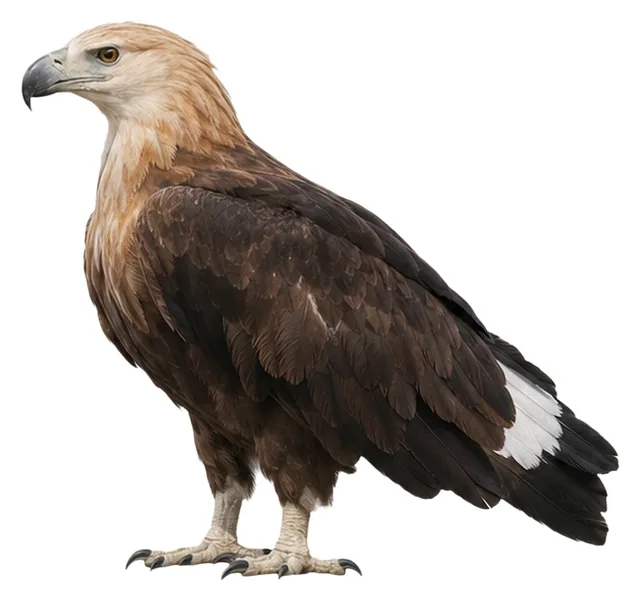
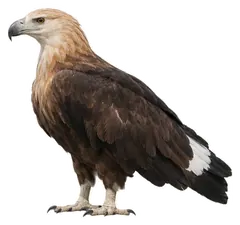
This large rufous sea eagle has a conspicuous single broad white band across its black tail.
Busiest months: February–March · Most records: India, Mongolia, Bhutan
AI-generated illustration. It may contain mistakes. · How the stickers are made
How to identify
Field marks
- Head and neck pale sandy-brown, face whitish
- Tail black, with a single broad white band
- Back rusty, wings dark brown
- Wings long and narrow, with darker brown underwings
Male, female and young
Female slightly larger than male; juvenile darker and colder brown, with no white tail band but a white band on underwing, taking about four years to acquire adult plumage.
Where and when it's recorded

Pallas's Fish Eagle has been recorded at 85 of the 8,171 birding hotspots we track, in 11 countries and regions.
Records by month Northern Hemisphere
To protect this bird from disturbance, we don't list exact sites.
Countries and regions with the most records
eBird records via GBIF up to 2024-12-31. A record means someone listed it; more records partly mean more birders, not more birds.
About
Pallas's fish eagle (Haliaeetus leucoryphus), also known as Pallas's sea eagle or band-tailed fish eagle, is a large, brownish sea eagle. It breeds in the east Palearctic in Kazakhstan, Russia, Tajikistan, Turkmenistan, Uzbekistan, Mongolia, China, India, Nepal, Bangladesh, Myanmar and Bhutan. It is listed as Endangered on the IUCN Red List.
Excerpt from Wikipedia, CC BY-SA 4.0 · authors · Read more on Wikipedia
Questions
How big is the Pallas's Fish Eagle?
The Pallas's Fish Eagle is about 72–85 cm long, with a wingspan of 200 cm and weighs around 2.9 kg.
Where does the Pallas's Fish Eagle live?
Its breeding range: Palearctic: central, also northern India. It is most often recorded in India, Mongolia and Bhutan.
When is the best time to see the Pallas's Fish Eagle?
At the hotspots we track, it is recorded most in February and March (Northern Hemisphere).
Is the Pallas's Fish Eagle endangered?
The IUCN Red List classifies the Pallas's Fish Eagle as Endangered.
What does the Pallas's Fish Eagle eat?
Main food: Fish, shrimp & shellfish.
What family is the Pallas's Fish Eagle in?
It belongs to the family Kites, Hawks, Eagles (Accipitridae), order Accipitriformes.
How do you identify the Pallas's Fish Eagle?
Head and neck pale sandy-brown, face whitish. Tail black, with a single broad white band. Back rusty, wings dark brown.
How do male and female Pallas's Fish Eagle differ?
Female slightly larger than male; juvenile darker and colder brown, with no white tail band but a white band on underwing, taking about four years to acquire adult plumage.
At a glance
- Length
- 72–85 cm
- Wingspan
- 200 cm
- Weight
- 2.9 kg
- Habitat
- Wetland
- Diet
- Fish, shrimp & shellfish
- Lifestyle
- Feeds in the air
- Migration
- Migratory
- Conservation
- Endangered
More measurements
- Wing
- 567 mm
- Tail
- 290 mm
- Bill
- 64 mm
- Tarsus
- 95 mm
Averages from the AVONET dataset; length from field guides where available.
Range
Palearctic: central, also northern India
Breeding range, IOC World Bird List 15.2
Classification
- Order
- Accipitriformes
- Family
- Kites, Hawks, Eagles Accipitridae
- Genus
- Haliaeetus
Other birds in the genus Haliaeetus
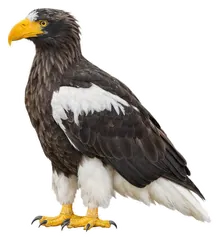 Steller's Sea EagleHaliaeetus pelagicus
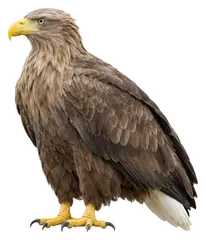 White-tailed EagleHaliaeetus albicilla
 Bald EagleHaliaeetus leucocephalus
 Pearl KiteGampsonyx swainsonii
 Scissor-tailed KiteChelictinia riocourii
 White-tailed KiteElanus leucurus
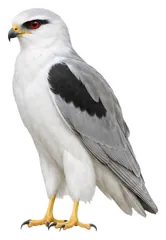 Black-winged KiteElanus caeruleus
 Black-shouldered KiteElanus axillaris
 Letter-winged KiteElanus scriptus
 African Harrier-HawkPolyboroides typus
Download illustration
Free to use with credit: “Illustration: Field Stickers”. AI-generated. Its appearance was checked against a reference photo by Вадим Ивушкин; the pose follows our standard. ↗
In other languages
- EnglishPallas's Fish Eagle
- 简体中文玉带海雕
- 繁體中文玉帶海鵰
- 日本語キガシラウミワシ
- 한국어팔라스바다수리
- DeutschBindenseeadler
- FrançaisPygargue de Pallas
- EspañolPigargo de Pallas
- Portuguêspigargo-de-cauda-barrada
- ItalianoAquila di mare di Pallas
- NederlandsWitbandzeearend
- РусскийОрлан-долгохвост
- Svenskabandhavsörn
- DanskPalla´ Havørn
- Polskibielik wschodni