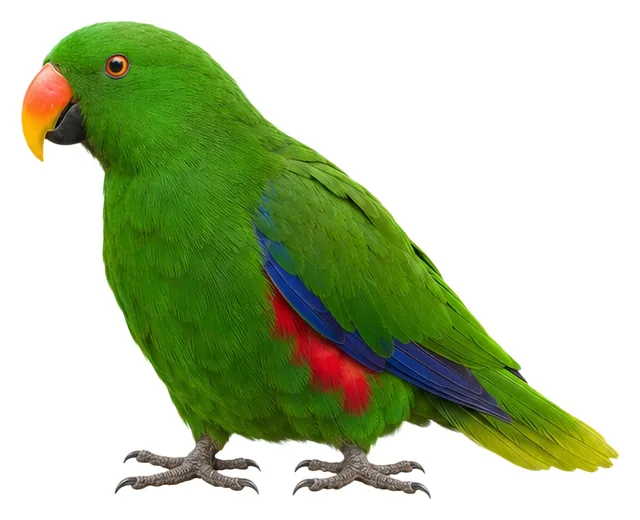
Papuan Eclectus
Eclectus polychloros (Scopoli, 1786)
481 gWeight
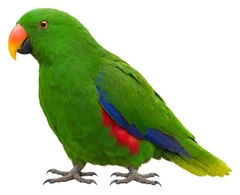
The Papuan eclectus, red-sided eclectus, or New Guinea eclectus (Eclectus polychloros) is a parrot species which is native to New Guinea.
Busiest months: July–August · Most records: Papua New Guinea, Indonesia, Palau
This sticker was generated from a written description only, without a reference photo, so it is more likely to contain mistakes than the others. Check a field guide for details.
AI-generated illustration. It may contain mistakes. · How the stickers are made
Where and when it's recorded

Papuan Eclectus has been recorded at 67 of the 8,171 birding hotspots we track, in 6 countries and regions.
Records by month Southern Hemisphere
Where it's recorded most
- Varirata National ParkPapua New Guinea502 records
- West Waigeo birding roadIndonesia340 records
- Pacific Adventist UniversityPapua New Guinea232 records
More places
- Kulu RiverPapua New Guinea187 records
- MalagufukIndonesia184 records
- Kwatu LodgePapua New Guinea170 records
- Airport BayIndonesia170 records
- West Waigeo forest - Red and Wilson's BOP sites areaIndonesia144 records
- Walindi Dive ResortPapua New Guinea143 records
- Garu WMAPapua New Guinea135 records
Countries and regions with the most records
eBird records via GBIF up to 2024-12-31. A record means someone listed it; more records partly mean more birders, not more birds.
About
The Papuan eclectus, red-sided eclectus, or New Guinea eclectus (Eclectus polychloros) is a parrot species which is native to New Guinea. Larger than the Moluccan eclectus, the green plumage of the male only has a slight yellow tinge and the tail is tipped with a half-inch yellow band. The central tail feathers are green and lateral ones blue and green.
Excerpt from Wikipedia, CC BY-SA 4.0 · authors · Read more on Wikipedia
Questions
How big is the Papuan Eclectus?
The Papuan Eclectus weighs around 481 g.
Where does the Papuan Eclectus live?
Its breeding range: Australasia: Kai Islands (southeastern Moluccas), New Guinea, Bismarck Archipelago, Solomon Islands, and northeastern Australia. It is most often recorded in Papua New Guinea, Indonesia and Palau.
When is the best time to see the Papuan Eclectus?
At the hotspots we track, it is recorded most in July and August (Southern Hemisphere).
Is the Papuan Eclectus endangered?
The IUCN Red List classifies the Papuan Eclectus as Least Concern.
What does the Papuan Eclectus eat?
Main food: Omnivore.
What family is the Papuan Eclectus in?
It belongs to the family Old World Parrots (Psittaculidae), order Parrot (Psittaciformes).
At a glance
- Weight
- 481 g
- Habitat
- Forest
- Diet
- Omnivore
- Lifestyle
- Perches in trees
- Migration
- Resident (barely migrates)
- Conservation
- Least Concern
More measurements
- Wing
- 228 mm
- Tail
- 115 mm
- Bill
- 40 mm
- Tarsus
- 22 mm
Averages from the AVONET dataset; length from field guides where available.
Range
Australasia: Kai Islands (southeastern Moluccas), New Guinea, Bismarck Archipelago, Solomon Islands, and northeastern Australia
Breeding range, IOC World Bird List 15.2
Classification
- Order
- Parrot Psittaciformes
- Family
- Old World Parrots Psittaculidae
- Genus
- Eclectus
Other birds in the genus Eclectus
 Moluccan EclectusEclectus roratus
 Sumba EclectusEclectus cornelia
 Tanimbar EclectusEclectus riedeli
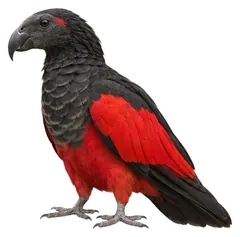 Pesquet's ParrotPsittrichas fulgidus
 Greater Vasa ParrotCoracopsis vasa
 Seychelles Black ParrotCoracopsis barklyi
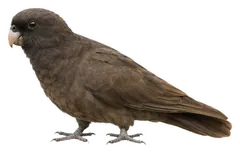 Comoro Black ParrotCoracopsis sibilans
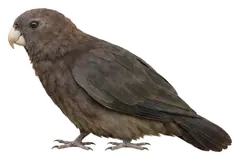 Lesser Vasa ParrotCoracopsis nigra
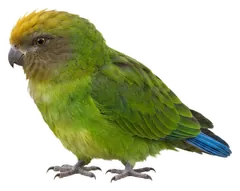 Yellow-capped Pygmy ParrotMicropsitta keiensis
 Geelvink Pygmy ParrotMicropsitta geelvinkiana
Download illustration
Free to use with credit: “Illustration: Field Stickers”. AI-generated from a written description only; no reference photo was used.