
Red-billed Blue Magpie
Urocissa erythroryncha (Boddaert, 1783)
53–68 cmLength152 gWeight
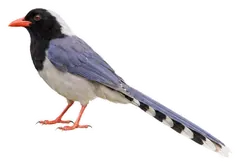
It has a red bill and red feet, with an exceptionally long, purple-blue tail tipped white.
Busiest months: February–March and December · Most records: China, India, Nepal
AI-generated illustration. It may contain mistakes. · How the stickers are made
How to identify
Field marks
- Bill bright orange-red; legs and feet orange-red; red ring around the eye
- Head, neck and breast black, with a blue patch on the crown
- Long tail purple-blue with a broad white tip
- Scapulars and rump dark purple-blue
Voice
Calls are varied; the most often heard are grating trills and high-pitched, flute-like whistles.
Where and when it's recorded

Red-billed Blue Magpie has been recorded at 193 of the 8,171 birding hotspots we track, in 8 countries and regions.
Records by month Northern Hemisphere
Where it's recorded most
- SattalIndia1,454 records
- Mai Po Nature ReserveHong Kong (China)1,157 records
- TmatboeyCambodia865 records
More places
- Forest Research Institute (FRI), New Forest CampusIndia658 records
- PangotIndia483 records
- Lam Tsuen ValleyHong Kong (China)439 records
- Mt. Phulchowki - Lowest Few Miles of RoadNepal426 records
- Lai Chi KokHong Kong (China)424 records
- Long ValleyHong Kong (China)375 records
- Nam Nao NP – visitor center & campgrounds vicinityThailand346 records
Countries and regions with the most records
eBird records via GBIF up to 2024-12-31. A record means someone listed it; more records partly mean more birders, not more birds.
About
The red-billed blue magpie (Urocissa erythroryncha) is a species of bird (magpie) in the crow family, Corvidae. It is about the same size as the Eurasian magpie, but has a much longer tail, one of the longest of any corvid.
Excerpt from Wikipedia, CC BY-SA 4.0 · authors · Read more on Wikipedia
Questions
How big is the Red-billed Blue Magpie?
The Red-billed Blue Magpie is about 53–68 cm long and weighs around 152 g.
Where does the Red-billed Blue Magpie live?
Its breeding range: Oriental: Himalayas, Southeast Asia. It is most often recorded in China, India and Nepal.
When is the best time to see the Red-billed Blue Magpie?
At the hotspots we track, it is recorded most in February, March and December (Northern Hemisphere).
Is the Red-billed Blue Magpie endangered?
The IUCN Red List classifies the Red-billed Blue Magpie as Least Concern.
What does the Red-billed Blue Magpie eat?
Main food: Omnivore.
What family is the Red-billed Blue Magpie in?
It belongs to the family Crows, Jays (Corvidae), order Passerines (Passeriformes).
How do you identify the Red-billed Blue Magpie?
Bill bright orange-red; legs and feet orange-red; red ring around the eye. Head, neck and breast black, with a blue patch on the crown. Long tail purple-blue with a broad white tip.
At a glance
- Length
- 53–68 cm
- Weight
- 152 g
- Habitat
- Forest
- Diet
- Omnivore
- Lifestyle
- Perches in trees
- Migration
- Resident (barely migrates)
- Conservation
- Least Concern
More measurements
- Wing
- 181 mm
- Tail
- 366 mm
- Bill
- 39 mm
- Tarsus
- 45 mm
Averages from the AVONET dataset; length from field guides where available.
Range
Oriental: Himalayas, Southeast Asia
Breeding range, IOC World Bird List 15.2
Subspecies · 3
- Urocissa erythroryncha alticola n Myanmar and sc China
- Urocissa erythroryncha brevivexilla ne China
- Urocissa erythroryncha erythroryncha c, e, se China, n Indochina
Classification
- Order
- Passerines Passeriformes
- Family
- Crows, Jays Corvidae
- Genus
- Urocissa
Other birds in the genus Urocissa
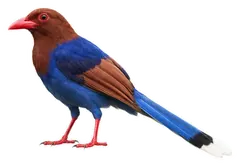 Sri Lanka Blue MagpieUrocissa ornata
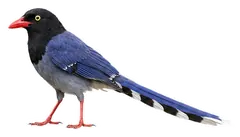 Taiwan Blue MagpieUrocissa caerulea
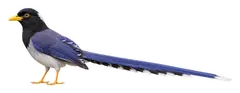 Yellow-billed Blue MagpieUrocissa flavirostris
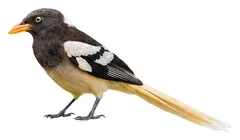 White-winged MagpieUrocissa whiteheadi
 Malayan Black MagpiePlatysmurus leucopterus
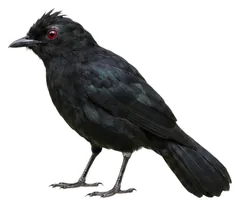 Bornean Black MagpiePlatysmurus aterrimus
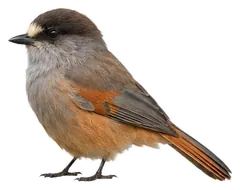 Siberian JayPerisoreus infaustus
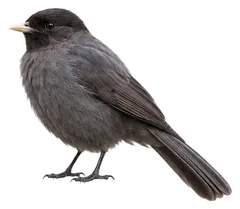 Sichuan JayPerisoreus internigrans
 Canada JayPerisoreus canadensis
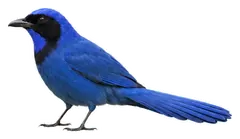 Black-collared JayCyanolyca armillata
Download illustration
Free to use with credit: “Illustration: Field Stickers”. AI-generated. Its appearance was checked against a reference photo by Charles Lam; the pose follows our standard. ↗

In other languages
- EnglishRed-billed Blue Magpie
- 简体中文红嘴蓝鹊
- 繁體中文紅嘴藍鵲
- 日本語サンジャク
- DeutschRotschnabelkitta
- FrançaisPirolle à bec rouge
- EspañolUrraca piquirroja
- Portuguêspega-azul-de-bico-vermelho
- ItalianoGazza blu
- NederlandsRoodsnavelkitta
- РусскийКрасноклювая лазоревая сорока
- Svenskarödnäbbad blåskata
- DanskRødnæbbet Kitta
- Polskikitta czerwonodzioba