
Red-necked Crake
Rallina tricolor Gray, GR, 1858
178 gWeight
The red-necked crake (Rallina tricolor) is a waterbird in the rail and crake family, Rallidae.
Busiest months: November · Most records: Australia, Indonesia, Papua New Guinea
AI-generated illustration. It may contain mistakes. · How the stickers are made
Where and when it's recorded

Red-necked Crake has been recorded at 29 of the 8,171 birding hotspots we track, in 3 countries and regions.
Records by month Southern Hemisphere
Where it's recorded most
- Kingfisher Park Birdwatchers LodgeAustralia569 records
- Kingfisher Park Birdwatchers Lodge – Morning WalkAustralia71 records
- Cairns Botanical Gardens and Centenary LakesAustralia66 records
More places
- Crater Lakes National Park – Lake BarrineAustralia49 records
- JulattenAustralia44 records
- West Waigeo birding roadIndonesia28 records
- Daintree Village Boat CruiseAustralia23 records
- Malagufuk villageIndonesia20 records
- Crater Lakes National Park – Chambers Rainforest LodgeAustralia16 records
- West Waigeo forest - Red and Wilson's BOP sites areaIndonesia16 records
Countries and regions with the most records
eBird records via GBIF up to 2024-12-31. A record means someone listed it; more records partly mean more birders, not more birds.
About
The red-necked crake (Rallina tricolor) is a waterbird in the rail and crake family, Rallidae.
Excerpt from Wikipedia, CC BY-SA 4.0 · authors · Read more on Wikipedia
Questions
How big is the Red-necked Crake?
The Red-necked Crake weighs around 178 g.
Where does the Red-necked Crake live?
Its breeding range: Australasia: Talaud Islands (northeast of northeastern Sulawesi), northern, southern Moluccas, New Guinea and satellites, Mussau, Lavongai (=New Hanover), New Ireland (northeastern Bismarck Archipelago) and northeastern Cape York Peninsula, northeastern Queensland (northeastern Australia). It is most often recorded in Australia, Indonesia and Papua New Guinea.
When is the best time to see the Red-necked Crake?
At the hotspots we track, it is recorded most in November (Southern Hemisphere).
Is the Red-necked Crake endangered?
The IUCN Red List classifies the Red-necked Crake as Least Concern.
What does the Red-necked Crake eat?
Main food: Fish, shrimp & shellfish.
What family is the Red-necked Crake in?
It belongs to the family Rails, Crakes & Coots (Rallidae), order Gruiformes.
At a glance
- Weight
- 178 g
- Habitat
- Forest
- Diet
- Fish, shrimp & shellfish
- Lifestyle
- Active on the ground
- Migration
- Resident (barely migrates)
- Conservation
- Least Concern
More measurements
- Wing
- 134 mm
- Tail
- 60 mm
- Bill
- 33 mm
- Tarsus
- 49 mm
Averages from the AVONET dataset; length from field guides where available.
Range
Australasia: Talaud Islands (northeast of northeastern Sulawesi), northern, southern Moluccas, New Guinea and satellites, Mussau, Lavongai (=New Hanover), New Ireland (northeastern Bismarck Archipelago) and northeastern Cape York Peninsula, northeastern Queensland (northeastern Australia)
Breeding range, IOC World Bird List 15.2
Classification
- Order
- Gruiformes
- Family
- Rails, Crakes & Coots Rallidae
- Genus
- Rallina
Other birds in the genus Rallina
 Slaty-legged CrakeRallina eurizonoides
 Andaman CrakeRallina canningi
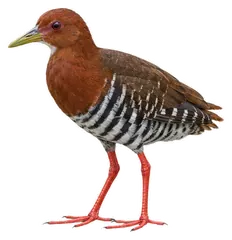 Red-legged CrakeRallina fasciata
 Grey-throated RailCanirallus oculeus
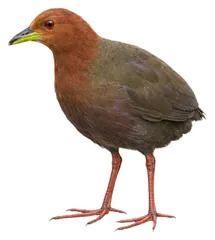 Chestnut-headed CrakeAnurolimnas castaneiceps
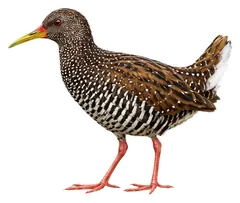 Spotted RailPardirallus maculatus
 Blackish RailPardirallus nigricans
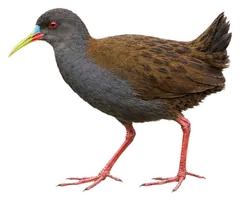 Plumbeous RailPardirallus sanguinolentus
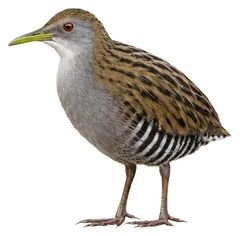 Ash-throated CrakeMustelirallus albicollis
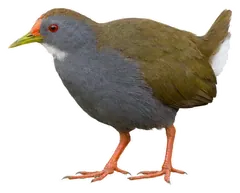 Zapata RailMustelirallus cerverai
 WebP · 1070 px
In other languages
- EnglishRed-necked Crake
- 简体中文红颈秧鸡
- 繁體中文紅頸秧雞
- 日本語ミナミオオクイナ
- DeutschDreifarbenralle
- FrançaisRâle tricolore
- EspañolPolluela tricolor
- Portuguêsfranga-de-água-tricolor
- ItalianoRallina collorosso
- NederlandsDriekleurige Ral
- РусскийТрёхцветный пастушок
- Svenskatrefärgad sumphöna
- DanskGrønnæbbet Kastanjerikse
- Polskikureczka ognistogłowa