
Red-throated Loon
Gavia stellata (Pontoppidan, 1763)
55–67 cmLength104 cmWingspan1.5 kgWeight
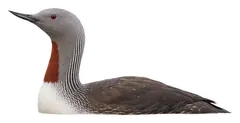
The smallest loon, it has a gray head, red throat and white belly in the breeding season.
Busiest months: November · Most records: United States, Canada, United Kingdom
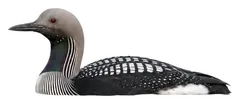
Looks like Black-throated Loon
This sticker was generated from a written description only, without a reference photo, so it is more likely to contain mistakes than the others. Check a field guide for details.
AI-generated illustration. It may contain mistakes. · How the stickers are made
How to identify
Field marks
- Triangular red patch on the throat in the breeding season
- Head and neck gray and belly white in the breeding season
- Bill slender, straight and pointed, often slightly upturned
- Face and front of neck whitish in winter plumage
Male, female and young
Sexes similar in appearance, with male slightly larger and heavier; juvenile densely spotted on the side of neck and throat, with a pale gray bill.
Voice
Gives rapid, goose-like “kaa-kaa-kaa” or “kak-kak-kak” calls in flight.
Similar species
Where and when it's recorded

Red-throated Loon has been recorded at 960 of the 8,171 birding hotspots we track, in 54 countries and regions.
Records by month Northern Hemisphere
Where it's recorded most
- Pt. Pinos – seawatch onlyUnited States10,103 records
- Ocean City InletUnited States6,417 records
- Parker River NWRUnited States5,872 records
More places
- Barnegat Lighthouse SPUnited States5,193 records
- Hammonasset Beach SPUnited States4,518 records
- Sandy HookUnited States4,160 records
- Quai, Pointe-au-PèreCanada3,953 records
- Cape Island – CMP – Coral Ave. dune crossingUnited States3,705 records
- Whitefish PointUnited States3,503 records
- Rodeo LagoonUnited States3,321 records
Countries and regions with the most records
eBird records via GBIF up to 2024-12-31. A record means someone listed it; more records partly mean more birders, not more birds.
About
The red-throated loon (North America) or red-throated diver (Britain and Ireland) (Gavia stellata) is a migratory aquatic bird found in the Northern Hemisphere. The most widely distributed member of the loon or diver family, it breeds primarily in Arctic regions, and it winters in northern coastal waters.
Excerpt from Wikipedia, CC BY-SA 4.0 · authors · Read more on Wikipedia
Questions
How big is the Red-throated Loon?
The Red-throated Loon is about 55–67 cm long, with a wingspan of 104 cm and weighs around 1.5 kg.
Where does the Red-throated Loon live?
Its breeding range: North America, Palearctic: high Arctic to subarctic: southwestern, southeastern Greenland, Iceland, Faroe Islands, northern British Isles, northern Scandinavia, Svalbard (north of Norway), northern Russia to Chukotka Peninsula, Kamchatka and Sakhalin and south to Lake Baikal (eastern Russia); Aleutian Islands, Alaska mainland to northwestern British Columbia, northern Canada to Ellesmere Island and Newfoundland (northeastern, southeastern Canada). It is most often recorded in United States, Canada and United Kingdom.
When is the best time to see the Red-throated Loon?
At the hotspots we track, it is recorded most in November (Northern Hemisphere).
Is the Red-throated Loon endangered?
The IUCN Red List classifies the Red-throated Loon as Least Concern.
What does the Red-throated Loon eat?
Main food: Fish, shrimp & shellfish.
What family is the Red-throated Loon in?
It belongs to the family Loons (Gaviidae), order Gaviiformes.
How do you identify the Red-throated Loon?
Triangular red patch on the throat in the breeding season. Head and neck gray and belly white in the breeding season. Bill slender, straight and pointed, often slightly upturned.
How do male and female Red-throated Loon differ?
Sexes similar in appearance, with male slightly larger and heavier; juvenile densely spotted on the side of neck and throat, with a pale gray bill.
How do you tell the Red-throated Loon from the Black-throated Loon?
They may be confused at a distance, during molt or in poor light; Red-throated Loon has more white on the head and neck, and often more white on the flanks when not sitting low in the water.
At a glance
- Length
- 55–67 cm
- Wingspan
- 104 cm
- Weight
- 1.5 kg
- Habitat
- Wetland
- Diet
- Fish, shrimp & shellfish
- Lifestyle
- On the water surface
- Migration
- Migratory
- Conservation
- Least Concern
More measurements
- Wing
- 275 mm
- Tail
- 46 mm
- Bill
- 63 mm
- Tarsus
- 66 mm
Averages from the AVONET dataset; length from field guides where available.
Range
North America, Palearctic: high Arctic to subarctic: southwestern, southeastern Greenland, Iceland, Faroe Islands, northern British Isles, northern Scandinavia, Svalbard (north of Norway), northern Russia to Chukotka Peninsula, Kamchatka and Sakhalin and south to Lake Baikal (eastern Russia); Aleutian Islands, Alaska mainland to northwestern British Columbia, northern Canada to Ellesmere Island and Newfoundland (northeastern, southeastern Canada)
Breeding range, IOC World Bird List 15.2
Classification
- Order
- Gaviiformes
- Family
- Loons Gaviidae
- Genus
- Gavia
Other birds in the genus Gavia
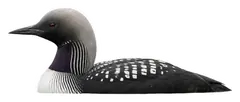 Pacific LoonGavia pacifica
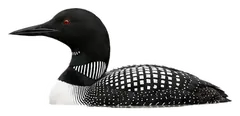 Common LoonGavia immer
 Yellow-billed LoonGavia adamsii
Download illustration
Free to use with credit: “Illustration: Field Stickers”. AI-generated from a written description only; no reference photo was used.