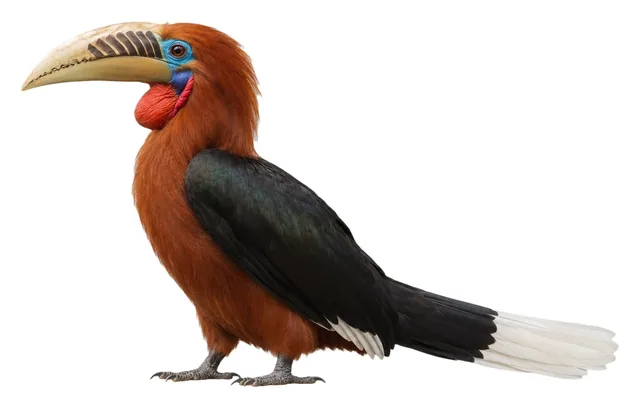
Rufous-necked Hornbill
Aceros nipalensis (Hodgson, 1829)
120 cmLength2.4 kgWeight
It has a large ivory-white bill and bare sky-blue skin on the cheeks.
Busiest months: April · Most records: India, Bhutan, Thailand
AI-generated illustration. It may contain mistakes. · How the stickers are made
How to identify
Field marks
- Large ivory-white bill without a casque
- Adults have black-and-white bands at the base of the upper mandible
- Sky-blue around the eye and on the cheeks
- Gular pouch red to golden orange-yellow
Male, female and young
The adult male has a rufous head, neck and underparts; these areas are black in the adult female.
Where and when it's recorded

Rufous-necked Hornbill has been recorded at 35 of the 8,171 birding hotspots we track, in 5 countries and regions.
Records by month Northern Hemisphere
To protect this bird from disturbance, we don't list exact sites.
Countries and regions with the most records
eBird records via GBIF up to 2024-12-31. A record means someone listed it; more records partly mean more birders, not more birds.
About
The rufous-necked hornbill (Aceros nipalensis) is a species of hornbill in Bhutan, northeastern India, especially in Arunachal Pradesh, Indian subcontinent and Southeast Asia. It is locally extinct in Nepal due to hunting and significant loss of habitat. There are less than 10,000 adults left in the wild.
Excerpt from Wikipedia, CC BY-SA 4.0 · authors · Read more on Wikipedia
Questions
How big is the Rufous-necked Hornbill?
The Rufous-necked Hornbill is about 120 cm long and weighs around 2.4 kg.
Where does the Rufous-necked Hornbill live?
Its breeding range: Oriental: northeastern India to western Thailand and northwestern Vietnam. It is most often recorded in India, Bhutan and Thailand.
When is the best time to see the Rufous-necked Hornbill?
At the hotspots we track, it is recorded most in April (Northern Hemisphere).
Is the Rufous-necked Hornbill endangered?
The IUCN Red List classifies the Rufous-necked Hornbill as Vulnerable.
What does the Rufous-necked Hornbill eat?
Main food: Fruit.
What family is the Rufous-necked Hornbill in?
It belongs to the family Hornbills (Bucerotidae), order Bucerotiformes.
How do you identify the Rufous-necked Hornbill?
Large ivory-white bill without a casque. Adults have black-and-white bands at the base of the upper mandible. Sky-blue around the eye and on the cheeks.
How do male and female Rufous-necked Hornbill differ?
The adult male has a rufous head, neck and underparts; these areas are black in the adult female.
At a glance
- Length
- 120 cm
- Weight
- 2.4 kg
- Habitat
- Forest
- Diet
- Fruit
- Lifestyle
- Perches in trees
- Migration
- Resident (barely migrates)
- Conservation
- Vulnerable
More measurements
- Wing
- 432 mm
- Tail
- 458 mm
- Bill
- 204 mm
- Tarsus
- 75 mm
Averages from the AVONET dataset; length from field guides where available.
Range
Oriental: northeastern India to western Thailand and northwestern Vietnam
Breeding range, IOC World Bird List 15.2
Classification
- Order
- Bucerotiformes
- Family
- Hornbills Bucerotidae
- Genus
- Aceros
More from the family Hornbills
 Abyssinian Ground HornbillBucorvus abyssinicus
 Southern Ground HornbillBucorvus leadbeateri
 Tanzanian Red-billed HornbillTockus ruahae
 Western Red-billed HornbillTockus kempi
 Damara Red-billed HornbillTockus damarensis
 Southern Red-billed HornbillTockus rufirostris
 Northern Red-billed HornbillTockus erythrorhynchus
 Monteiro's HornbillTockus monteiri
 Von der Decken's HornbillTockus deckeni
 Jackson's HornbillTockus jacksoni

Download illustration
Free to use with credit: “Illustration: Field Stickers”. AI-generated. Its appearance was checked against a reference photo by an uncredited photographer; the pose follows our standard. ↗
In other languages
- EnglishRufous-necked Hornbill
- 简体中文棕颈犀鸟
- 繁體中文棕頸犀鳥
- 日本語ナナミゾサイチョウ
- DeutschNepalhornvogel
- FrançaisCalao à cou roux
- EspañolCálao del Nepal
- Portuguêscalau-de-pescoço-ruivo
- ItalianoBucero collorossiccio
- NederlandsHimalayajaarvogel
- РусскийНепальский калао
- Svenskarosthalsad näshornsfågel
- DanskRødhalset Rynkenæb
- Polskidzioborożec rudy