Siberian Sand Plover
Anarhynchus mongolus (Pallas, 1776)
52 cmWingspan
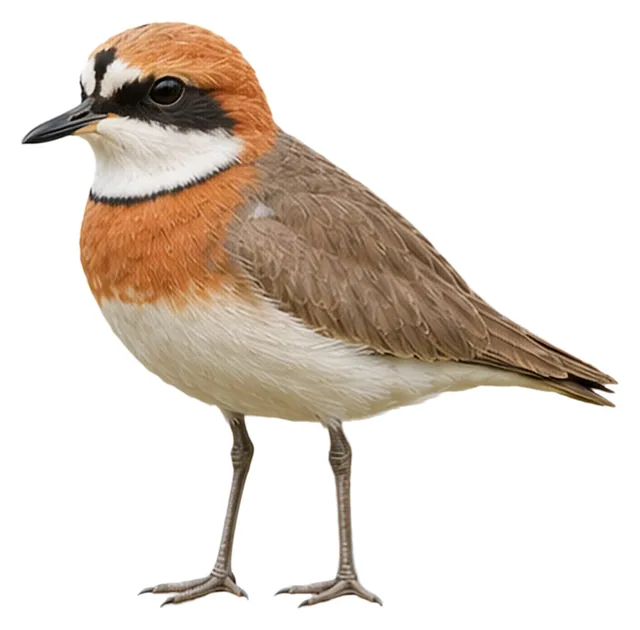
This stout, long-legged sand plover has a chestnut breast and nape and a black mask in the male during the breeding season.
Most records: Australia, China, Japan
Looks like Greater Sand Plover
AI-generated illustration. It may contain mistakes. · How the stickers are made
How to identify
Field marks
- Male has a chestnut breast and nape in the breeding season
- Male has a black mask in the breeding season
- Gray back and white belly
- Dark legs and feet; black bill
Male, female and young
The female is duller; winter plumage and juveniles lack chestnut, with only a slight reddish-brown tinge on the head.
Voice
A hard trill in flight.
Similar species
Where and when it's recorded

Siberian Sand Plover has been recorded at 389 of the 8,171 birding hotspots we track, in 28 countries and regions.
Records by month Northern Hemisphere
To protect this bird from disturbance, we don't list exact sites.
Countries and regions with the most records
eBird records via GBIF up to 2024-12-31. A record means someone listed it; more records partly mean more birders, not more birds.
Questions
Where does the Siberian Sand Plover live?
Its breeding range: Palearctic: eastern Russia (southern, southeastern Siberia). It is most often recorded in Australia, China and Japan.
Is the Siberian Sand Plover endangered?
The IUCN Red List classifies the Siberian Sand Plover as Endangered.
What family is the Siberian Sand Plover in?
It belongs to the family Plovers (Charadriidae), order Charadriiformes.
How do you identify the Siberian Sand Plover?
Male has a chestnut breast and nape in the breeding season. Male has a black mask in the breeding season. Gray back and white belly.
How do male and female Siberian Sand Plover differ?
The female is duller; winter plumage and juveniles lack chestnut, with only a slight reddish-brown tinge on the head.
How do you tell the Siberian Sand Plover from the Greater Sand Plover?
Siberian Sand Plover is slightly smaller, with a usually shorter bill and usually darker legs and feet (black to gray); Greater Sand Plover has paler legs and feet (gray to pale yellow).
At a glance
- Wingspan
- 52 cm
- Conservation
- Endangered
Range
Palearctic: eastern Russia (southern, southeastern Siberia)
Breeding range, IOC World Bird List 15.2
Subspecies · 1
- Anarhynchus mongolus mongolus Sea of Okhotsk to Ussuriland (se Siberia) | non-breeding: coastal Taiwan (China), Vietnam to New Guinea region and Australia (except s and Tasmania)
Classification
- Order
- Charadriiformes
- Family
- Plovers Charadriidae
- Genus
- Anarhynchus
Other birds in the genus Anarhynchus
 Caspian PloverAnarhynchus asiaticus
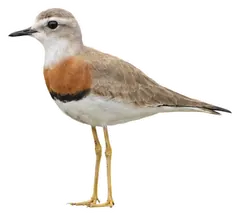 Oriental PloverAnarhynchus veredus
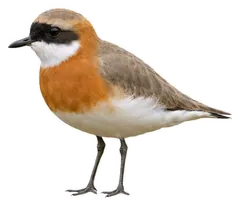 Tibetan Sand PloverAnarhynchus atrifrons
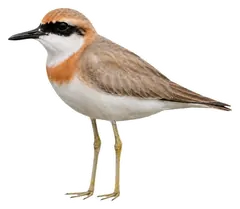 Greater Sand PloverAnarhynchus leschenaultii
 Double-banded PloverAnarhynchus bicinctus
 WrybillAnarhynchus frontalis
 New Zealand PloverAnarhynchus obscurus
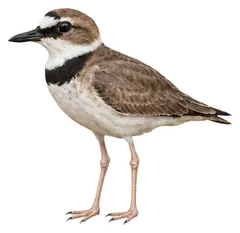 Wilson's PloverAnarhynchus wilsonia
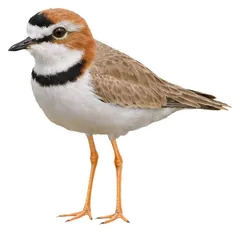 Collared PloverAnarhynchus collaris
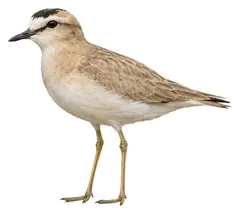 Mountain PloverAnarhynchus montanus
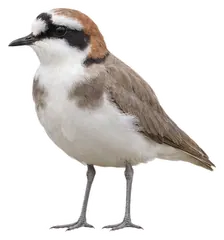 Puna PloverAnarhynchus alticola
 Two-banded PloverAnarhynchus falklandicus

Download illustration
Free to use with credit: “Illustration: Field Stickers”. AI-generated. Its appearance was checked against a reference photo by Vedant Raju Kasambe; the pose follows our standard. ↗

In other languages
- EnglishSiberian Sand Plover
- 简体中文蒙古沙鸻
- 繁體中文蒙古鴴
- 日本語メダイチドリ
- 한국어왕눈물떼새
- DeutschMongolenregenpfeifer
- FrançaisPluvier de Mongolie
- EspañolChorlitejo mongol chico
- Portuguêsborrelho-mongol
- ItalianoCorriere mongolo
- NederlandsMongoolse Plevier
- РусскийМонгольский зуёк
- Svenskakamtjatkapipare
- DanskMongolsk Præstekrave
- Polskisieweczka syberyjska