Siberian Thrush
Geokichla sibirica (Pallas, 1776)
≈24 cmLength76 gWeight
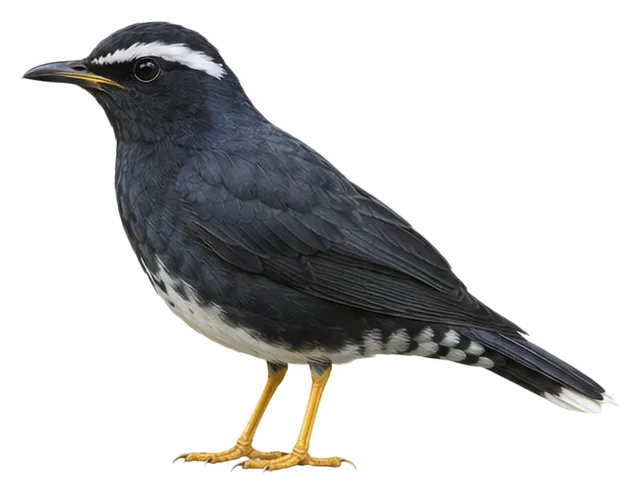
The elusive male is deep blue-gray with a single white supercilium above the eye.
Busiest months: May · Most records: China, Singapore, Malaysia
This sticker was generated from a written description only, without a reference photo, so it is more likely to contain mistakes than the others. Check a field guide for details.
AI-generated illustration. It may contain mistakes. · How the stickers are made
How to identify
Field marks
- Male is deep blue-gray with white lower belly and body sides
- A single white stripe above the eye
- Male has white lower belly and body sides
- In flight, underwing is white with black stripes
Male, female and young
Female is brownish, with a pale yellow stripe above the eye.
Where and when it's recorded

Siberian Thrush has been recorded at 295 of the 8,171 birding hotspots we track, in 14 countries and regions.
Records by month Northern Hemisphere
Where it's recorded most
- Nanhui DongtanChina280 records
- Dairy Farm Nature ParkSingapore239 records
- Bukit FraserMalaysia121 records
More places
- Deo Nui San passVietnam112 records
- Yeliu IBATaiwan (China)95 records
- Jiulongshan National Forest ParkChina85 records
- Happy IslandChina77 records
- Bukit Timah Nature ReserveSingapore64 records
- Dinhthinh( Tim) (12,1024,108,3599)Vietnam61 records
- Wajima – Hegurajima (island)Japan58 records
Countries and regions with the most records
eBird records via GBIF up to 2024-12-31. A record means someone listed it; more records partly mean more birders, not more birds.
About
The Siberian thrush (Geokichla sibirica) is a member of the thrush family, Turdidae. The genus name Geokichla comes from Ancient Greek geo-, "ground-" and kikhle, " thrush". The specific sibirica is Latin for Siberia.
Excerpt from Wikipedia, CC BY-SA 4.0 · authors · Read more on Wikipedia
Questions
How big is the Siberian Thrush?
The Siberian Thrush is about ≈24 cm long and weighs around 76 g.
Where does the Siberian Thrush live?
Its breeding range: Palearctic: eastern. It is most often recorded in China, Singapore and Malaysia.
When is the best time to see the Siberian Thrush?
At the hotspots we track, it is recorded most in May (Northern Hemisphere).
Is the Siberian Thrush endangered?
The IUCN Red List classifies the Siberian Thrush as Least Concern.
What does the Siberian Thrush eat?
Main food: Insects & other invertebrates.
What family is the Siberian Thrush in?
It belongs to the family Thrushes (Turdidae), order Passerines (Passeriformes).
At a glance
- Length
- ≈24 cm
- Weight
- 76 g
- Habitat
- Forest
- Diet
- Insects & other invertebrates
- Lifestyle
- Active on the ground
- Migration
- Migratory
- Conservation
- Least Concern
More measurements
- Wing
- 119 mm
- Tail
- 88 mm
- Bill
- 22 mm
- Tarsus
- 28 mm
Averages from the AVONET dataset; length from field guides where available.
Range
Palearctic: eastern
Breeding range, IOC World Bird List 15.2
Subspecies · 1
- Geokichla sibirica sibirica c, e Siberia to n Mongolia and ne China | non-breeding: to Greater Sundas
Classification
- Order
- Passerines Passeriformes
- Family
- Thrushes Turdidae
- Genus
- Geokichla
Other birds in the genus Geokichla
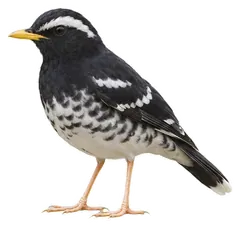 Pied ThrushGeokichla wardii
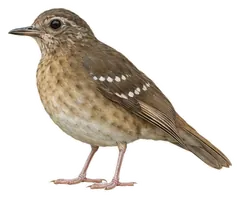 Grey Ground ThrushGeokichla princei
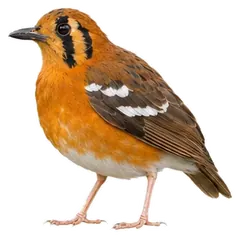 Black-eared Ground ThrushGeokichla camaronensis
 Spotted Ground ThrushGeokichla guttata
 Spot-winged ThrushGeokichla spiloptera
 Crossley's Ground ThrushGeokichla crossleyi
 Abyssinian Ground ThrushGeokichla piaggiae
 Oberländer's Ground ThrushGeokichla oberlaenderi
 Orange Ground ThrushGeokichla gurneyi
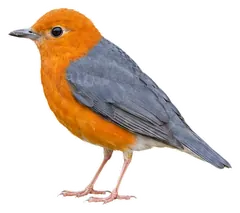 Orange-headed ThrushGeokichla citrina
 Buru ThrushGeokichla dumasi
 Seram ThrushGeokichla joiceyi
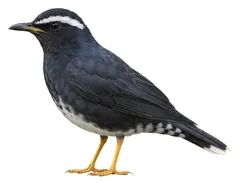
Download illustration
Free to use with credit: “Illustration: Field Stickers”. AI-generated from a written description only; no reference photo was used.