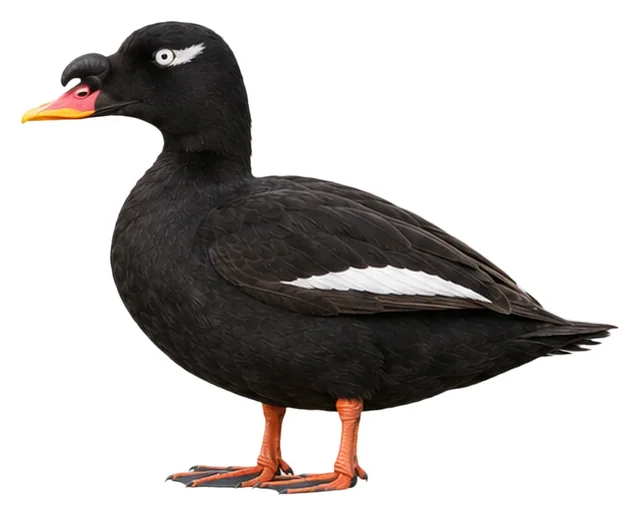
Stejneger's Scoter
Melanitta stejnegeri (Ridgway, 1887)
≈52 cmLength1.8 kgWeight
This large sea duck has a very tall knob at the base of the bill in the male, whose bill is mostly orange-yellow.
Busiest months: May · Most records: Japan, Mongolia, China
AI-generated illustration. It may contain mistakes. · How the stickers are made
How to identify
Field marks
- Male has a very tall knob at the base of the bill
- Male has a mostly orange-yellow bill
- Male has a long bill-to-head profile, like a “Roman nose”
- Feather edges at the base of the upper mandible form an acute angle
Where and when it's recorded

Stejneger's Scoter has been recorded at 106 of the 8,171 birding hotspots we track, in 12 countries and regions.
Records by month Northern Hemisphere
Where it's recorded most
- Funabashi – Funabashi Sanbanze Seaside ParkJapan184 records
- GambellUnited States170 records
- Ugii Lake, Ugiinuur, Arkhangai, MNMongolia170 records
More places
- Gun Galuut NRMongolia157 records
- MeynypilgynoRussia92 records
- Betsukai – Notsuke Peninsula – NarawaraJapan84 records
- Hamanaka – Cape KiritappuJapan75 records
- Baengnyeong-do (island)South Korea68 records
- Betsukai – Notsuke Peninsula Nature CenterJapan62 records
- Nemuro – Cape NosappuJapan51 records
Countries and regions with the most records
eBird records via GBIF up to 2024-12-31. A record means someone listed it; more records partly mean more birders, not more birds.
Questions
How big is the Stejneger's Scoter?
The Stejneger's Scoter is about ≈52 cm long and weighs around 1.8 kg.
Where does the Stejneger's Scoter live?
Its breeding range: Palearctic: Yenisey Basin to Kamchatka (central, eastern Siberia), northeastern Kazakhstan and northern, western Mongolia. It is most often recorded in Japan, Mongolia and China.
When is the best time to see the Stejneger's Scoter?
At the hotspots we track, it is recorded most in May (Northern Hemisphere).
Is the Stejneger's Scoter endangered?
The IUCN Red List classifies the Stejneger's Scoter as Least Concern.
What does the Stejneger's Scoter eat?
Main food: Fish, shrimp & shellfish.
What family is the Stejneger's Scoter in?
It belongs to the family Ducks, Geese, Swans (Anatidae), order Anseriformes.
At a glance
- Length
- ≈52 cm
- Weight
- 1.8 kg
- Habitat
- Wetland
- Diet
- Fish, shrimp & shellfish
- Lifestyle
- On the water surface
- Migration
- Migratory
- Conservation
- Least Concern
More measurements
- Wing
- 267 mm
- Tail
- 69 mm
- Bill
- 56 mm
- Tarsus
- 43 mm
Averages from the AVONET dataset; length from field guides where available.
Range
Palearctic: Yenisey Basin to Kamchatka (central, eastern Siberia), northeastern Kazakhstan and northern, western Mongolia
Breeding range, IOC World Bird List 15.2
Classification
- Order
- Anseriformes
- Family
- Ducks, Geese, Swans Anatidae
- Genus
- Melanitta
Other birds in the genus Melanitta
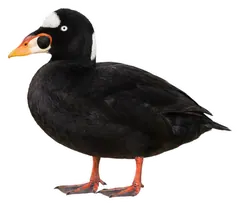 Surf ScoterMelanitta perspicillata
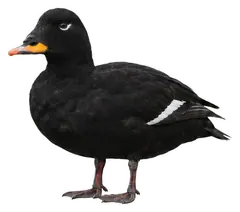 Velvet ScoterMelanitta fusca
 White-winged ScoterMelanitta deglandi
 Common ScoterMelanitta nigra
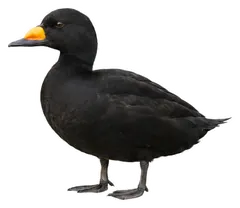 Black ScoterMelanitta americana
 White-faced Whistling DuckDendrocygna viduata
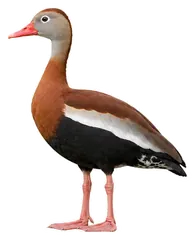 Black-bellied Whistling DuckDendrocygna autumnalis
 Spotted Whistling DuckDendrocygna guttata
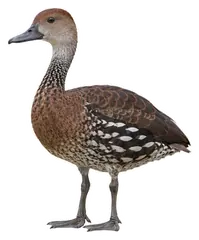 West Indian Whistling DuckDendrocygna arborea
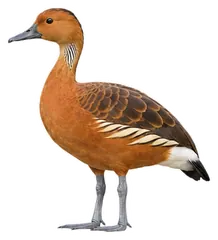 Fulvous Whistling DuckDendrocygna bicolor
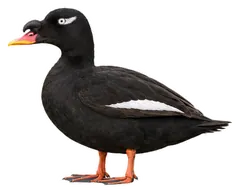
Download illustration
Free to use with credit: “Illustration: Field Stickers”. AI-generated. Its appearance was checked against a reference photo by 조흥상; the pose follows our standard. ↗
In other languages
- EnglishStejneger's Scoter
- 简体中文斑脸海番鸭
- 繁體中文斑臉海番鴨
- 日本語ビロードキンクロ
- 한국어검둥오리사촌
- DeutschKamtschatkasamtente
- FrançaisMacreuse de Sibérie
- EspañolNegrón siberiano
- Portuguêsnegrola-siberiana
- ItalianoOrco marino di Stejneger
- NederlandsAziatische Grote Zee-eend
- Svenskasibirisk knölsvärta
- DanskAsiatisk Fløjlsand
- Polskiuhla azjatycka