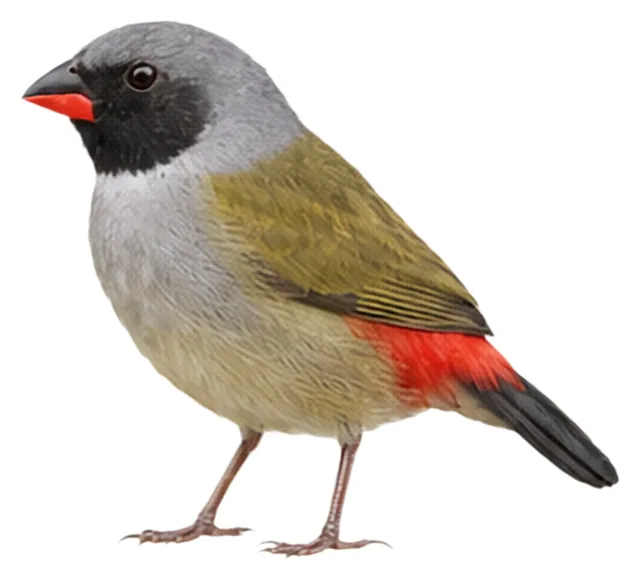
Swee Waxbill
Coccopygia melanotis (Temminck, 1823)
6.5 gWeight
The swee waxbill (Coccopygia melanotis), is a common species of estrildid finch native to Southern Africa.
Busiest months: October · Most records: South Africa, Eswatini, Lesotho
AI-generated illustration. It may contain mistakes. · How the stickers are made
Where and when it's recorded

Swee Waxbill has been recorded at 42 of the 8,171 birding hotspots we track, in 3 countries and regions.
Records by month Southern Hemisphere
Where it's recorded most
- Kirstenbosch Botanical GardenSouth Africa1,423 records
- Harold Porter Botanical GardensSouth Africa751 records
- Sani Pass (ZA) – low elevationSouth Africa79 records
More places
- Rooi-ElsSouth Africa20 records
- De Hoop Nature ReserveSouth Africa13 records
- Malolotja Nature ReserveEswatini8 records
- Strandfontein WTPSouth Africa7 records
- Ts'ehlanyane NPLesotho6 records
- DO NOT USE** Hluhluwe-Imfolozi GRSouth Africa5 records
- Eshowe – Dlinza ForestSouth Africa5 records
Countries and regions with the most records
eBird records via GBIF up to 2024-12-31. A record means someone listed it; more records partly mean more birders, not more birds.
About
The swee waxbill (Coccopygia melanotis), is a common species of estrildid finch native to Southern Africa.
Excerpt from Wikipedia, CC BY-SA 4.0 · authors · Read more on Wikipedia
Questions
How big is the Swee Waxbill?
The Swee Waxbill weighs around 6.5 g.
Where does the Swee Waxbill live?
Its breeding range: Africa: south-central Zimbabwe and southwestern Mozambique to southern South Africa. It is most often recorded in South Africa, Eswatini and Lesotho.
When is the best time to see the Swee Waxbill?
At the hotspots we track, it is recorded most in October (Southern Hemisphere).
Is the Swee Waxbill endangered?
The IUCN Red List classifies the Swee Waxbill as Least Concern.
What does the Swee Waxbill eat?
Main food: Seeds.
What family is the Swee Waxbill in?
It belongs to the family Waxbills, Munias & Allies (Estrildidae), order Passerines (Passeriformes).
At a glance
- Weight
- 6.5 g
- Habitat
- Shrubland
- Diet
- Seeds
- Lifestyle
- Varied
- Migration
- Resident (barely migrates)
- Conservation
- Least Concern
More measurements
- Wing
- 48 mm
- Tail
- 37 mm
- Bill
- 9 mm
- Tarsus
- 14 mm
Averages from the AVONET dataset; length from field guides where available.
Range
Africa: south-central Zimbabwe and southwestern Mozambique to southern South Africa
Breeding range, IOC World Bird List 15.2
Classification
- Order
- Passerines Passeriformes
- Family
- Waxbills, Munias & Allies Estrildidae
- Genus
- Coccopygia
Other birds in the genus Coccopygia
 Yellow-bellied WaxbillCoccopygia quartinia
 Angola WaxbillCoccopygia bocagei
 Pictorella MannikinHeteromunia pectoralis
 Mountain FiretailOreostruthus fuliginosus
 Diamond FiretailStagonopleura guttata
 Red-eared FiretailStagonopleura oculata
 Beautiful FiretailStagonopleura bella
 Crimson FinchNeochmia phaeton
 Red-browed FinchNeochmia temporalis
 Painted FinchEmblema pictum
 WebP · 1070 px
In other languages
- EnglishSwee Waxbill
- 简体中文黑颊黄腹梅花雀
- 繁體中文史威梅花雀
- 日本語キバラカエデチョウ
- DeutschKapgrünastrild
- FrançaisAstrild à joues noires
- EspañolEstrilda ventrigualda meridional
- Portuguêsbico-de-lacre-de-garganta-preta
- ItalianoEstrilda sui sui
- NederlandsGroenrugastrild
- РусскийЧерногорлый астрильд
- Svenskasvartkindad astrild
- DanskSortkindet Astrild
- Polskiszarogłówka czarnolica