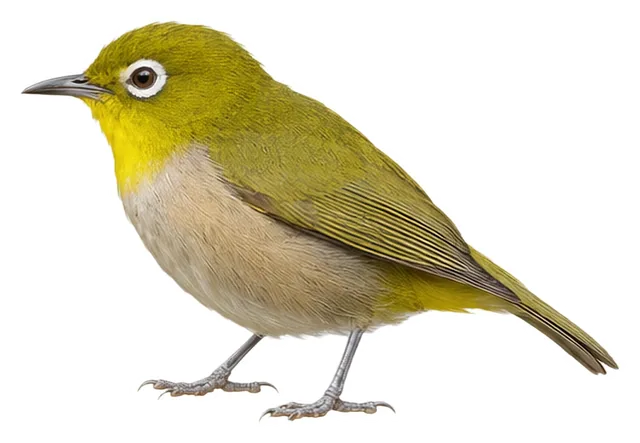
Warbling White-eye
Zosterops japonicus Temminck & Schlegel, 1847
≈12 cmLength11 gWeight
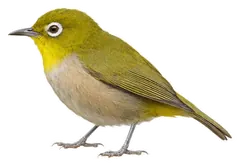
It is a small bird that often occurs in flocks, with a white eye-ring, olive back and yellow throat.
Busiest months: December–March and May · Most records: Japan, South Korea, Philippines
AI-generated illustration. It may contain mistakes. · How the stickers are made
How to identify
Field marks
- A white eye-ring around the eye
- Yellow throat; green forehead
- Olive back; pale green underparts
- Fine bill; bill, legs and feet black to brown
Where and when it's recorded

Warbling White-eye has been recorded at 204 of the 8,171 birding hotspots we track, in 6 countries and regions.
Records by month Northern Hemisphere
Where it's recorded most
- Edogawa Ward – Kasai Rinkai Park / Kasai Kaihin ParkJapan1,388 records
- Nerima Ward – Shakujii ParkJapan846 records
- Ota Ward – Tokyo Port Wild Bird Park (including Tidal Pond)Japan650 records
More places
- Kyoto – Kyoto Gyoen Garden / Kyoto Imperial Palace ParkJapan593 records
- Shinjuku Ward – Shinjuku Gyoen National GardenJapan518 records
- Shibuya Ward – Meiji Jingu ShrineJapan421 records
- Okayama – Okayama Korakuen GardenJapan409 records
- Mt. Tagubud, New BataanPhilippines405 records
- Lake HolonPhilippines394 records
- Ichikawa – Gyotoku Bird SanctuaryJapan376 records
Countries and regions with the most records
eBird records via GBIF up to 2024-12-31. A record means someone listed it; more records partly mean more birders, not more birds.
About
The warbling white-eye (Zosterops japonicus) is a small passerine bird in the white-eye family. The specific epithet is occasionally written japonica, but this is incorrect due to the gender of the genus. Its native range includes much of East Asia, including the Russian Far East, Japan, Indonesia, Korea, and the Philippines.
Excerpt from Wikipedia, CC BY-SA 4.0 · authors · Read more on Wikipedia
Questions
How big is the Warbling White-eye?
The Warbling White-eye is about ≈12 cm long and weighs around 11 g.
Where does the Warbling White-eye live?
Its breeding range: Palearctic, Oriental, Australasia: widespread East Asia, Japan to Greater Sundas (except Borneo), Sulawesi region, Moluccas, Lesser Sundas and Philippines (except Sulu Archipelago). It is most often recorded in Japan, South Korea and Philippines.
When is the best time to see the Warbling White-eye?
At the hotspots we track, it is recorded most in January, February, March, May and December (Northern Hemisphere).
Is the Warbling White-eye endangered?
The IUCN Red List classifies the Warbling White-eye as Least Concern.
What does the Warbling White-eye eat?
Main food: Omnivore.
What family is the Warbling White-eye in?
It belongs to the family White-eyes (Zosteropidae), order Passerines (Passeriformes).
How do you identify the Warbling White-eye?
A white eye-ring around the eye. Yellow throat; green forehead. Olive back; pale green underparts.
At a glance
- Length
- ≈12 cm
- Weight
- 11 g
- Habitat
- Forest
- Diet
- Omnivore
- Lifestyle
- Perches in trees
- Migration
- Resident (barely migrates)
- Conservation
- Least Concern
More measurements
- Wing
- 57 mm
- Tail
- 42 mm
- Bill
- 13 mm
- Tarsus
- 17 mm
Averages from the AVONET dataset; length from field guides where available.
Range
Palearctic, Oriental, Australasia: widespread East Asia, Japan to Greater Sundas (except Borneo), Sulawesi region, Moluccas, Lesser Sundas and Philippines (except Sulu Archipelago)
Breeding range, IOC World Bird List 15.2
Classification
- Order
- Passerines Passeriformes
- Family
- White-eyes Zosteropidae
- Genus
- Zosterops
Other birds in the genus Zosterops
 Sri Lanka White-eyeZosterops ceylonensis
 Yellowish White-eyeZosterops nigrorum
 Black-capped White-eyeZosterops atricapilla
 Abyssinian White-eyeZosterops abyssinicus
 Pale White-eyeZosterops flavilateralis
 Mbulu White-eyeZosterops mbuluensis
 Chestnut-flanked White-eyeZosterops erythropleurus
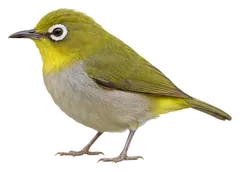 Swinhoe's White-eyeZosterops simplex
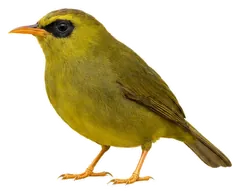 Mountain BlackeyeZosterops emiliae
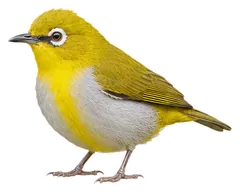 Indian White-eyeZosterops palpebrosus
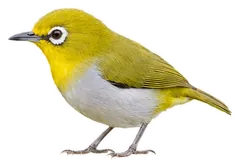 Lowland White-eyeZosterops meyeni
 Karthala White-eyeZosterops mouroniensis
Download illustration
Free to use with credit: “Illustration: Field Stickers”. AI-generated. Its appearance was checked against a reference photo by gg_copen; the pose follows our standard. ↗
In other languages
- EnglishWarbling White-eye
- 简体中文日本绣眼鸟
- 繁體中文暗綠繡眼
- 日本語メジロ
- 한국어동박새
- DeutschJapanbrillenvogel
- FrançaisZostérops du Japon
- EspañolAnteojitos japonés
- Portuguêsolho-branco-da-montanha
- ItalianoOcchialino del Giappone
- NederlandsZangbrilvogel
- РусскийЯпонская белоглазка
- Svenskasångglasögonfågel
- DanskJapansk Brillefugl
- Polskiszlarnik japoński