
White-necklaced Partridge
Arborophila gingica (Gmelin, JF, 1789)
25–30 cmLength253 gWeight
The nominate subspecies has a white forehead, a long supercilium, orange-chestnut sides of the neck, and a black collar with a white band across the breast.
Busiest months: May · Most records: China
AI-generated illustration. It may contain mistakes. · How the stickers are made
How to identify
Field marks
- Forehead white in the nominate subspecies; supercilium long
- Side of neck and throat orange-chestnut
- Black collar; white band above the chestnut upper breast
- Back reddish-brown with black spots; legs red
Male, female and young
The female resembles the male but is smaller; juveniles have a duller breast.
Voice
The territorial call is a repeated, plaintive whistle, such as “wooop” or “co-qwee”, mostly at dawn and dusk.
Where and when it's recorded

White-necklaced Partridge has been recorded at 29 of the 8,171 birding hotspots we track, in 1 country or region.
Records by month Northern Hemisphere
Where it's recorded most
- Emei Peak NNRChina228 records
- Fuzhou National Forest ParkChina154 records
- Fengyang Mountain NNRChina49 records
More places
- Nanling NNR [Ruyang Area]China18 records
- Junzi Peak NNRChina16 records
- Tianzhu Mountain Forest ParkChina15 records
- Tongling MountainChina11 records
- Ruoliao Primeval ForestChina11 records
- Xiaoping Forest ParkChina11 records
- Sanming Luoboyan PNRChina9 records
Countries and regions with the most records
eBird records via GBIF up to 2024-12-31. A record means someone listed it; more records partly mean more birders, not more birds.
About
The white-necklaced partridge (Arborophila gingica), also known as the collared partridge or Rickett's hill-partridge, is a species of bird in the family Phasianidae. It is endemic to southeastern China. It is threatened by habitat loss and hunting, and the IUCN has assessed it as near-threatened.
Excerpt from Wikipedia, CC BY-SA 4.0 · authors · Read more on Wikipedia
Questions
How big is the White-necklaced Partridge?
The White-necklaced Partridge is about 25–30 cm long and weighs around 253 g.
Where does the White-necklaced Partridge live?
Its breeding range: Oriental: southern China. It is most often recorded in China.
When is the best time to see the White-necklaced Partridge?
At the hotspots we track, it is recorded most in May (Northern Hemisphere).
Is the White-necklaced Partridge endangered?
The IUCN Red List classifies the White-necklaced Partridge as Near Threatened.
What does the White-necklaced Partridge eat?
Main food: Omnivore.
What family is the White-necklaced Partridge in?
It belongs to the family Pheasants & Allies (Phasianidae), order Galliformes.
How do you identify the White-necklaced Partridge?
Forehead white in the nominate subspecies; supercilium long. Side of neck and throat orange-chestnut. Black collar; white band above the chestnut upper breast.
How do male and female White-necklaced Partridge differ?
The female resembles the male but is smaller; juveniles have a duller breast.
At a glance
- Length
- 25–30 cm
- Weight
- 253 g
- Habitat
- Woodland
- Diet
- Omnivore
- Lifestyle
- Active on the ground
- Migration
- Resident (barely migrates)
- Conservation
- Near Threatened
More measurements
- Wing
- 138 mm
- Tail
- 56 mm
- Bill
- 22 mm
- Tarsus
- 40 mm
Averages from the AVONET dataset; length from field guides where available.
Range
Oriental: southern China
Breeding range, IOC World Bird List 15.2
Subspecies · 2
- Arborophila gingica gingica se China
- Arborophila gingica guangxiensis Guangxi (sc China)
Classification
- Order
- Galliformes
- Family
- Pheasants & Allies Phasianidae
- Genus
- Arborophila
Other birds in the genus Arborophila
 Hill PartridgeArborophila torqueola
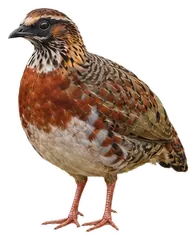 Sichuan PartridgeArborophila rufipectus
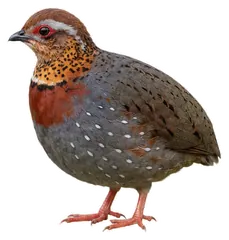 Chestnut-breasted PartridgeArborophila mandellii
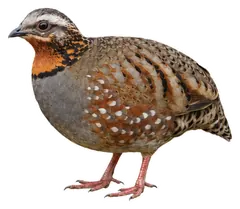 Rufous-throated PartridgeArborophila rufogularis
 Red-billed PartridgeArborophila rubrirostris
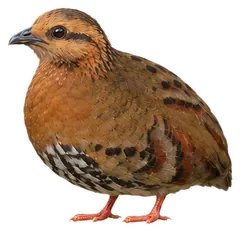 Chestnut-headed PartridgeArborophila cambodiana
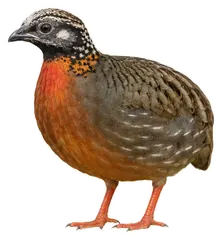 Hainan PartridgeArborophila ardens
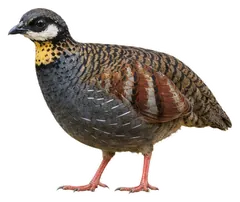 Taiwan PartridgeArborophila crudigularis
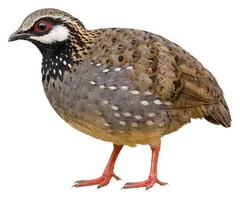 White-cheeked PartridgeArborophila atrogularis
 Bar-backed PartridgeArborophila brunneopectus
 Orange-necked PartridgeArborophila davidi
 Red-breasted PartridgeArborophila hyperythra

Download illustration
Free to use with credit: “Illustration: Field Stickers”. AI-generated. Its appearance was checked against a reference photo by xiwen CHEN; the pose follows our standard. ↗
In other languages
- EnglishWhite-necklaced Partridge
- 简体中文白眉山鹧鸪
- 繁體中文白額山鷓鴣
- 日本語フッケンミヤマテッケイ
- DeutschChinabuschwachtel
- FrançaisTorquéole de Sonnerat
- EspañolArborófila de Fujián
- Portuguêsperdiz-de-gargantilha
- ItalianoPernice dal collare
- NederlandsRicketts Bospatrijs
- РусскийКитайская лесная куропатка
- Svenskavitpannad sånghöna
- DanskKraveskovhøne
- Polskipstropiór białoczelny