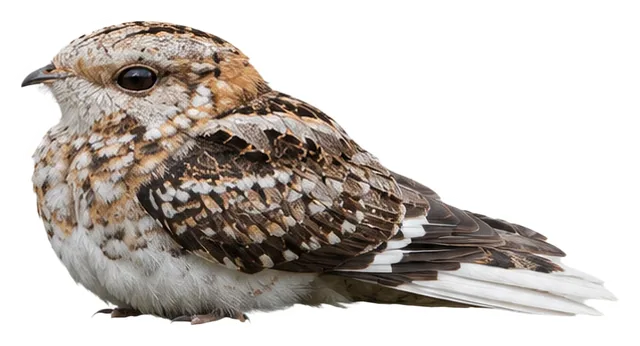
White-tailed Nightjar
Hydropsalis cayennensis (Gmelin, JF, 1789)
36 gWeight
The white-tailed nightjar (Hydropsalis cayennensis) is a species of nightjar in the family Caprimulgidae.
Busiest months: November–January · Most records: Trinidad & Tobago, Venezuela, Colombia
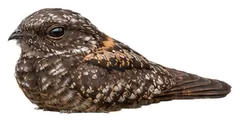
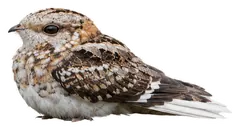
AI-generated illustration. It may contain mistakes. · How the stickers are made
Where and when it's recorded

White-tailed Nightjar has been recorded at 133 of the 8,171 birding hotspots we track, in 12 countries and regions.
Records by month Northern Hemisphere
Where it's recorded most
- Cuffie River Nature RetreatTrinidad & Tobago487 records
- Waller FieldTrinidad & Tobago400 records
- LVV areaCuraçao229 records
More places
- Bubali Bird SanctuaryAruba211 records
- Universidad de Los LlanosColombia207 records
- Surama EcoLodgeGuyana173 records
- Aripo Livestock (Agriculture Research) StationTrinidad & Tobago148 records
- Kralendijk Water Treatment PlantCaribbean Netherlands143 records
- Little Tobago IslandTrinidad & Tobago138 records
- Hato PiñeroVenezuela128 records
Countries and regions with the most records
eBird records via GBIF up to 2024-12-31. A record means someone listed it; more records partly mean more birders, not more birds.
About
The white-tailed nightjar (Hydropsalis cayennensis) is a species of nightjar in the family Caprimulgidae. It is found in the tropic regions of Central and South America.
Excerpt from Wikipedia, CC BY-SA 4.0 · authors · Read more on Wikipedia
Questions
How big is the White-tailed Nightjar?
The White-tailed Nightjar weighs around 36 g.
Where does the White-tailed Nightjar live?
Its breeding range: Middle America, South America: Costa Rica through northern South America. It is most often recorded in Trinidad & Tobago, Venezuela and Colombia.
When is the best time to see the White-tailed Nightjar?
At the hotspots we track, it is recorded most in January, November and December (Northern Hemisphere).
Is the White-tailed Nightjar endangered?
The IUCN Red List classifies the White-tailed Nightjar as Least Concern.
What does the White-tailed Nightjar eat?
Main food: Insects & other invertebrates.
What family is the White-tailed Nightjar in?
It belongs to the family Nightjars (Caprimulgidae), order Caprimulgiformes.
At a glance
- Weight
- 36 g
- Habitat
- Grassland
- Diet
- Insects & other invertebrates
- Lifestyle
- Varied
- Migration
- Partial migrant
- Conservation
- Least Concern
More measurements
- Wing
- 136 mm
- Tail
- 102 mm
- Bill
- 18 mm
- Tarsus
- 16 mm
Averages from the AVONET dataset; length from field guides where available.
Range
Middle America, South America: Costa Rica through northern South America
Breeding range, IOC World Bird List 15.2
Classification
- Order
- Caprimulgiformes
- Family
- Nightjars Caprimulgidae
- Genus
- Hydropsalis
Other birds in the genus Hydropsalis
 Ladder-tailed NightjarHydropsalis climacocerca
 Scissor-tailed NightjarHydropsalis torquata
 Long-trained NightjarHydropsalis forcipata
 Spotted NightjarEurostopodus argus
 White-throated NightjarEurostopodus mystacalis
 Solomons NightjarEurostopodus nigripennis
 New Caledonian NightjarEurostopodus exul
 Satanic NightjarEurostopodus diabolicus
 Papuan NightjarEurostopodus papuensis
 Archbold's NightjarEurostopodus archboldi
Download illustration
Free to use with credit: “Illustration: Field Stickers”. AI-generated. Its appearance was checked against a reference photo by Chris Harrison; the pose follows our standard. ↗
In other languages
- EnglishWhite-tailed Nightjar
- 简体中文白尾夜鹰
- 繁體中文白尾夜鷹
- 日本語オジロヨタカ
- DeutschWeißschwanz-Nachtschwalbe
- FrançaisEngoulevent coré
- EspañolChotacabras coliblanco
- Portuguêsbacurau-de-cauda-branca
- ItalianoSucciacapre codabianca
- NederlandsWitstaartnachtzwaluw
- РусскийБелохвостый козодой
- Svenskavitstjärtad nattskärra
- DanskHvidhalet Natravn
- Polskilelkowiec białopręgi