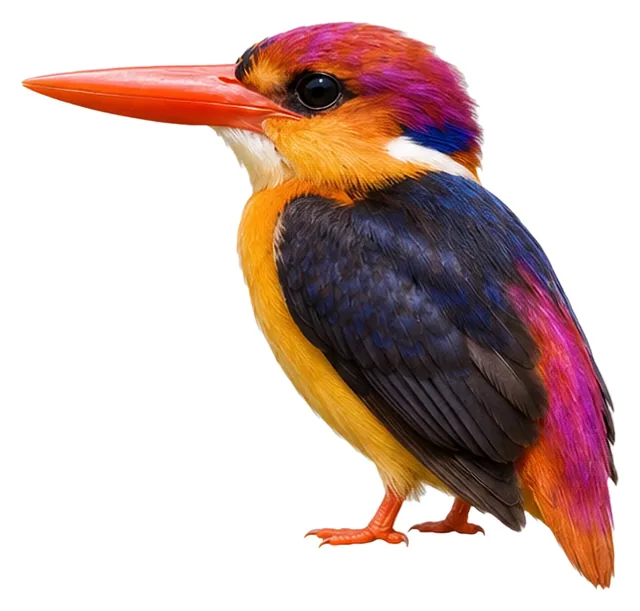
Black-backed Dwarf Kingfisher
Ceyx erithaca (Linnaeus, 1758)
≈13 cmLength18 gWeight
It is a pocket-sized kingfisher with a red bill, red legs and feet, and yellow-orange underparts.
Busiest months: April–May and October–November · Most records: India, Sri Lanka, Thailand
AI-generated illustration. It may contain mistakes. · How the stickers are made
How to identify
Field marks
- Bill, legs, and feet red
- A single black patch on forehead
- Blue and white patches on side of neck
- Back and wings dark blue; underparts pale yellow-orange
Male, female and young
Sexes similar, with male slightly larger; juvenile is duller, with a yellow-orange bill and pale tip.
Voice
A high-pitched “tsriet-tsriet”; a soft “tjie-tjie-tjie” in flight.
Where and when it's recorded

Black-backed Dwarf Kingfisher has been recorded at 172 of the 8,171 birding hotspots we track, in 12 countries and regions.
Records by month Northern Hemisphere
Where it's recorded most
- Bondla Wildlife SanctuaryIndia262 records
- Garbhanga Reserve ForestIndia178 records
- Kaeng Krachan NP – stream crossings 1–3Thailand136 records
More places
- Windsor Nature Park including Venus Drive and Venus LoopSingapore123 records
- Dinhthinh( Tim) (11,1401,107,3771)Vietnam118 records
- Kaeng Krachan NPThailand105 records
- Dihing Patkai NP – SoraipungIndia98 records
- Thattekkad Bird SanctuaryIndia86 records
- Dihing Patkai NP – SoraipungIndia74 records
- KitulgalaSri Lanka68 records
Countries and regions with the most records
eBird records via GBIF up to 2024-12-31. A record means someone listed it; more records partly mean more birders, not more birds.
About
The black-backed dwarf kingfisher (Ceyx erithaca), also known as the three-toed kingfisher, is a pocket-sized bird in the family Alcedinidae.
Excerpt from Wikipedia, CC BY-SA 4.0 · authors · Read more on Wikipedia
Questions
How big is the Black-backed Dwarf Kingfisher?
The Black-backed Dwarf Kingfisher is about ≈13 cm long and weighs around 18 g.
Where does the Black-backed Dwarf Kingfisher live?
Its breeding range: Oriental: Indian subcontinent to southeastern China, Indochina and Thailand.. It is most often recorded in India, Sri Lanka and Thailand.
When is the best time to see the Black-backed Dwarf Kingfisher?
At the hotspots we track, it is recorded most in April, May, October and November (Northern Hemisphere).
Is the Black-backed Dwarf Kingfisher endangered?
The IUCN Red List classifies the Black-backed Dwarf Kingfisher as Near Threatened.
What does the Black-backed Dwarf Kingfisher eat?
Main food: Insects & other invertebrates.
What family is the Black-backed Dwarf Kingfisher in?
It belongs to the family Kingfishers (Alcedinidae), order Coraciiformes.
How do you identify the Black-backed Dwarf Kingfisher?
Bill, legs, and feet red. A single black patch on forehead. Blue and white patches on side of neck.
How do male and female Black-backed Dwarf Kingfisher differ?
Sexes similar, with male slightly larger; juvenile is duller, with a yellow-orange bill and pale tip.
At a glance
- Length
- ≈13 cm
- Weight
- 18 g
- Habitat
- Forest
- Diet
- Insects & other invertebrates
- Lifestyle
- Perches in trees
- Migration
- Resident (barely migrates)
- Conservation
- Near Threatened
More measurements
- Wing
- 58 mm
- Tail
- 23 mm
- Bill
- 36 mm
- Tarsus
- 8 mm
Averages from the AVONET dataset; length from field guides where available.
Range
Oriental: Indian subcontinent to southeastern China, Indochina and Thailand.
Breeding range, IOC World Bird List 15.2
Subspecies · 1
- Ceyx erithaca erithaca ne India, Myanmar, Thailand, Indochina, se China, Indochina and Thailand s to n Thai-Malay Pen. Disjunctly in sw India and Sri Lanka. | non-breeding: to s Thai-Malay Pen. and Sumatra
Classification
- Order
- Coraciiformes
- Family
- Kingfishers Alcedinidae
- Genus
- Ceyx
Other birds in the genus Ceyx
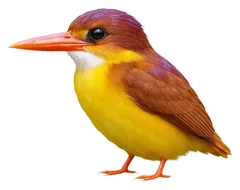 Rufous-backed Dwarf KingfisherCeyx rufidorsa
 Philippine Dwarf KingfisherCeyx melanurus
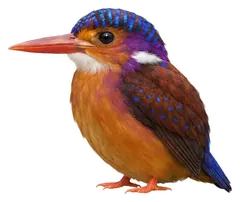 Sangihe Dwarf KingfisherCeyx sangirensis
 Sulawesi Dwarf KingfisherCeyx fallax
 Moluccan Dwarf KingfisherCeyx lepidus
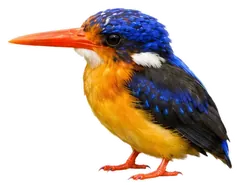 Dimorphic Dwarf KingfisherCeyx margarethae
 Sula Dwarf KingfisherCeyx wallacii
 Buru Dwarf KingfisherCeyx cajeli
 Papuan Dwarf KingfisherCeyx solitarius
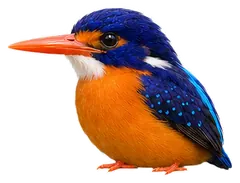 Manus Dwarf KingfisherCeyx dispar
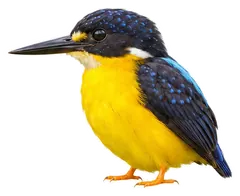 New Ireland Dwarf KingfisherCeyx mulcatus
 New Britain Dwarf KingfisherCeyx sacerdotis
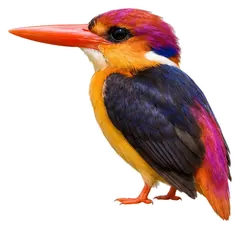
Download illustration
Free to use with credit: “Illustration: Field Stickers”. AI-generated. Its appearance was checked against a reference photo by Dhruva Punde; the pose follows our standard. ↗
In other languages
- EnglishBlack-backed Dwarf Kingfisher
- 简体中文三趾翠鸟
- 繁體中文三趾翠鳥
- 日本語ミツユビカワセミ
- DeutschDschungelzwergfischer
- FrançaisMartin-pêcheur pourpré
- EspañolMartín pigmeo oriental
- Portuguêsmartim-pigmeu-de-dorso-escuro
- ItalianoMartin pescatore dorsonero
- NederlandsZwartrugdwergijsvogel
- РусскийТрёхпалый зимородок
- Svenskaorientkungsfiskare
- DanskOrientalsk Dværgisfugl
- Polskizimorodek orientalny