
Blue-faced Honeyeater
Entomyzon cyanotis (Latham, 1801)
26–32 cmLength105 gWeight
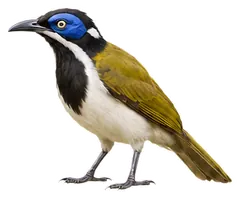
The blue-faced honeyeater (Entomyzon cyanotis), also colloquially known as the bananabird, is a passerine bird of the honeyeater family, Meliphagidae.
Busiest months: September–October · Most records: Australia, United Arab Emirates
AI-generated illustration. It may contain mistakes. · How the stickers are made
Where and when it's recorded

Blue-faced Honeyeater has been recorded at 125 of the 8,171 birding hotspots we track, in 2 countries and regions.
Records by month Southern Hemisphere
Where it's recorded most
- Oxley Creek CommonAustralia4,442 records
- Sandy Camp Road WetlandsAustralia3,013 records
- Carlyle Gardens Retirement Resort, TownsvilleAustralia1,637 records
More places
- Dowse LagoonAustralia1,594 records
- Bowra Wildlife SanctuaryAustralia1,365 records
- SeymourAustralia1,210 records
- Bundaberg Botanical GardensAustralia1,185 records
- Kumbartcho SanctuaryAustralia1,084 records
- Gemmill Swamp Wildlife ReserveAustralia1,011 records
- Sherwood ArboretumAustralia930 records
Countries and regions with the most records
eBird records via GBIF up to 2024-12-31. A record means someone listed it; more records partly mean more birders, not more birds.
About
The blue-faced honeyeater (Entomyzon cyanotis), also colloquially known as the bananabird, is a passerine bird of the honeyeater family, Meliphagidae. It is the only member of its genus, and it is most closely related to honeyeaters of the genus Melithreptus. Three subspecies are recognised.
Excerpt from Wikipedia, CC BY-SA 4.0 · authors · Read more on Wikipedia
Questions
How big is the Blue-faced Honeyeater?
The Blue-faced Honeyeater is about 26–32 cm long and weighs around 105 g.
Where does the Blue-faced Honeyeater live?
Its breeding range: Australasia: south-central New Guinea and northern, eastern Australia. It is most often recorded in Australia and United Arab Emirates.
When is the best time to see the Blue-faced Honeyeater?
At the hotspots we track, it is recorded most in September and October (Southern Hemisphere).
Is the Blue-faced Honeyeater endangered?
The IUCN Red List classifies the Blue-faced Honeyeater as Least Concern.
What does the Blue-faced Honeyeater eat?
Main food: Omnivore.
What family is the Blue-faced Honeyeater in?
It belongs to the family Honeyeaters (Meliphagidae), order Passerines (Passeriformes).
At a glance
- Length
- 26–32 cm
- Weight
- 105 g
- Habitat
- Forest
- Diet
- Omnivore
- Lifestyle
- Perches in trees
- Migration
- Resident (barely migrates)
- Conservation
- Least Concern
More measurements
- Wing
- 151 mm
- Tail
- 120 mm
- Bill
- 34 mm
- Tarsus
- 32 mm
Averages from the AVONET dataset; length from field guides where available.
Range
Australasia: south-central New Guinea and northern, eastern Australia
Breeding range, IOC World Bird List 15.2
Classification
- Order
- Passerines Passeriformes
- Family
- Honeyeaters Meliphagidae
- Genus
- Entomyzon
More from the family Honeyeaters
 Dark-eared MyzaMyza celebensis
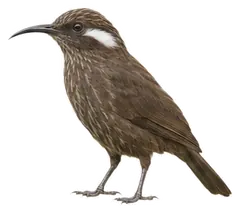 White-eared MyzaMyza sarasinorum
 Eastern SpinebillAcanthorhynchus tenuirostris
 Western SpinebillAcanthorhynchus superciliosus
 Green-backed HoneyeaterGlycichaera fallax
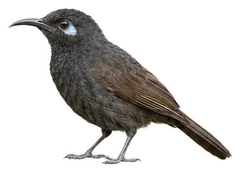 Sooty HoneyeaterMelionyx fuscus
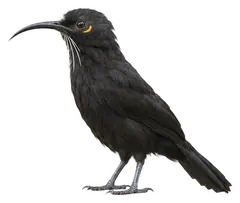 Long-bearded HoneyeaterMelionyx princeps
 Short-bearded HoneyeaterMelionyx nouhuysi
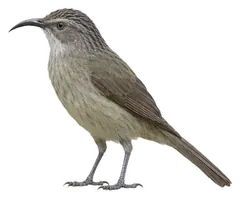 Leaden HoneyeaterPtiloprora plumbea
 Yellowish-streaked HoneyeaterPtiloprora meekiana
 WebP · 1070 px
In other languages
- EnglishBlue-faced Honeyeater
- 简体中文蓝脸吸蜜鸟
- 繁體中文藍臉吸蜜鳥
- 日本語アオツラミツスイ
- DeutschBlauohr-Honigfresser
- FrançaisMéliphage à oreillons bleus
- EspañolMielero cariazul
- Portuguêspapa-mel-de-faces-azuis
- ItalianoSucciamiele guanceblu
- NederlandsBlauwwanghoningeter
- РусскийСинелицая медвянка
- Svenskablåkindad honungsfågel
- DanskBlåmasket Honningæder
- Polskisłodnik (modrolicy)