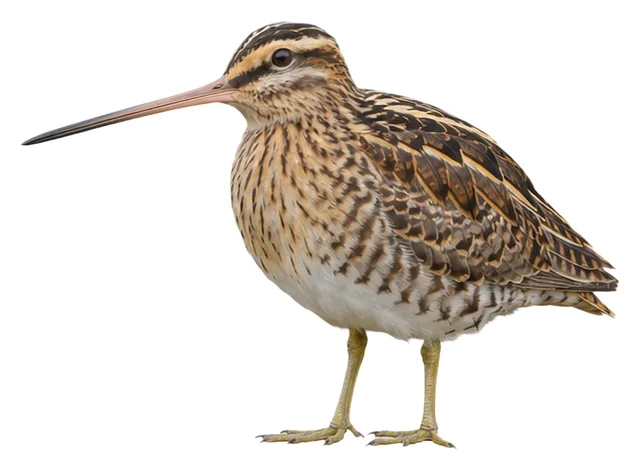
Latham's Snipe
Gallinago hardwickii (Gray, JE, 1831)
≈32 cmLength51 cmWingspan151 gWeight
This long-billed snipe is well camouflaged by mixed black, brown, buff and white markings.
Busiest months: January · Most records: Australia, Japan, South Korea
Looks like Swinhoe's Snipe, Pin-tailed Snipe
This sticker was generated from a written description only, without a reference photo, so it is more likely to contain mistakes than the others. Check a field guide for details.
AI-generated illustration. It may contain mistakes. · How the stickers are made
How to identify
Field marks
- Bill very long
- Plumage a mixture of black, brown, buff and white
Similar species
Where and when it's recorded

Latham's Snipe has been recorded at 188 of the 8,171 birding hotspots we track, in 8 countries and regions.
Records by month Southern Hemisphere
Where it's recorded most
- Jerrabomberra Wetlands Nature ReserveAustralia3,635 records
- Dowse LagoonAustralia1,007 records
- West Belconnen PondAustralia568 records
More places
- Oxley Creek CommonAustralia479 records
- Banyule Flats ReserveAustralia448 records
- Eastlakes golf courseAustralia423 records
- Finland Road, Paradise WatersAustralia406 records
- Coombabah Lakelands Conservation AreaAustralia394 records
- Minnippi ParklandsAustralia390 records
- Sandy Camp Road WetlandsAustralia352 records
Countries and regions with the most records
eBird records via GBIF up to 2024-12-31. A record means someone listed it; more records partly mean more birders, not more birds.
About
Latham's snipe (Gallinago hardwickii), also Japanese snipe is a medium-sized, long-billed, migratory snipe of the East Asian–Australasian Flyway. The origin of the bird's common name is not clear. John Latham was a well-known English physician and ornithologist in the late 18th and early 19th centuries, and had a great interest in Australasian birds.
Excerpt from Wikipedia, CC BY-SA 4.0 · authors · Read more on Wikipedia
Questions
How big is the Latham's Snipe?
The Latham's Snipe is about ≈32 cm long, with a wingspan of 51 cm and weighs around 151 g.
Where does the Latham's Snipe live?
Its breeding range: Palearctic: meadows and fields of temperate northeastern Palearctic: eastern Amurland and southern Sakhalin (southeastern Russia) and southern Kuril Islands south through Honshu and ?Kyushu (northern to southern Japan). It is most often recorded in Australia, Japan and South Korea.
When is the best time to see the Latham's Snipe?
At the hotspots we track, it is recorded most in January (Southern Hemisphere).
Is the Latham's Snipe endangered?
The IUCN Red List classifies the Latham's Snipe as Near Threatened.
What does the Latham's Snipe eat?
Main food: Fish, shrimp & shellfish.
What family is the Latham's Snipe in?
It belongs to the family Sandpipers, Snipes (Scolopacidae), order Charadriiformes.
How do you identify the Latham's Snipe?
Bill very long. Plumage a mixture of black, brown, buff and white.
How do you tell the Latham's Snipe from the Swinhoe's Snipe?
Difficult to separate in the field; Latham's Snipe is slightly larger.
At a glance
- Length
- ≈32 cm
- Wingspan
- 51 cm
- Weight
- 151 g
- Habitat
- Towns & farmland
- Diet
- Fish, shrimp & shellfish
- Lifestyle
- Active on the ground
- Migration
- Migratory
- Conservation
- Near Threatened
More measurements
- Wing
- 151 mm
- Tail
- 61 mm
- Bill
- 73 mm
- Tarsus
- 35 mm
Averages from the AVONET dataset; length from field guides where available.
Range
Palearctic: meadows and fields of temperate northeastern Palearctic: eastern Amurland and southern Sakhalin (southeastern Russia) and southern Kuril Islands south through Honshu and ?Kyushu (northern to southern Japan)
Breeding range, IOC World Bird List 15.2
Classification
- Order
- Charadriiformes
- Family
- Sandpipers, Snipes Scolopacidae
- Genus
- Gallinago
Other birds in the genus Gallinago
 Imperial SnipeGallinago imperialis
 Jameson's SnipeGallinago jamesoni
 Fuegian SnipeGallinago stricklandii
 Solitary SnipeGallinago solitaria
 Wood SnipeGallinago nemoricola
 Great SnipeGallinago media
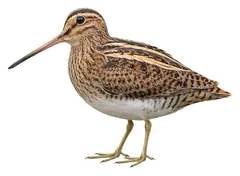 Swinhoe's SnipeGallinago megala
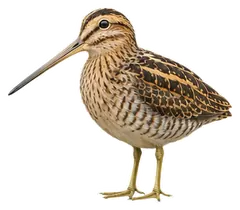 Pin-tailed SnipeGallinago stenura
 African SnipeGallinago nigripennis
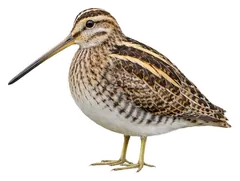 Common SnipeGallinago gallinago
 Wilson's SnipeGallinago delicata
 Giant SnipeGallinago undulata
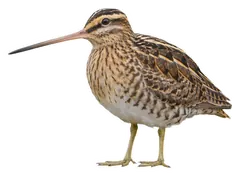
Download illustration
Free to use with credit: “Illustration: Field Stickers”. AI-generated from a written description only; no reference photo was used.