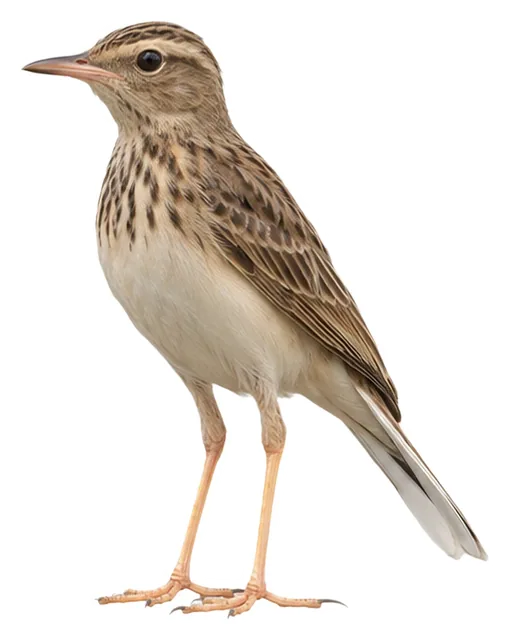
Paddyfield Pipit
Anthus rufulus Vieillot, 1818
≈15 cmLength24 cmWingspan20 gWeight
It runs very quickly on the ground and does not fly far even when alarmed.
Busiest months: December–February · Most records: India, Thailand, Singapore
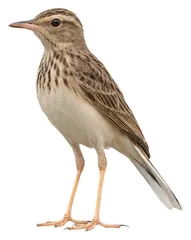
This sticker was generated from a written description only, without a reference photo, so it is more likely to contain mistakes than the others. Check a field guide for details.
AI-generated illustration. It may contain mistakes. · How the stickers are made
How to identify
Field marks
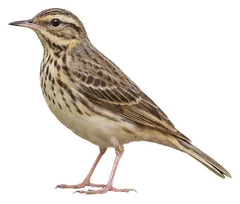
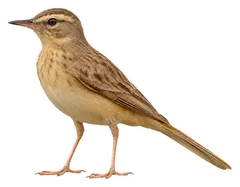
- Upperparts gray-brown with dark streaks
- Underparts pale, with streaks on the breast
- Long legs and feet and long tail
- Bill long and dark
Male, female and young
Sexes similar; juvenile has more richly colored underparts, with more prominent pale feather edges on the upperparts and spots on the breast.
Voice
The typical call is a series of “chip-chip-chip”.
Where and when it's recorded

Paddyfield Pipit has been recorded at 833 of the 8,171 birding hotspots we track, in 19 countries and regions.
Records by month Northern Hemisphere
Where it's recorded most
- Marina EastSingapore2,067 records
- Hessaraghatta KereIndia1,913 records
- Hoskote / Hosakote KereIndia1,898 records
More places
- Baruipur MarshesIndia1,491 records
- Kanha NP – Mukki ZoneIndia1,431 records
- Madayi ParaIndia1,393 records
- Stanley Reservoir – Pannavadi, MetturIndia1,216 records
- Vetal Tekdi/HillIndia1,097 records
- KattampallyIndia1,087 records
- Byatarayana Doddi KereIndia857 records
Countries and regions with the most records
eBird records via GBIF up to 2024-12-31. A record means someone listed it; more records partly mean more birders, not more birds.
About
The paddyfield pipit or Oriental pipit (Anthus rufulus) is a small passerine bird in the pipit and wagtail family. It is a resident (non-migratory) breeder in open scrub, grassland and cultivation in southern Asia east to the Philippines. Although among the few breeding pipits in the Asian region, identification becomes difficult in winter when several other species migrate into the region.
Excerpt from Wikipedia, CC BY-SA 4.0 · authors · Read more on Wikipedia
Questions
How big is the Paddyfield Pipit?
The Paddyfield Pipit is about ≈15 cm long, with a wingspan of 24 cm and weighs around 20 g.
Where does the Paddyfield Pipit live?
Its breeding range: Oriental, Australasia: widespread, also Lesser Sundas and Sulawesi. It is most often recorded in India, Thailand and Singapore.
When is the best time to see the Paddyfield Pipit?
At the hotspots we track, it is recorded most in January, February and December (Northern Hemisphere).
Is the Paddyfield Pipit endangered?
The IUCN Red List classifies the Paddyfield Pipit as Least Concern.
What does the Paddyfield Pipit eat?
Main food: Insects & other invertebrates.
What family is the Paddyfield Pipit in?
It belongs to the family Wagtails, Pipits (Motacillidae), order Passerines (Passeriformes).
How do you identify the Paddyfield Pipit?
Upperparts gray-brown with dark streaks. Underparts pale, with streaks on the breast. Long legs and feet and long tail.
How do male and female Paddyfield Pipit differ?
Sexes similar; juvenile has more richly colored underparts, with more prominent pale feather edges on the upperparts and spots on the breast.
At a glance
- Length
- ≈15 cm
- Wingspan
- 24 cm
- Weight
- 20 g
- Habitat
- Grassland
- Diet
- Insects & other invertebrates
- Lifestyle
- Active on the ground
- Migration
- Resident (barely migrates)
- Conservation
- Least Concern
More measurements
- Wing
- 77 mm
- Tail
- 56 mm
- Bill
- 15 mm
- Tarsus
- 25 mm
Averages from the AVONET dataset; length from field guides where available.
Range
Oriental, Australasia: widespread, also Lesser Sundas and Sulawesi
Breeding range, IOC World Bird List 15.2
Subspecies · 1
- Anthus rufulus rufulus India and Sri Lanka to s China and Indochina
Classification
- Order
- Passerines Passeriformes
- Family
- Wagtails, Pipits Motacillidae
- Genus
- Anthus
Other birds in the genus Anthus
 Richard's PipitAnthus richardi
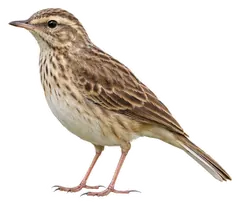 Australian PipitAnthus australis
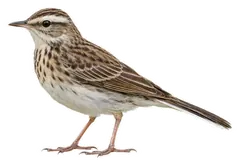 New Zealand PipitAnthus novaeseelandiae
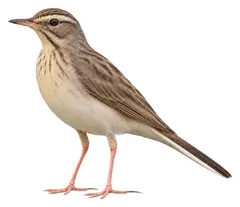 African PipitAnthus cinnamomeus
 Mountain PipitAnthus hoeschi
 Blyth's PipitAnthus godlewskii
 Tawny PipitAnthus campestris
 Long-billed PipitAnthus similis
 Nicholson's PipitAnthus nicholsoni
 Wood PipitAnthus nyassae
 Buffy PipitAnthus vaalensis
 Plain-backed PipitAnthus leucophrys
Download illustration
Free to use with credit: “Illustration: Field Stickers”. AI-generated from a written description only; no reference photo was used.