Tawny Pipit
Anthus campestris (Linnaeus, 1758)
16 cmLength23 gWeight
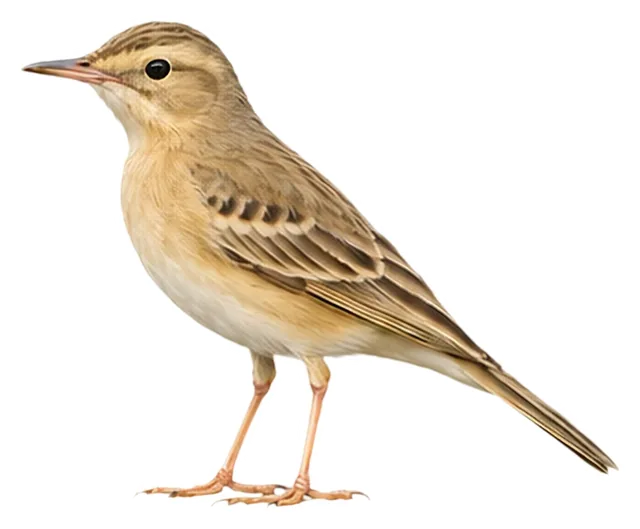
This inconspicuous large pipit on the ground has sandy-brown upperparts and pale underparts.
Busiest months: April and September–October · Most records: United Arab Emirates, India, Spain
Looks like Richard's Pipit
AI-generated illustration. It may contain mistakes. · How the stickers are made
How to identify
Field marks
- Upperparts sandy-brown; underparts pale
- Fewer streaks than Richard's Pipit
- Bill narrower than in Richard's Pipit
- Legs and feet, wings and tail shorter than in Richard's Pipit
Voice
A “schip” call, higher-pitched than in Richard's Pipit; the song is a loud, two-syllable “chir-ree chir-ree”, repeated in short phrases.
Similar species
Where and when it's recorded

Tawny Pipit has been recorded at 707 of the 8,171 birding hotspots we track, in 82 countries and regions.
Records by month Northern Hemisphere
Where it's recorded most
- Wamm FarmsUnited Arab Emirates1,143 records
- Private estate near Green MubazzarahUnited Arab Emirates1,071 records
- RivaTürkiye925 records
More places
- Dubai Pivot FieldsUnited Arab Emirates796 records
- Tal Chhapar SanctuaryIndia495 records
- Laguna de Pitillas RN – AreaSpain417 records
- Green MubazzarahUnited Arab Emirates401 records
- Besh Barmag bottleneckAzerbaijan362 records
- PN Sudoeste Alentejano e Costa Vicentina – CabranosaPortugal325 records
- Madayi ParaIndia322 records
Countries and regions with the most records
eBird records via GBIF up to 2024-12-31. A record means someone listed it; more records partly mean more birders, not more birds.
About
The tawny pipit (Anthus campestris) is a medium-large passerine bird which breeds in much of the central Palearctic from northwest Africa and Portugal to Central Siberia and on to Inner Mongolia. It is a migrant moving in winter to tropical Africa and the Indian subcontinent.
Excerpt from Wikipedia, CC BY-SA 4.0 · authors · Read more on Wikipedia
Questions
How big is the Tawny Pipit?
The Tawny Pipit is about 16 cm long and weighs around 23 g.
Where does the Tawny Pipit live?
Its breeding range: Palearctic, Africa: western Europe to western Mongolia and south to northwestern Africa, the Middle East and Afghanistan. It is most often recorded in United Arab Emirates, India and Spain.
When is the best time to see the Tawny Pipit?
At the hotspots we track, it is recorded most in April, September and October (Northern Hemisphere).
Is the Tawny Pipit endangered?
The IUCN Red List classifies the Tawny Pipit as Least Concern.
What does the Tawny Pipit eat?
Main food: Insects & other invertebrates.
What family is the Tawny Pipit in?
It belongs to the family Wagtails, Pipits (Motacillidae), order Passerines (Passeriformes).
How do you identify the Tawny Pipit?
Upperparts sandy-brown; underparts pale. Fewer streaks than Richard's Pipit. Bill narrower than in Richard's Pipit.
How do you tell the Tawny Pipit from the Richard's Pipit?
Very similar to Richard's Pipit, but slightly smaller, with shorter wings, tail, legs and feet, a narrower bill and fewer streaks; its “schip” call is higher-pitched.
At a glance
- Length
- 16 cm
- Weight
- 23 g
- Habitat
- Grassland
- Diet
- Insects & other invertebrates
- Lifestyle
- Active on the ground
- Migration
- Migratory
- Conservation
- Least Concern
More measurements
- Wing
- 91 mm
- Tail
- 71 mm
- Bill
- 16 mm
- Tarsus
- 25 mm
Averages from the AVONET dataset; length from field guides where available.
Range
Palearctic, Africa: western Europe to western Mongolia and south to northwestern Africa, the Middle East and Afghanistan
Breeding range, IOC World Bird List 15.2
Classification
- Order
- Passerines Passeriformes
- Family
- Wagtails, Pipits Motacillidae
- Genus
- Anthus
Other birds in the genus Anthus
 Richard's PipitAnthus richardi
 Paddyfield PipitAnthus rufulus
 Australian PipitAnthus australis
 New Zealand PipitAnthus novaeseelandiae
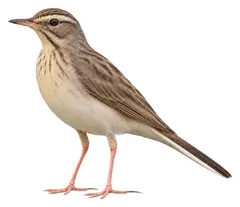 African PipitAnthus cinnamomeus
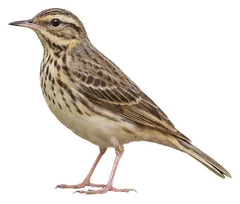 Mountain PipitAnthus hoeschi
 Blyth's PipitAnthus godlewskii
 Long-billed PipitAnthus similis
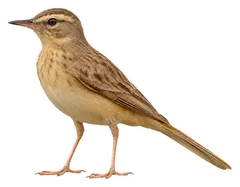 Nicholson's PipitAnthus nicholsoni
 Wood PipitAnthus nyassae
 Buffy PipitAnthus vaalensis
 Plain-backed PipitAnthus leucophrys

Download illustration
Free to use with credit: “Illustration: Field Stickers”. AI-generated. Its appearance was checked against a reference photo by cog2022; the pose follows our standard. ↗