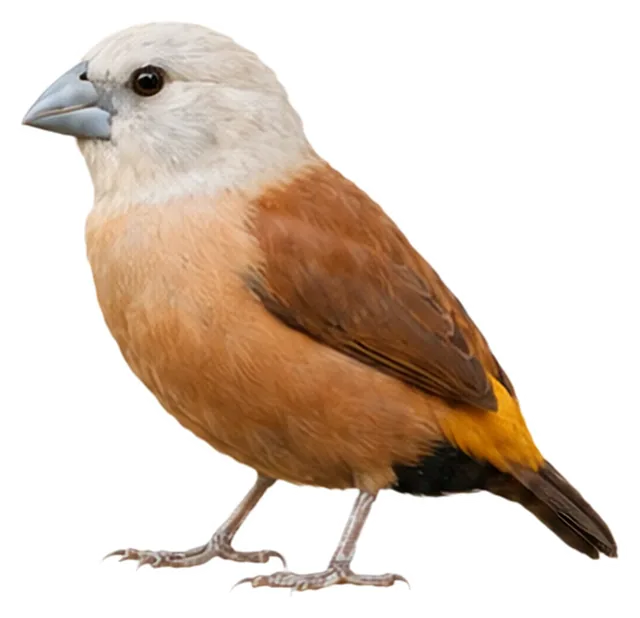
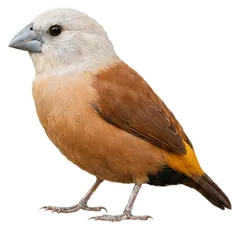
Pale-headed Munia
Lonchura pallida (Wallace, 1864)
10–11 cmLength12 gWeight
The pale-headed munia (Lonchura pallida) is a species of estrildid finch native to eastern Indonesia and Timor-Leste.
Busiest months: July and October · Most records: Indonesia, Timor-Leste
AI-generated illustration. It may contain mistakes. · How the stickers are made
Where and when it's recorded

Pale-headed Munia has been recorded at 15 of the 8,171 birding hotspots we track, in 2 countries and regions.
Records by month Southern Hemisphere
Where it's recorded most
- Lore Lindu NPIndonesia23 records
- Lore Lindu NP – Lake Tambing vicinityIndonesia9 records
- TasiTolu LakeTimor-Leste8 records
More places
- Seical river estuary, SeicalTimor-Leste5 records
- Comoro River EstuaryTimor-Leste4 records
- BeloiTimor-Leste3 records
- Manatuto salt pans & mangrovesTimor-Leste2 records
- Lagoa MaubaraTimor-Leste2 records
- Gunung MahawuIndonesia2 records
- Tangkoko Batuangus NR – Forest andIndonesia2 records
Countries and regions with the most records
eBird records via GBIF up to 2024-12-31. A record means someone listed it; more records partly mean more birders, not more birds.
About
The pale-headed munia (Lonchura pallida) is a species of estrildid finch native to eastern Indonesia and Timor-Leste. It inhabits subtropical and tropical lowlands, dry shrubland, grassland, marshes and agricultural areas. The species has shown recent range expansion due to increasing agriculture and land clearance.
Excerpt from Wikipedia, CC BY-SA 4.0 · authors · Read more on Wikipedia
Questions
How big is the Pale-headed Munia?
The Pale-headed Munia is about 10–11 cm long and weighs around 12 g.
Where does the Pale-headed Munia live?
Its breeding range: Australasia: Sulawesi and Lesser Sundas. It is most often recorded in Indonesia and Timor-Leste.
When is the best time to see the Pale-headed Munia?
At the hotspots we track, it is recorded most in July and October (Southern Hemisphere).
Is the Pale-headed Munia endangered?
The IUCN Red List classifies the Pale-headed Munia as Least Concern.
What does the Pale-headed Munia eat?
Main food: Seeds.
What family is the Pale-headed Munia in?
It belongs to the family Waxbills, Munias & Allies (Estrildidae), order Passerines (Passeriformes).
At a glance
- Length
- 10–11 cm
- Weight
- 12 g
- Habitat
- Shrubland
- Diet
- Seeds
- Lifestyle
- Varied
- Migration
- Resident (barely migrates)
- Conservation
- Least Concern
More measurements
- Wing
- 52 mm
- Tail
- 35 mm
- Bill
- 12 mm
- Tarsus
- 15 mm
Averages from the AVONET dataset; length from field guides where available.
Range
Australasia: Sulawesi and Lesser Sundas
Breeding range, IOC World Bird List 15.2
Classification
- Order
- Passerines Passeriformes
- Family
- Waxbills, Munias & Allies Estrildidae
- Genus
- Lonchura
Other birds in the genus Lonchura
 Scaly-breasted MuniaLonchura punctulata
 Black-throated MuniaLonchura kelaarti
 Black-faced MuniaLonchura molucca
 White-rumped MuniaLonchura striata
 Dusky MuniaLonchura fuscans
 White-bellied MuniaLonchura leucogastra
 Javan MuniaLonchura leucogastroides
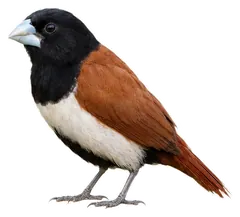 Tricolored MuniaLonchura malacca
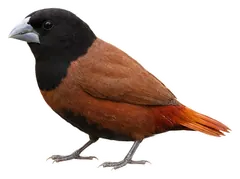 Chestnut MuniaLonchura atricapilla
 White-capped MuniaLonchura ferruginosa
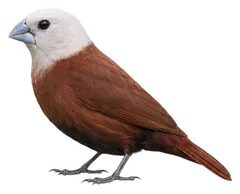 White-headed MuniaLonchura maja
 Great-billed MannikinLonchura grandis
 WebP · 1070 px