White-headed Munia
Lonchura maja (Linnaeus, 1766)
11 cmLength12 gWeight
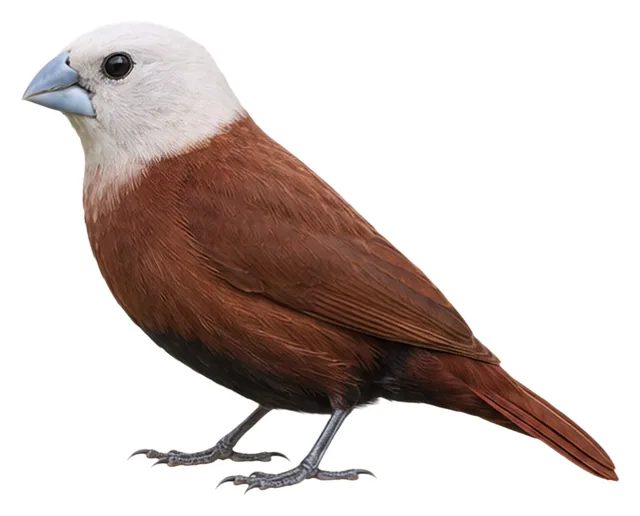
This small munia has an entirely white head and throat and a rufous body, and tends to move in flocks.
Busiest months: September–December · Most records: Singapore, Indonesia, China
Looks like Tricolored Munia, Chestnut Munia
AI-generated illustration. It may contain mistakes. · How the stickers are made
How to identify
Field marks
- Entire head and throat white
- Upperparts, flanks and wings chestnut-rufous
- Belly black, tail blackish-brown
- Bill gray
Male, female and young
Differences between the sexes are subtle: the male has a whiter head that whitens further with age; the juvenile has cinnamon-tinged upperparts and a pale yellowish-brown face and underparts.
Voice
High-pitched chirps.
Similar species
Where and when it's recorded

White-headed Munia has been recorded at 183 of the 8,171 birding hotspots we track, in 9 countries and regions.
Records by month Northern Hemisphere
Where it's recorded most
- Long ValleyHong Kong (China)314 records
- Marina EastSingapore296 records
- Taman Botani Negara Shah AlamMalaysia226 records
More places
- Nusa Dua WTPIndonesia169 records
- Sungai Balang rice fieldsMalaysia164 records
- Salt PansIndonesia146 records
- Kebun Raya BogorIndonesia128 records
- Campuhan RidgeIndonesia105 records
- Guandu IBATaiwan (China)86 records
- Holland PlainSingapore82 records
Countries and regions with the most records
eBird records via GBIF up to 2024-12-31. A record means someone listed it; more records partly mean more birders, not more birds.
Questions
How big is the White-headed Munia?
The White-headed Munia is about 11 cm long and weighs around 12 g.
Where does the White-headed Munia live?
Its breeding range: Oriental: Malay Peninsula, southern Vietnam, Sumatra, Java and Bali. It is most often recorded in Singapore, Indonesia and China.
When is the best time to see the White-headed Munia?
At the hotspots we track, it is recorded most in September, October, November and December (Northern Hemisphere).
Is the White-headed Munia endangered?
The IUCN Red List classifies the White-headed Munia as Least Concern.
What does the White-headed Munia eat?
Main food: Seeds.
What family is the White-headed Munia in?
It belongs to the family Waxbills, Munias & Allies (Estrildidae), order Passerines (Passeriformes).
How do you identify the White-headed Munia?
Entire head and throat white. Upperparts, flanks and wings chestnut-rufous. Belly black, tail blackish-brown.
How do male and female White-headed Munia differ?
Differences between the sexes are subtle: the male has a whiter head that whitens further with age; the juvenile has cinnamon-tinged upperparts and a pale yellowish-brown face and underparts.
How do you tell the White-headed Munia from the Tricolored Munia?
This species has paler rufous plumage than Tricolored Munia, with the entire head and throat white.
At a glance
- Length
- 11 cm
- Weight
- 12 g
- Habitat
- Wetland
- Diet
- Seeds
- Lifestyle
- Varied
- Migration
- Resident (barely migrates)
- Conservation
- Least Concern
More measurements
- Wing
- 54 mm
- Tail
- 36 mm
- Bill
- 12 mm
- Tarsus
- 15 mm
Averages from the AVONET dataset; length from field guides where available.
Range
Oriental: Malay Peninsula, southern Vietnam, Sumatra, Java and Bali
Breeding range, IOC World Bird List 15.2
Classification
- Order
- Passerines Passeriformes
- Family
- Waxbills, Munias & Allies Estrildidae
- Genus
- Lonchura
Other birds in the genus Lonchura
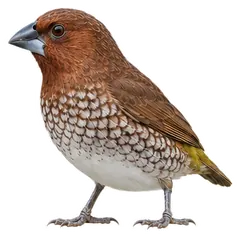 Scaly-breasted MuniaLonchura punctulata
 Black-throated MuniaLonchura kelaarti
 Black-faced MuniaLonchura molucca
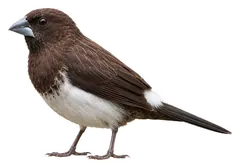 White-rumped MuniaLonchura striata
 Dusky MuniaLonchura fuscans
 White-bellied MuniaLonchura leucogastra
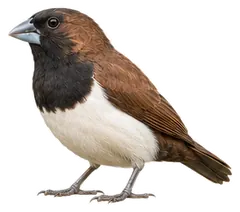 Javan MuniaLonchura leucogastroides
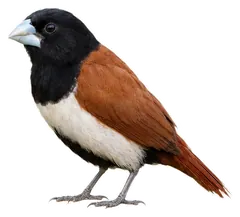 Tricolored MuniaLonchura malacca
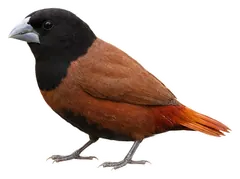 Chestnut MuniaLonchura atricapilla
 White-capped MuniaLonchura ferruginosa
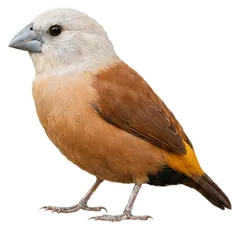 Pale-headed MuniaLonchura pallida
 Great-billed MannikinLonchura grandis
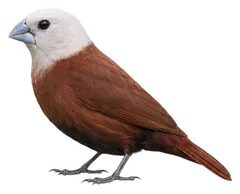
Download illustration
Free to use with credit: “Illustration: Field Stickers”. AI-generated. Its appearance was checked against a reference photo by akw123; the pose follows our standard. ↗