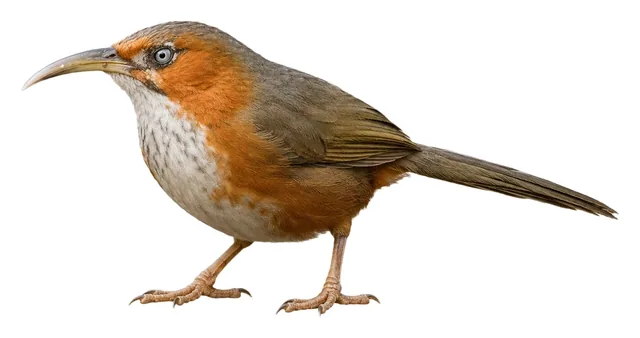
Rusty-cheeked Scimitar Babbler
Erythrogenys erythrogenys (Vigors, 1831)
≈24 cmLength55 gWeight
This vocal bird has a long, decurved, scimitar-like bill and rusty sides to the face, and often forms small flocks.
Busiest months: February · Most records: India, Nepal, Pakistan
Looks like Red-eyed Scimitar Babbler
AI-generated illustration. It may contain mistakes. · How the stickers are made
How to identify
Field marks
- Long, decurved bill, like a scimitar
- Rusty sides of face and head
- Olive-brown upperparts
- Mostly white belly
Male, female and young
Sexes similar.
Voice
Soft, flute-like whistles, a two-syllable “CUE..PE...CUE..pe”; the mate responds with a single note.
Similar species
Where and when it's recorded

Rusty-cheeked Scimitar Babbler has been recorded at 93 of the 8,171 birding hotspots we track, in 5 countries and regions.
Records by month Northern Hemisphere
Where it's recorded most
- Wildlife Institute of IndiaIndia2,385 records
- SattalIndia905 records
- Sangla and AreaNepal840 records
More places
- Wildlife Institute of India (WII) – Nature Trail & LakeIndia607 records
- Forest Research Institute (FRI), New Forest CampusIndia375 records
- PangotIndia298 records
- Corbett NP – DhikalaIndia288 records
- Ichangu NarayanNepal262 records
- Margalla Hills Trail 5Pakistan242 records
- Munsyari – Bheema WodeyarIndia198 records
Countries and regions with the most records
eBird records via GBIF up to 2024-12-31. A record means someone listed it; more records partly mean more birders, not more birds.
About
The rusty-cheeked scimitar babbler (Erythrogenys erythrogenys) is a passerine bird in the babbler family Timaliidae that is found in the Himalayas from northeast Pakistan to Bhutan. It was formerly considered as conspecific with the red-eyed scimitar babbler that is found in eastern Myanmar and northwestern Thailand.
Excerpt from Wikipedia, CC BY-SA 4.0 · authors · Read more on Wikipedia
Questions
How big is the Rusty-cheeked Scimitar Babbler?
The Rusty-cheeked Scimitar Babbler is about ≈24 cm long and weighs around 55 g.
Where does the Rusty-cheeked Scimitar Babbler live?
Its breeding range: Oriental: Himalayas from northeastern Pakistan to Bhutan. It is most often recorded in India, Nepal and Pakistan.
When is the best time to see the Rusty-cheeked Scimitar Babbler?
At the hotspots we track, it is recorded most in February (Northern Hemisphere).
Is the Rusty-cheeked Scimitar Babbler endangered?
The IUCN Red List classifies the Rusty-cheeked Scimitar Babbler as Least Concern.
What does the Rusty-cheeked Scimitar Babbler eat?
Main food: Insects & other invertebrates.
What family is the Rusty-cheeked Scimitar Babbler in?
It belongs to the family Babblers, Scimitar Babblers (Timaliidae), order Passerines (Passeriformes).
How do you identify the Rusty-cheeked Scimitar Babbler?
Long, decurved bill, like a scimitar. Rusty sides of face and head. Olive-brown upperparts.
How do male and female Rusty-cheeked Scimitar Babbler differ?
Sexes similar.
How do you tell the Rusty-cheeked Scimitar Babbler from the Red-eyed Scimitar Babbler?
Formerly treated as the same species, but separated because of differences in appearance and calls; Red-eyed Scimitar Babbler occurs in eastern Myanmar and northwestern Thailand.
At a glance
- Length
- ≈24 cm
- Weight
- 55 g
- Habitat
- Shrubland
- Diet
- Insects & other invertebrates
- Lifestyle
- Active on the ground
- Migration
- Resident (barely migrates)
- Conservation
- Least Concern
More measurements
- Wing
- 95 mm
- Tail
- 108 mm
- Bill
- 34 mm
- Tarsus
- 37 mm
Averages from the AVONET dataset; length from field guides where available.
Range
Oriental: Himalayas from northeastern Pakistan to Bhutan
Breeding range, IOC World Bird List 15.2
Classification
- Order
- Passerines Passeriformes
- Family
- Babblers, Scimitar Babblers Timaliidae
- Genus
- Erythrogenys
Other birds in the genus Erythrogenys
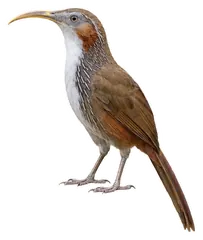 Large Scimitar BabblerErythrogenys hypoleucos
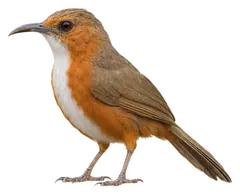 Red-eyed Scimitar BabblerErythrogenys imberbis
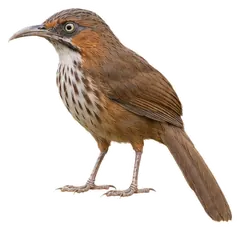 Spot-breasted Scimitar BabblerErythrogenys mcclellandi
 Black-streaked Scimitar BabblerErythrogenys gravivox
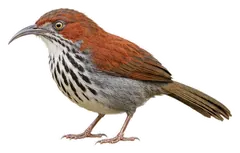 Grey-sided Scimitar BabblerErythrogenys swinhoei
 Black-necklaced Scimitar BabblerErythrogenys erythrocnemis
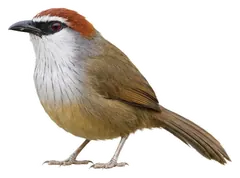 Chestnut-capped BabblerTimalia pileata
 Tawny-bellied BabblerDumetia hyperythra
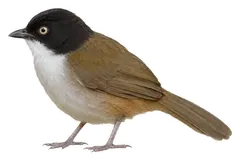 Dark-fronted BabblerDumetia atriceps
 Grey-faced Tit-BabblerMixornis kelleyi
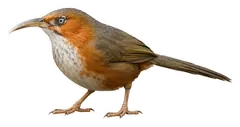
Download illustration
Free to use with credit: “Illustration: Field Stickers”. AI-generated. Its appearance was checked against a reference photo by pelagicgraf; the pose follows our standard. ↗
In other languages
- EnglishRusty-cheeked Scimitar Babbler
- 简体中文锈脸钩嘴鹛
- 繁體中文鏽臉鉤嘴鶥
- 日本語ホオアカマルハシ
- DeutschRotwangensäbler
- FrançaisPomatorhin à joues rousses
- EspañolCimitarra carirrufa
- Portuguêstagarela-ferrugíneo
- ItalianoGarrulo scimitarra guanceruggine
- NederlandsRoodwangkruiplijster
- РусскийКраснощёкий саблеклюв
- Svenskarostkindad sabeltimalia
- DanskRustflanket Segltimalie
- Polskisierpodziób rudolicy