
Sedge Wren
Cistothorus stellaris (Naumann, JF, 1823)
9 gWeight
The sedge wren (Cistothorus stellaris) is a small and secretive passerine bird in the family Troglodytidae.
Busiest months: April–May · Most records: United States, Canada, Mexico
AI-generated illustration. It may contain mistakes. · How the stickers are made
Where and when it's recorded

Sedge Wren has been recorded at 331 of the 8,171 birding hotspots we track, in 3 countries and regions.
Records by month Northern Hemisphere
Where it's recorded most
- Jocelyn Nungaray NWR (Anahuac)United States2,578 records
- Lake Apopka North Shore – Orange County sectionUnited States1,558 records
- Lake Apopka Wildlife DriveUnited States1,529 records
More places
- Sweetwater Wetlands ParkUnited States1,375 records
- Montrose Point Bird Sanctuary, Lincoln Park, ChicagoUnited States1,288 records
- Galveston Island SPUnited States1,095 records
- St. Marks NWRUnited States1,082 records
- Sabine WoodsUnited States988 records
- Horicon NWR – Auto Tour and TrailsUnited States905 records
- Commons Ford Ranch Metro ParkUnited States884 records
Countries and regions with the most records
eBird records via GBIF up to 2024-12-31. A record means someone listed it; more records partly mean more birders, not more birds.
About
The sedge wren (Cistothorus stellaris) is a small and secretive passerine bird in the family Troglodytidae. It is widely distributed in North America. It is often found in wet grasslands and meadows where it nests in the tall grasses and sedges and feeds on insects.
Excerpt from Wikipedia, CC BY-SA 4.0 · authors · Read more on Wikipedia
Questions
How big is the Sedge Wren?
The Sedge Wren weighs around 9 g.
Where does the Sedge Wren live?
Its breeding range: North America: south-central, southeastern Canada and northeastern USA. It is most often recorded in United States, Canada and Mexico.
When is the best time to see the Sedge Wren?
At the hotspots we track, it is recorded most in April and May (Northern Hemisphere).
Is the Sedge Wren endangered?
The IUCN Red List classifies the Sedge Wren as Least Concern.
What does the Sedge Wren eat?
Main food: Insects & other invertebrates.
What family is the Sedge Wren in?
It belongs to the family Wrens (Troglodytidae), order Passerines (Passeriformes).
At a glance
- Weight
- 9 g
- Habitat
- Grassland
- Diet
- Insects & other invertebrates
- Lifestyle
- Perches in trees
- Migration
- Partial migrant
- Conservation
- Least Concern
More measurements
- Wing
- 45 mm
- Tail
- 36 mm
- Bill
- 12 mm
- Tarsus
- 16 mm
Averages from the AVONET dataset; length from field guides where available.
Range
North America: south-central, southeastern Canada and northeastern USA
Breeding range, IOC World Bird List 15.2
Classification
- Order
- Passerines Passeriformes
- Family
- Wrens Troglodytidae
- Genus
- Cistothorus
Other birds in the genus Cistothorus
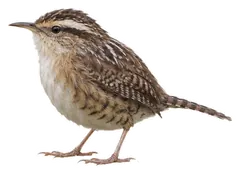 Merida WrenCistothorus meridae
 Apolinar's WrenCistothorus apolinari
 Grass WrenCistothorus platensis
 Marsh WrenCistothorus palustris
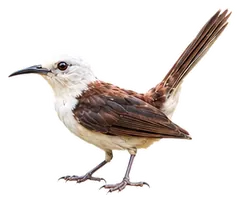 White-headed WrenCampylorhynchus albobrunneus
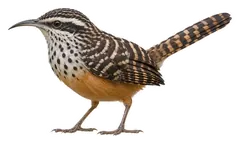 Band-backed WrenCampylorhynchus zonatus
 Grey-barred WrenCampylorhynchus megalopterus
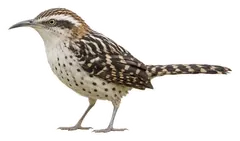 Stripe-backed WrenCampylorhynchus nuchalis
 Fasciated WrenCampylorhynchus fasciatus
 Giant WrenCampylorhynchus chiapensis
 WebP · 1070 px