
White-rumped Sandpiper
Calidris fuscicollis (Vieillot, 1819)
≈20 cmLength37 cmWingspan43 gWeight
The white-rumped sandpiper (Calidris fuscicollis) is a small migratory shorebird that breeds in the northern tundra of Canada and Alaska.
Busiest months: May · Most records: United States, Canada, Argentina
AI-generated illustration. It may contain mistakes. · How the stickers are made
How to identify
Field marks
- Wings long, extending slightly beyond the tail tip when folded
- Pale supercilium
- Bill moderately long, slender and dark; legs and feet very black
Male, female and young
Sexes similar in appearance in all seasons; plumage less distinct in winter.
Voice
A repeated “pip, pip, pip”, also a metallic “tzeep”, like two small stones rubbing together.
Where and when it's recorded

White-rumped Sandpiper has been recorded at 944 of the 8,171 birding hotspots we track, in 83 countries and regions.
Records by month Northern Hemisphere
To protect this bird from disturbance, we don't list exact sites.
Countries and regions with the most records
eBird records via GBIF up to 2024-12-31. A record means someone listed it; more records partly mean more birders, not more birds.
About
The white-rumped sandpiper (Calidris fuscicollis) is a small migratory shorebird that breeds in the northern tundra of Canada and Alaska. This bird can be difficult to distinguish from other similar tiny shorebirds; these are known collectively as "peeps" or "stints".
Excerpt from Wikipedia, CC BY-SA 4.0 · authors · Read more on Wikipedia
Questions
How big is the White-rumped Sandpiper?
The White-rumped Sandpiper is about ≈20 cm long, with a wingspan of 37 cm and weighs around 43 g.
Where does the White-rumped Sandpiper live?
Its breeding range: North America: high to low Arctic wet tundra of far northern Nearctic: North Slope Alaska, coastal northern Canada to northwestern Hudson Bay, and Banks to Devon and Baffin islands (northeastern Canada). It is most often recorded in United States, Canada and Argentina.
When is the best time to see the White-rumped Sandpiper?
At the hotspots we track, it is recorded most in May (Northern Hemisphere).
Is the White-rumped Sandpiper endangered?
The IUCN Red List classifies the White-rumped Sandpiper as Vulnerable.
What does the White-rumped Sandpiper eat?
Main food: Fish, shrimp & shellfish.
What family is the White-rumped Sandpiper in?
It belongs to the family Sandpipers, Snipes (Scolopacidae), order Charadriiformes.
At a glance
- Length
- ≈20 cm
- Wingspan
- 37 cm
- Weight
- 43 g
- Habitat
- Wetland
- Diet
- Fish, shrimp & shellfish
- Lifestyle
- Active on the ground
- Migration
- Migratory
- Conservation
- Vulnerable
More measurements
- Wing
- 118 mm
- Tail
- 48 mm
- Bill
- 26 mm
- Tarsus
- 24 mm
Averages from the AVONET dataset; length from field guides where available.
Range
North America: high to low Arctic wet tundra of far northern Nearctic: North Slope Alaska, coastal northern Canada to northwestern Hudson Bay, and Banks to Devon and Baffin islands (northeastern Canada)
Breeding range, IOC World Bird List 15.2
Classification
- Order
- Charadriiformes
- Family
- Sandpipers, Snipes Scolopacidae
- Genus
- Calidris
Other birds in the genus Calidris
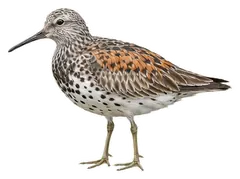 Great KnotCalidris tenuirostris
 Red KnotCalidris canutus
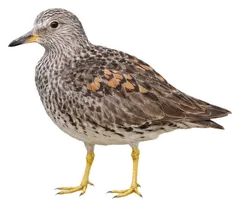 SurfbirdCalidris virgata
 RuffCalidris pugnax
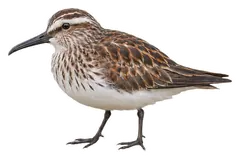 Broad-billed SandpiperCalidris falcinellus
 Sharp-tailed SandpiperCalidris acuminata
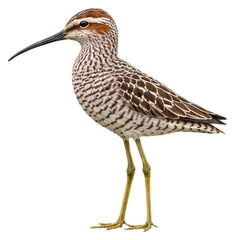 Stilt SandpiperCalidris himantopus
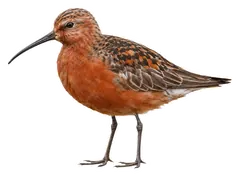 Curlew SandpiperCalidris ferruginea
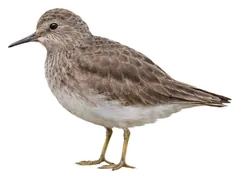 Temminck's StintCalidris temminckii
 Long-toed StintCalidris subminuta
 Red-necked StintCalidris ruficollis
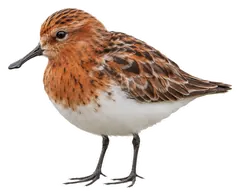 Spoon-billed SandpiperCalidris pygmaea
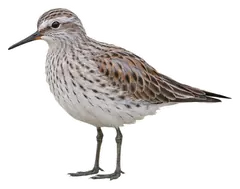
Download illustration
Free to use with credit: “Illustration: Field Stickers”. AI-generated. Its appearance was checked against a reference photo by Christoph Moning; the pose follows our standard. ↗
In other languages
- EnglishWhite-rumped Sandpiper
- 简体中文白腰滨鹬
- 繁體中文白腰濱鷸
- 日本語コシジロウズラシギ
- 한국어흰허리도요
- DeutschWeißbürzel-Strandläufer
- FrançaisBécasseau à croupion blanc
- EspañolCorrelimos culiblanco
- Portuguêspilrito-de-sobre-branco
- ItalianoGambecchio di Bonaparte
- NederlandsBonapartes Strandloper
- РусскийБонапартов песочник
- Svenskavitgumpsnäppa
- DanskHvidrygget Ryle
- Polskibiegus białorzytny