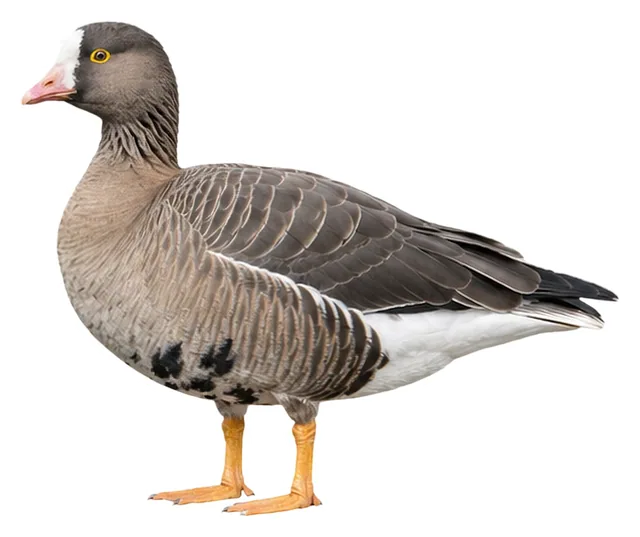
Lesser White-fronted Goose
Anser erythropus (Linnaeus, 1758)
≈58 cmLength130 cmWingspan1.8 kgWeight
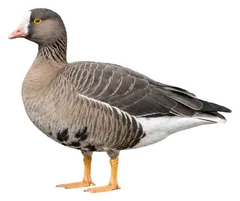
Smaller than Greater White-fronted Goose, it has golden-yellow around the eye and a white ring at the base of the bill, with white extending farther back onto the crown.
Busiest months: January–February · Most records: China, Sweden, Greece
Looks like Greater White-fronted Goose
AI-generated illustration. It may contain mistakes. · How the stickers are made
How to identify
Field marks
- White ring at the base of the bill extends onto the crown
- Golden-yellow around the eye
- Gray-brown overall, with faint pale barring on the upperparts
- Uppertail-coverts white, tail feathers black with white tips
Male, female and young
Sexes show no obvious differences apart from size.
Voice
Call sharper than that of Greater White-fronted Goose.
Similar species
Where and when it's recorded

Lesser White-fronted Goose has been recorded at 283 of the 8,171 birding hotspots we track, in 40 countries and regions.
Records by month Northern Hemisphere
To protect this bird from disturbance, we don't list exact sites.
Countries and regions with the most records
eBird records via GBIF up to 2024-12-31. A record means someone listed it; more records partly mean more birders, not more birds.
About
The lesser white-fronted goose (Anser erythropus) is a goose closely related to the larger greater white-fronted goose (A. albifrons). It breeds in the northernmost Palearctic, but it is a scarce breeder in Europe, with a reintroduction attempt in Fennoscandia.
Excerpt from Wikipedia, CC BY-SA 4.0 · authors · Read more on Wikipedia
Questions
How big is the Lesser White-fronted Goose?
The Lesser White-fronted Goose is about ≈58 cm long, with a wingspan of 130 cm and weighs around 1.8 kg.
Where does the Lesser White-fronted Goose live?
Its breeding range: Palearctic: northern Eurasia. It is most often recorded in China, Sweden and Greece.
When is the best time to see the Lesser White-fronted Goose?
At the hotspots we track, it is recorded most in January and February (Northern Hemisphere).
Is the Lesser White-fronted Goose endangered?
The IUCN Red List classifies the Lesser White-fronted Goose as Vulnerable.
What does the Lesser White-fronted Goose eat?
Main food: Land plants.
What family is the Lesser White-fronted Goose in?
It belongs to the family Ducks, Geese, Swans (Anatidae), order Anseriformes.
How do you identify the Lesser White-fronted Goose?
White ring at the base of the bill extends onto the crown. Golden-yellow around the eye. Gray-brown overall, with faint pale barring on the upperparts.
How do male and female Lesser White-fronted Goose differ?
Sexes show no obvious differences apart from size.
How do you tell the Lesser White-fronted Goose from the Greater White-fronted Goose?
This species is smaller, with white extending farther back on the head, golden-yellow around the eye and a sharper call.
At a glance
- Length
- ≈58 cm
- Wingspan
- 130 cm
- Weight
- 1.8 kg
- Habitat
- Grassland
- Diet
- Land plants
- Lifestyle
- Active on the ground
- Migration
- Migratory
- Conservation
- Vulnerable
More measurements
- Wing
- 369 mm
- Tail
- 112 mm
- Bill
- 41 mm
- Tarsus
- 61 mm
Averages from the AVONET dataset; length from field guides where available.
Range
Palearctic: northern Eurasia
Breeding range, IOC World Bird List 15.2
Classification
- Order
- Anseriformes
- Family
- Ducks, Geese, Swans Anatidae
- Genus
- Anser
Other birds in the genus Anser
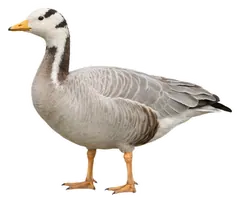 Bar-headed GooseAnser indicus
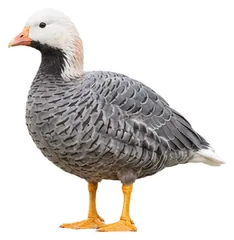 Emperor GooseAnser canagicus
 Ross's GooseAnser rossii
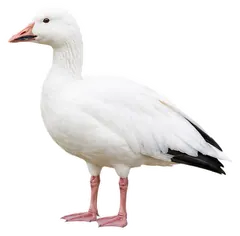 Snow GooseAnser caerulescens
 Greylag GooseAnser anser
 Swan GooseAnser cygnoides
 Taiga Bean GooseAnser fabalis
 Pink-footed GooseAnser brachyrhynchus
 Tundra Bean GooseAnser serrirostris
 Greater White-fronted GooseAnser albifrons
Download illustration
Free to use with credit: “Illustration: Field Stickers”. AI-generated. Its appearance was checked against a reference photo by an uncredited photographer; the pose follows our standard. ↗
