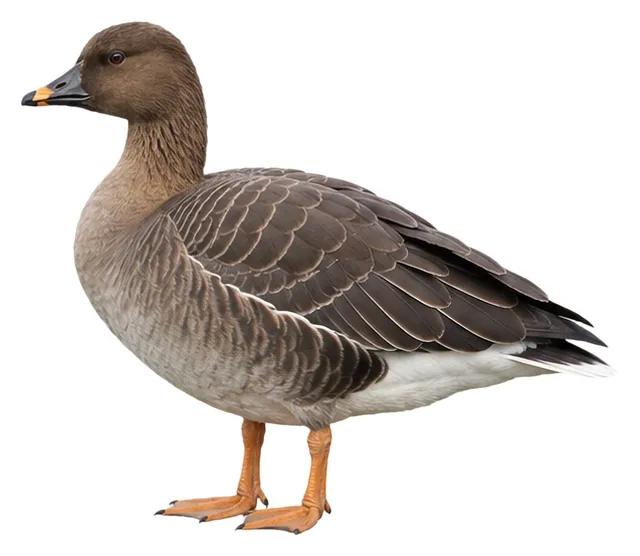
Tundra Bean Goose
Anser serrirostris Gould, 1852
≈70 cmLength2.7 kgWeight
This goose has a single orange band across its black bill, bright orange legs and feet, and a loud trumpet-like call.
Busiest months: October–January · Most records: China, South Korea, Poland
Looks like Greater White-fronted Goose, Lesser White-fronted Goose
AI-generated illustration. It may contain mistakes. · How the stickers are made
How to identify
Field marks
- Base of the bill and bill tip black, with a single orange band between
- Legs and feet bright orange
- Upperwing coverts dark brown with narrow white feather edges
- Body length 68–90 cm
Male, female and young
In the nominate subspecies, male averages 3.2 kg and female 2.84 kg.
Voice
Like a loud trumpet, higher in pitch in the smaller subspecies.
Similar species
Where and when it's recorded

Tundra Bean Goose has been recorded at 816 of the 8,171 birding hotspots we track, in 47 countries and regions.
Records by month Northern Hemisphere
Where it's recorded most
- Taipei – Tianliaoyang WetlandTaiwan (China)419 records
- Eschefelder TeicheGermany347 records
- Paju – Sannam WetlandSouth Korea304 records
More places
- Geschiebesperre HollenstedtGermany260 records
- Objezierze FishpondsPoland246 records
- Hel – CypelPoland239 records
- Seoul – Gangseo Wetland Eco ParkSouth Korea220 records
- Mechtersheimer TongrubenGermany216 records
- Long ValleyHong Kong (China)215 records
- Paju – Gongneungcheon(stream) & Fields-SouthSouth Korea208 records
Countries and regions with the most records
eBird records via GBIF up to 2024-12-31. A record means someone listed it; more records partly mean more birders, not more birds.
About
The tundra bean goose (Anser serrirostris) is a goose that breeds in northern Siberia. This and the taiga bean goose are recognised as separate species by the American Ornithological Society and International Ornithologists' Union, but are considered a single species by other authorities (collectively called bean goose). It is migratory and winters further south in Asia.
Excerpt from Wikipedia, CC BY-SA 4.0 · authors · Read more on Wikipedia
Questions
How big is the Tundra Bean Goose?
The Tundra Bean Goose is about ≈70 cm long and weighs around 2.7 kg.
Where does the Tundra Bean Goose live?
Its breeding range: Palearctic: northern. It is most often recorded in China, South Korea and Poland.
When is the best time to see the Tundra Bean Goose?
At the hotspots we track, it is recorded most in January, October, November and December (Northern Hemisphere).
What does the Tundra Bean Goose eat?
Main food: Land plants.
What family is the Tundra Bean Goose in?
It belongs to the family Ducks, Geese, Swans (Anatidae), order Anseriformes.
At a glance
- Length
- ≈70 cm
- Weight
- 2.7 kg
- Habitat
- Grassland
- Diet
- Land plants
- Lifestyle
- Active on the ground
- Migration
- Migratory
More measurements
- Wing
- 432 mm
- Tail
- 141 mm
- Bill
- 49 mm
- Tarsus
- 74 mm
Averages from the AVONET dataset; length from field guides where available.
Range
Palearctic: northern
Breeding range, IOC World Bird List 15.2
Subspecies · 1
- Anser serrirostris serrirostris ne Siberia | non-breeding: China, Korean Pen. and Japan
Classification
- Order
- Anseriformes
- Family
- Ducks, Geese, Swans Anatidae
- Genus
- Anser
Other birds in the genus Anser
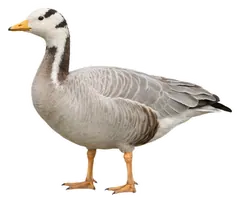 Bar-headed GooseAnser indicus
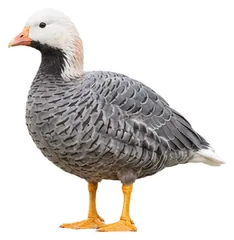 Emperor GooseAnser canagicus
 Ross's GooseAnser rossii
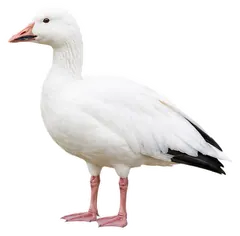 Snow GooseAnser caerulescens
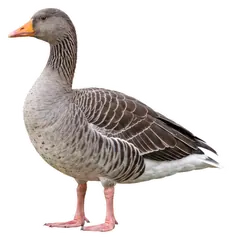 Greylag GooseAnser anser
 Swan GooseAnser cygnoides
 Taiga Bean GooseAnser fabalis
 Pink-footed GooseAnser brachyrhynchus
 Greater White-fronted GooseAnser albifrons
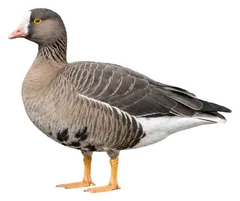 Lesser White-fronted GooseAnser erythropus

Download illustration
Free to use with credit: “Illustration: Field Stickers”. AI-generated. Its appearance was checked against a reference photo by 邱文強; the pose follows our standard. ↗

In other languages
- EnglishTundra Bean Goose
- 简体中文短嘴豆雁
- 繁體中文凍原豆雁
- 한국어큰기러기
- DeutschTundrasaatgans
- FrançaisOie de la toundra
- EspañolÁnsar campestre de la tundra
- Portuguêsganso-campestre-da-tundra
- ItalianoOca granaiola della tundra
- NederlandsToendrarietgans
- РусскийТундровый гуменник
- Svenskatundrasädgås
- DanskTundrasædgås
- Polskigęś tundrowa