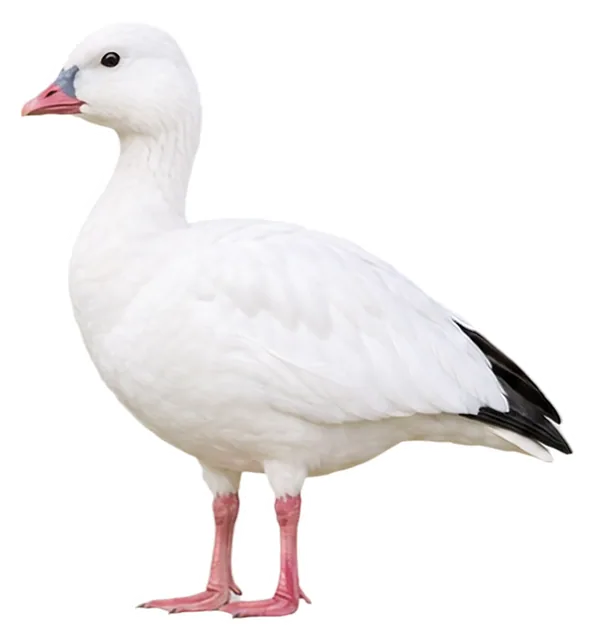
Ross's Goose
Anser rossii Cassin, 1861
59–64 cmLength1.6 kgWeight
Ross's goose (Anser rossii) is a white goose with black wingtips and a relatively short neck.
Busiest months: November–January · Most records: United States, Canada, United Kingdom
AI-generated illustration. It may contain mistakes. · How the stickers are made
Where and when it's recorded

Ross's Goose has been recorded at 418 of the 8,171 birding hotspots we track, in 11 countries and regions.
Records by month Northern Hemisphere
Where it's recorded most
- Hagerman NWRUnited States4,083 records
- Bosque del Apache NWRUnited States3,667 records
- Sacramento NWR – Auto Route & Visitor CenterUnited States2,430 records
More places
- Whitewater Draw Wildlife AreaUnited States1,739 records
- Loess Bluffs NWRUnited States1,451 records
- Gray Lodge Wildlife AreaUnited States1,353 records
- Réservoir BeaudetCanada1,342 records
- Sonny Bono Salton Sea NWR – Union Tract / Visitor CenterUnited States1,106 records
- Riverlands Migratory Bird SanctuaryUnited States972 records
- China Lake NAWS – Sewage PondsUnited States578 records
Countries and regions with the most records
eBird records via GBIF up to 2024-12-31. A record means someone listed it; more records partly mean more birders, not more birds.
About
Ross's goose (Anser rossii) is a white goose with black wingtips and a relatively short neck. It is the smallest of the three white geese that breed in North America. It is similar in appearance to a white-phase snow goose, but about 40% smaller.
Excerpt from Wikipedia, CC BY-SA 4.0 · authors · Read more on Wikipedia
Questions
How big is the Ross's Goose?
The Ross's Goose is about 59–64 cm long and weighs around 1.6 kg.
Where does the Ross's Goose live?
Its breeding range: North America: northern Canada. It is most often recorded in United States, Canada and United Kingdom.
When is the best time to see the Ross's Goose?
At the hotspots we track, it is recorded most in January, November and December (Northern Hemisphere).
Is the Ross's Goose endangered?
The IUCN Red List classifies the Ross's Goose as Least Concern.
What does the Ross's Goose eat?
Main food: Land plants.
What family is the Ross's Goose in?
It belongs to the family Ducks, Geese, Swans (Anatidae), order Anseriformes.
At a glance
- Length
- 59–64 cm
- Weight
- 1.6 kg
- Habitat
- Wetland
- Diet
- Land plants
- Lifestyle
- Active on the ground
- Migration
- Migratory
- Conservation
- Least Concern
More measurements
- Wing
- 346 mm
- Tail
- 103 mm
- Bill
- 38 mm
- Tarsus
- 59 mm
Averages from the AVONET dataset; length from field guides where available.
Range
North America: northern Canada
Breeding range, IOC World Bird List 15.2
Classification
- Order
- Anseriformes
- Family
- Ducks, Geese, Swans Anatidae
- Genus
- Anser
Other birds in the genus Anser
 Bar-headed GooseAnser indicus
 Emperor GooseAnser canagicus
 Snow GooseAnser caerulescens
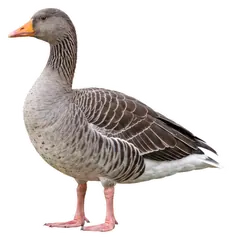 Greylag GooseAnser anser
 Swan GooseAnser cygnoides
 Taiga Bean GooseAnser fabalis
 Pink-footed GooseAnser brachyrhynchus
 Tundra Bean GooseAnser serrirostris
 Greater White-fronted GooseAnser albifrons
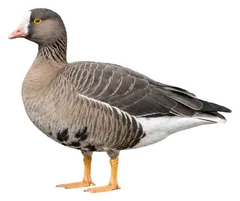 Lesser White-fronted GooseAnser erythropus
 WebP · 1070 px