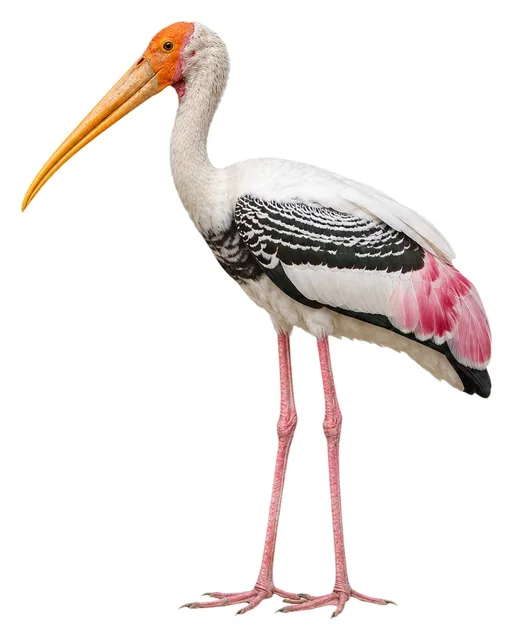
Painted Stork
Mycteria leucocephala (Pennant, 1769)
≈105 cmLength150–160 cmWingspan3.2 kgWeight
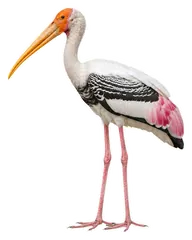
The adult has a thick yellow bill with a decurved tip and pink-tipped tertials.
Busiest months: December–February · Most records: India, Thailand, Sri Lanka
AI-generated illustration. It may contain mistakes. · How the stickers are made
How to identify
Field marks
- Adult bill yellow and thick, with a decurved tip
- Adult head bare, orange or reddish
- Adult has a black band across the breast with white scaly markings
- Adult tertials pink-tipped, covering the back and rump at rest
Male, female and young
Sexes similar in appearance; male usually larger than female; juvenile has brownish plumage.
Voice
Almost silent, with faint moaning near the nest or bill-clattering.
Where and when it's recorded

Painted Stork has been recorded at 369 of the 8,171 birding hotspots we track, in 12 countries and regions.
Records by month Northern Hemisphere
To protect this bird from disturbance, we don't list exact sites.
Countries and regions with the most records
eBird records via GBIF up to 2024-12-31. A record means someone listed it; more records partly mean more birders, not more birds.
About
The painted stork (Mycteria leucocephala) is a large wader in the stork family. It is found in the wetlands of the plains of tropical Asia south of the Himalayas in the Indian subcontinent and extending into Southeast Asia. Their distinctive pink tertial feathers of the adults give them their name.
Excerpt from Wikipedia, CC BY-SA 4.0 · authors · Read more on Wikipedia
Questions
How big is the Painted Stork?
The Painted Stork is about ≈105 cm long, with a wingspan of 150–160 cm and weighs around 3.2 kg.
Where does the Painted Stork live?
Its breeding range: Oriental: India and Southeast Asia. It is most often recorded in India, Thailand and Sri Lanka.
When is the best time to see the Painted Stork?
At the hotspots we track, it is recorded most in January, February and December (Northern Hemisphere).
Is the Painted Stork endangered?
The IUCN Red List classifies the Painted Stork as Least Concern.
What does the Painted Stork eat?
Main food: Fish, shrimp & shellfish.
What family is the Painted Stork in?
It belongs to the family Storks (Ciconiidae), order Ciconiiformes.
How do you identify the Painted Stork?
Adult bill yellow and thick, with a decurved tip. Adult head bare, orange or reddish. Adult has a black band across the breast with white scaly markings.
How do male and female Painted Stork differ?
Sexes similar in appearance; male usually larger than female; juvenile has brownish plumage.
At a glance
- Length
- ≈105 cm
- Wingspan
- 150–160 cm
- Weight
- 3.2 kg
- Habitat
- Wetland
- Diet
- Fish, shrimp & shellfish
- Lifestyle
- Active on the ground
- Migration
- Partial migrant
- Conservation
- Least Concern
More measurements
- Wing
- 474 mm
- Tail
- 184 mm
- Bill
- 254 mm
- Tarsus
- 222 mm
Averages from the AVONET dataset; length from field guides where available.
Range
Oriental: India and Southeast Asia
Breeding range, IOC World Bird List 15.2
Classification
- Order
- Ciconiiformes
- Family
- Storks Ciconiidae
- Genus
- Mycteria
Other birds in the genus Mycteria
 Wood StorkMycteria americana
 Yellow-billed StorkMycteria ibis
 Milky StorkMycteria cinerea
 African OpenbillAnastomus lamelligerus
 Asian OpenbillAnastomus oscitans
 Marabou StorkLeptoptilos crumenifer
 Lesser AdjutantLeptoptilos javanicus
 Greater AdjutantLeptoptilos dubius
 JabiruJabiru mycteria
 Saddle-billed StorkEphippiorhynchus senegalensis
Download illustration
Free to use with credit: “Illustration: Field Stickers”. AI-generated. Its appearance was checked against a reference photo by Charles J. Sharp; the pose follows our standard. ↗
