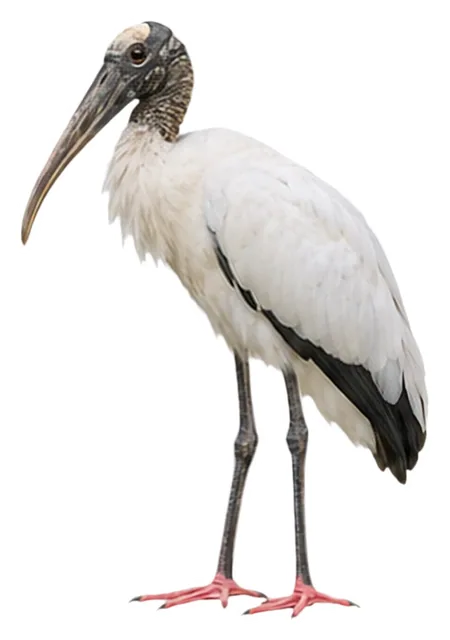
Wood Stork
Mycteria americana Linnaeus, 1758
2.6 kgWeight
The wood stork (Mycteria americana) is a large wading bird in the family Ciconiidae (storks).
Busiest months: January–February · Most records: United States, Costa Rica, Brazil
AI-generated illustration. It may contain mistakes. · How the stickers are made
Where and when it's recorded

Wood Stork has been recorded at 733 of the 8,171 birding hotspots we track, in 27 countries and regions.
Records by month Northern Hemisphere
Where it's recorded most
- Sweetwater Wetlands ParkUnited States10,516 records
- Audubon Corkscrew Swamp SanctuaryUnited States9,364 records
- Wakodahatchee WetlandsUnited States8,438 records
More places
- Green Cay Wetlands & Nature CenterUnited States7,975 records
- The Celery FieldsUnited States7,779 records
- Merritt Island NWR – Black Point Wildlife DriveUnited States7,554 records
- Huntington Beach SPUnited States7,118 records
- Orlando WetlandsUnited States6,860 records
- Caw Caw Interpretive CenterUnited States5,139 records
- Circle B Bar ReserveUnited States4,892 records
Countries and regions with the most records
eBird records via GBIF up to 2024-12-31. A record means someone listed it; more records partly mean more birders, not more birds.
About
The wood stork (Mycteria americana) is a large wading bird in the family Ciconiidae (storks). Originally described in 1758 by Carl Linnaeus, this stork is native to the subtropics and tropics of the Americas, where it persists in habitats with fluctuating water levels. It is the only stork species that breeds in North America.
Excerpt from Wikipedia, CC BY-SA 4.0 · authors · Read more on Wikipedia
Questions
How big is the Wood Stork?
The Wood Stork weighs around 2.6 kg.
Where does the Wood Stork live?
Its breeding range: North America, Middle America, South America: southeastern USA to northern Argentina. It is most often recorded in United States, Costa Rica and Brazil.
When is the best time to see the Wood Stork?
At the hotspots we track, it is recorded most in January and February (Northern Hemisphere).
Is the Wood Stork endangered?
The IUCN Red List classifies the Wood Stork as Least Concern.
What does the Wood Stork eat?
Main food: Fish, shrimp & shellfish.
What family is the Wood Stork in?
It belongs to the family Storks (Ciconiidae), order Ciconiiformes.
At a glance
- Weight
- 2.6 kg
- Habitat
- Wetland
- Diet
- Fish, shrimp & shellfish
- Lifestyle
- Active on the ground
- Migration
- Partial migrant
- Conservation
- Least Concern
More measurements
- Wing
- 456 mm
- Tail
- 191 mm
- Bill
- 224 mm
- Tarsus
- 191 mm
Averages from the AVONET dataset; length from field guides where available.
Range
North America, Middle America, South America: southeastern USA to northern Argentina
Breeding range, IOC World Bird List 15.2
Classification
- Order
- Ciconiiformes
- Family
- Storks Ciconiidae
- Genus
- Mycteria
Other birds in the genus Mycteria
 Yellow-billed StorkMycteria ibis
 Painted StorkMycteria leucocephala
 Milky StorkMycteria cinerea
 African OpenbillAnastomus lamelligerus
 Asian OpenbillAnastomus oscitans
 Marabou StorkLeptoptilos crumenifer
 Lesser AdjutantLeptoptilos javanicus
 Greater AdjutantLeptoptilos dubius
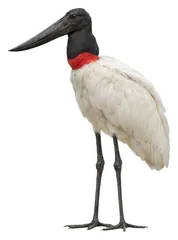 JabiruJabiru mycteria
 Saddle-billed StorkEphippiorhynchus senegalensis
 WebP · 1070 px