
Tree Pipit
Anthus trivialis (Linnaeus, 1758)
≈16 cmLength27 cmWingspan23 gWeight
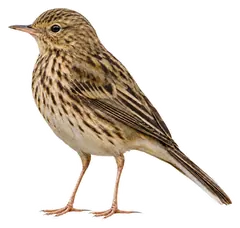
This small pipit has rufous streaks, often perches in trees, and sings as it glides down on stiff wings.
Busiest months: September · Most records: India, United Kingdom, Israel
Looks like Meadow Pipit
AI-generated illustration. It may contain mistakes. · How the stickers are made
How to identify
Field marks
- Upperparts rufous with stripes
- Breast yellowish-brown with black markings; belly white
- Contrast between breast and belly stronger than in Meadow Pipit
- Bill stouter than in Meadow Pipit
Voice
A strong “spek”; the song in flight becomes increasingly drawn out toward the end.
Similar species
Where and when it's recorded

Tree Pipit has been recorded at 1,579 of the 8,171 birding hotspots we track, in 123 countries and regions.
Records by month Northern Hemisphere
Where it's recorded most
- International Birding and Research Center Eilat (IBRCE)Israel1,230 records
- Aras Kuş Halkalama İstasyonuTürkiye869 records
- Thursley CommonUnited Kingdom849 records
More places
- GKVK CampusIndia738 records
- Mushrif Palace GardensUnited Arab Emirates716 records
- Vetal Tekdi/HillIndia573 records
- Falsterbonäset – NabbenSweden568 records
- Antikythira Bird ObservatoryGreece565 records
- Jerusalem Bird ObservatoryIsrael528 records
- LindusSpain527 records
Countries and regions with the most records
eBird records via GBIF up to 2024-12-31. A record means someone listed it; more records partly mean more birders, not more birds.
About
The tree pipit (Anthus trivialis) is a small passerine bird that breeds throughout most of Europe and the Palearctic as far east as the East Siberian Mountains. It is a long-distance migrant, migrating in winter to Africa and southern Asia. The scientific name is from Latin: anthus is the name of a small bird of grasslands, and the specific trivialis means "common".
Excerpt from Wikipedia, CC BY-SA 4.0 · authors · Read more on Wikipedia
Questions
How big is the Tree Pipit?
The Tree Pipit is about ≈16 cm long, with a wingspan of 27 cm and weighs around 23 g.
Where does the Tree Pipit live?
Its breeding range: Palearctic: widespread. It is most often recorded in India, United Kingdom and Israel.
When is the best time to see the Tree Pipit?
At the hotspots we track, it is recorded most in September (Northern Hemisphere).
Is the Tree Pipit endangered?
The IUCN Red List classifies the Tree Pipit as Least Concern.
What does the Tree Pipit eat?
Main food: Insects & other invertebrates.
What family is the Tree Pipit in?
It belongs to the family Wagtails, Pipits (Motacillidae), order Passerines (Passeriformes).
How do you identify the Tree Pipit?
Upperparts rufous with stripes. Breast yellowish-brown with black markings; belly white. Contrast between breast and belly stronger than in Meadow Pipit.
How do you tell the Tree Pipit from the Meadow Pipit?
Meadow Pipit is slightly smaller; Tree Pipit has a stouter bill and a stronger contrast between the yellowish-brown breast and white belly.
At a glance
- Length
- ≈16 cm
- Wingspan
- 27 cm
- Weight
- 23 g
- Habitat
- Woodland
- Diet
- Insects & other invertebrates
- Lifestyle
- Active on the ground
- Migration
- Migratory
- Conservation
- Least Concern
More measurements
- Wing
- 86 mm
- Tail
- 60 mm
- Bill
- 16 mm
- Tarsus
- 21 mm
Averages from the AVONET dataset; length from field guides where available.
Range
Palearctic: widespread
Breeding range, IOC World Bird List 15.2
Subspecies · 1
- Anthus trivialis trivialis Europe to sw Siberia, n Iran and Turkey, e Kazakhstan, sc Siberia, Mongolia and nw China | non-breeding: Africa and India
Classification
- Order
- Passerines Passeriformes
- Family
- Wagtails, Pipits Motacillidae
- Genus
- Anthus
Other birds in the genus Anthus
 Richard's PipitAnthus richardi
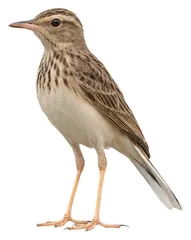 Paddyfield PipitAnthus rufulus
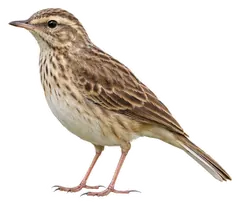 Australian PipitAnthus australis
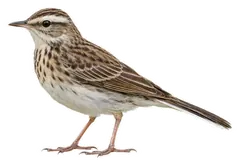 New Zealand PipitAnthus novaeseelandiae
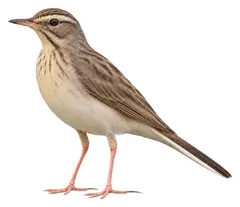 African PipitAnthus cinnamomeus
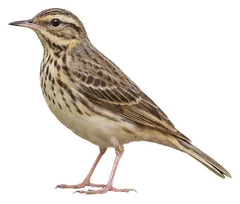 Mountain PipitAnthus hoeschi
 Blyth's PipitAnthus godlewskii
 Tawny PipitAnthus campestris
 Long-billed PipitAnthus similis
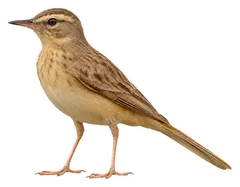 Nicholson's PipitAnthus nicholsoni
 Wood PipitAnthus nyassae
 Buffy PipitAnthus vaalensis

Download illustration
Free to use with credit: “Illustration: Field Stickers”. AI-generated. Its appearance was checked against a reference photo by Gianmaria Marchese; the pose follows our standard. ↗